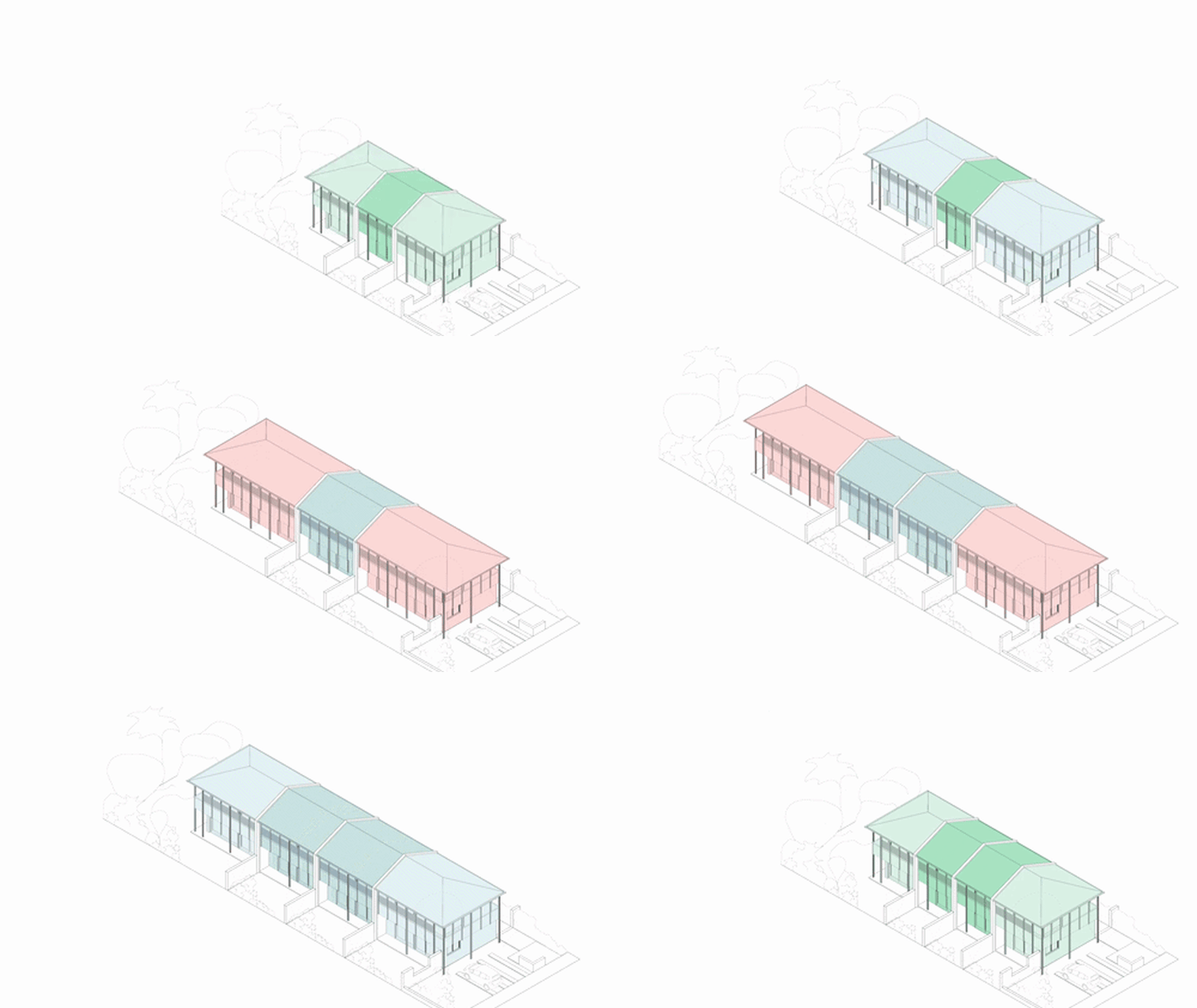

The Minns government will establish an east coast housing manufacturing hub which could help fundamentally change the way homes are built in NSW by using pre-fabricated materials to speed up construction.
The government will on Sunday announce a key budget measure will be to partner with a private manufacturer to help establish a facility which would dramatically ramp up the use of pre-fabricated or modular housing in a bid to turbocharge construction.
A key focus of the facility would be to deliver medium-density housing developments based on existing pattern book designs, something the government hopes would create a faster and more consistent pathway to get more homes built.
The prefab manufacturing hub could also be used to provide parts for a range of public infrastructure, including schools and hospitals.
Governments across Australia have taken a closer interest in expanding the use of prefab or modular housing as high costs, labour shortages and construction delays hamper the ambitious national housing accord targets. The federal Housing Minister Clare O’Neil last month announced a $40 million trial of prefabrication systems.
While traditional houses take more than a year from approval to completion, according to Australian Bureau of Statistics data, modular experts say they can get more homes built affordably, faster, and with fewer disruptions.
The NSW government has made a series of ambitious planning reforms since coming to power, but has struggled to turn around housing supply numbers thanks in part to feasibility challenges hampering development.
But it is arguably in better shape than any other jurisdiction to take advantage of prefabricated homes because its decision last year to roll out its architect-designed Pattern Book homes.
The designs, which are cheaper than those used for traditional new builds, offer low and mid-rise developments such as semis, terrace housing and larger four to six storey apartment buildings. Home owners and developers who use them are offered fast-tracked approval.
Treasurer Daniel Mookhey said that developing the pattern book had been a prerequisite for investment in the prefabrication hub. He said the government recognised it needed to get creative to solve the problem, and was bullish about the prospects of establishing a market in NSW.
“The moment you have those standardised designs is the moment you just start thinking about how to build a modular and advanced manufacturing industry,” he said.
“From our perspective, we believe in building more things here in NSW, whether it’s buses, whether it’s trains, or whether it’s new homes for people.
“These aren’t chip boxes, these are great places to live, so we’re bullish about this. We want to see what more we can do to help anchor an east coast market for this, and how we can help the private sector coming after us to be able to also deploy these designs.”
While the government has set aside funds for the tender in the budget, it will not release it before awarding the contract to protect its commercial interests.
But in the coming weeks it will open a two-stage tender process for experienced local and international prefab operators to partner with the government to develop and deliver the facility.
“We are excited about the prospects that modular housing presents as a form of, fundamentally, productivity in the construction industry,” Mookhey said.
“The fact that you assemble a property indoors means you’re not exposed to weather risks, for example, which means you can turn it out a lot faster.”
Prefab and modular technology is widely used in countries such as Sweden, but in NSW is largely used for smaller single-dwelling homes. Experts have long argued for greater integration into the existing planning system, which the government says it will do by integrating modern methods of construction into the approvals system.
The budget will also include $32.3 million over four years to modernise the building approvals system, integrate it into the NSW Planning Portal and pilot AI tools to speed up licence application processing. An additional $1.6 million will be spent establishing a new regulatory framework and introducing a national certification system.
Premier Chris Minns said housing was “one of the biggest challenges facing our state, and we are pulling every lever to build more homes, faster”.
“The way we build homes has barely changed for generations, but the housing pressures facing NSW demand new thinking, new technology and new solutions.”
Start the day with a summary of the day’s most important and interesting stories, analysis and insights. Sign up for our Morning Edition newsletter.