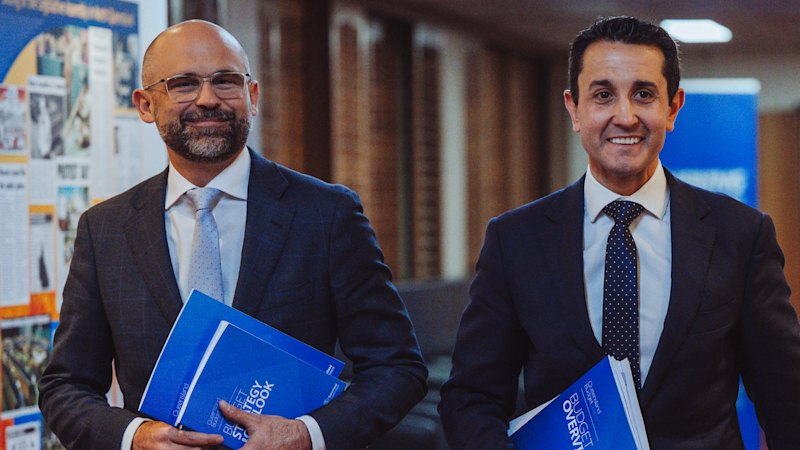

Treasurer David Janetzki’s second budget tinkers on the fringes and lacks the genuine structural reform needed to rein in debt and shield the state from a dreaded credit rating downgrade.
The Queensland government is eager to sell its fiscal update as a steady-as-she-goes plan delivering on responsible financial management.
But the budget will run at a deficit in each of the next three financial years to send debt spiralling from more than $142 billion at the end of this month to almost $216.5 billion by mid-2030. Net debt in NSW is forecast to reach $219.4 billion by the same year.
By 2030, Queensland will be paying $7.7 billion each year just to cover the debt’s interest bill.
The budget papers forecast a slim surplus of $619 million in the final year of the forward estimates based on a range of optimistic assumptions, such as lower spending and consistently strong revenue from typically volatile coal royalties.
It also predicts half-a-billion in savings from reducing senior executives in the public service, “consolidating office accommodation”, and cutting back on contracting consultants.
Following a costly inflation-induced bump to the public service, the budget predicts wage growth will slow to 3.6 per cent across the forward estimates. Government employee expense growth is also pencilled in to be more than halved – from 6.3 per cent this financial year to 2.9 per cent by mid-2028.
But the most rose-tinted forecast that underpins the return to surplus was an assumption that the 17 venues for the 2032 Olympic Games would avoid cost and time blowouts.
And, even if this was achieved, a significant chunk of the total Olympics build has been pushed out to beyond the four-year forward projection – meaning the ongoing construction spend will weigh on the state’s books for many years to come.
Former federal treasury official and Brisbane-based director of Adept Economics Gene Tunny said the surplus assumption is based on a “heroic” reduction in spending uncommon in modern state governments.
He said the government’s cost-of-living splash in the upcoming financial year – a state record of $9.3 billion – was understandable given household pressures, but was hard to reconcile with the escalating debt.
“You’re borrowing already to pay wages to keep the lights on, so you’re borrowing effectively for consumption purposes, you’re not borrowing for investment, and from a budget management perspective and from an intergenerational equity perspective, that’s not a good thing,” Tunny told this masthead.
“I think they could have run it a lot leaner than they have.”
Despite the ongoing expenditure, Tuesday’s no-frills budget is an exercise in restraint compared to the high-spending years propping up the economy through the COVID pandemic, as well as the vote-grabbing handouts synonymous with the 2024 state election.
To Janetzki and Premier David Crisafulli’s credit, the continued budget tinkering is delivering on an election promise to not impose new taxes or significantly slash from the public service – the two things economists say are the only way to control runaway debt.
“We haven’t taken the easy road, haven’t found justifications to whack people with new taxes under the cover of global crises,” Crisafulli told reporters when the budget was handed down.
“We’re on your side. And we’re going to continue to drive down tax, not find new ways to catch you.”
Start the day with a summary of the day’s most important and interesting stories, analysis and insights. Sign up for our Morning Edition newsletter.
 James Hall is the News Director at the Brisbane Times. He is the former Queensland correspondent at The Australian Financial Review and has reported for a range of mastheads across the country, specialising on political and finance reporting.Connect via X or email.