Claire Isaac
From dishwasher wars to toilet seat battles, Australians have no shortage of domestic disagreements. Some are minor irritations but in many households, others are debates that have rumbled on for years without resolution.
Should your tomato sauce live in the fridge or the cupboard? Is it really necessary to separate the laundry? How concerning is it really to go a week without washing your towel? Everyone has thoughts.
So, to settle some of the country’s most hotly contested arguments, we asked the experts.
Toilet seat up or down?
Ruling: Down (with the lid shut)
For Associate Professor Julian Cox, microbiologist at UNSW and scientific director of the Food Safety Information Council, the issue isn’t the seat at all: it’s the lid.
When you flush, tiny droplets can be propelled into the air in what’s known as a toilet plume. While that’s less of a concern if the toilet contains only urine, things change when number twos are involved.
“Urine is basically sterile,” he says. “Unless you’ve got a urinary tract infection or a kidney infection, those parts of the body have very low or no bugs present.”
It’s a different story when it comes to faecal matter, which contains huge numbers of bacteria. Most are harmless, but some can cause illness, particularly in vulnerable people. And if you have gastro, for example, that plume could spread bacteria to a sensitive area, like the kitchen.
“The lid is the most important part in terms of that plume,” says Cox. “Closing the lid when you flush simply contains it.”
Make no mistake, though, when it comes to the seat, Cox is firmly in the down camp. “I’ve always found it, even as a male, a little offensive to see a toilet seat being left up,” he says. “I think a closed toilet just says it’s ready for the next person.”
And whatever your position on toilet etiquette, Cox says the most important habit is washing your hands. “Even if it’s a number one, there’s the potential you’re picking up bugs that could be unsafe on your hands,” he says.
Condiments in the fridge or cupboard?
Ruling: The fridge wins
According to Cox, the instructions on the bottle are there for a reason: “If the label says refrigerate after opening, please, please, please follow the instructions.”
Unopened condiments are designed to sit safely on supermarket shelves but opening them introduces oxygen and the possibility of contamination.
“Once you open them, all bets are off,” says Cox. “You’ve taken something out, you’ve allowed oxygen in – you’ve potentially contaminated the product with spoilage bugs or indeed with some kind of pathogen.”
Rachel Meryment, food scientist and global certification manager at HACCP Australia, agrees. “My rule of thumb is simple: when in doubt, refrigerate it. Cold storage slows microbial growth, helps preserve flavour and reduces the chance of mould or spoilage,” she says.
“The pantry is fine for unopened shelf-stable condiments, but once opened, the fridge wins.“
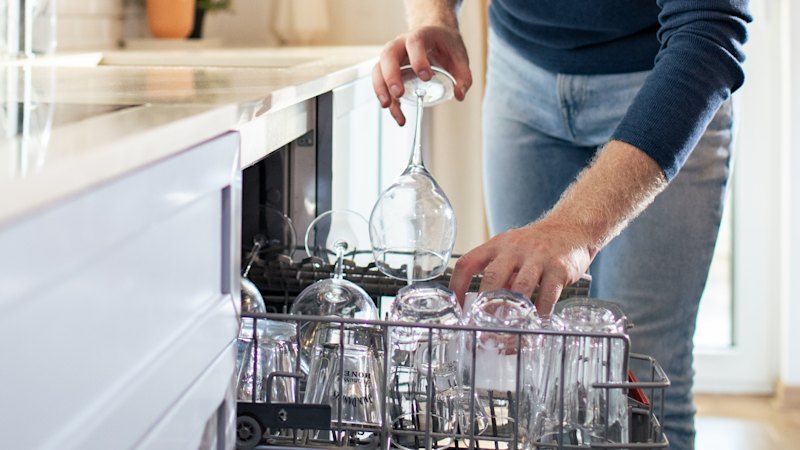
The best way to stack a dishwasher?
Ruling: Don’t overload it
“The best way to stack a dishwasher is to make sure water, detergent and heat can reach every food-contact surface,” says Meryment. “A dishwasher is not magic. If items are nested together, overloaded or blocking the spray arms, they may come out looking clean while still carrying food residue or moisture.”
The simple rule? Stack for water flow, not maximum capacity.
“Do not block the water,” says Bree Uebergang, founder of Filthy Clean. “The dirtiest, heaviest stuff belongs on the bottom rack, facing inward toward the spray arms. Plates, bowls, pots and pans need to be angled, so water can actually hit the dirty side.
“If a saucepan is blocking the detergent door or spray arm, the whole load is already in trouble.”
Meryment also warns against putting items away while they are still wet: “Moisture can support microbial growth, so proper drying matters too.“
Shoes on or off in the house?
Ruling: Off
Bad news for those who routinely walk from the front door straight into the kitchen. Cox says there’s more on the soles of our shoes than just a bit of dirt: contaminants can range from road grime and tyre particles to bacteria and parasites from animal waste.
“You’ve got chemicals in the outside environment that you can bring into your home,” he says. “You’ve got residue that might have bugs in it. You traipse them into your house, the dirt dries and becomes dust, and suddenly, you’ve got aerosols that might contain bad bugs that end up in your kitchen, for example, floating down onto surfaces where you’re preparing food.”
His advice is simple: have separate shoes for indoors when possible.
Do lights and darks need to be separated?
Ruling: Yes
“I know everyone wants the ‘throw it all in and hope for the best’ answer, but laundry is not always that kind,” says Uebergang. “The issue is not every coloured item bleeding dramatically – it is the slow dulling you barely notice until your whites look tired, grey, or vaguely sad.”
Adam Lindsay, founder of Koh, says whites – usually sheets, socks and towels – benefit from a hotter wash, away from dark or coloured items. “Hot washes are where dye runs become an issue from darker clothes, so run those on warm or cold wash settings.”
And how often should you wash towels?
Ruling: More than you think
The first thing to do with bath towels after use is hang them up, so they can dry, says Lindsay.
“Assuming you’re managing to hang them up after use, then changing over every three to four days should do the trick.”
Hand towels should be replaced every couple of days, as should tea towels, which can end up with more bacteria from food remnants.
“If you’ve been handling raw meat, then don’t risk it and put them in the wash straight after,” he says. And as for gym towels? They’re a single-use situation.
Make the most of your health, relationships, fitness and nutrition with our Live Well newsletter. Get it in your inbox every Monday.