Politicians love opening new factories: events where they can sing the praises of a proud family business, put on some PPE and get the obligatory photo opportunity.
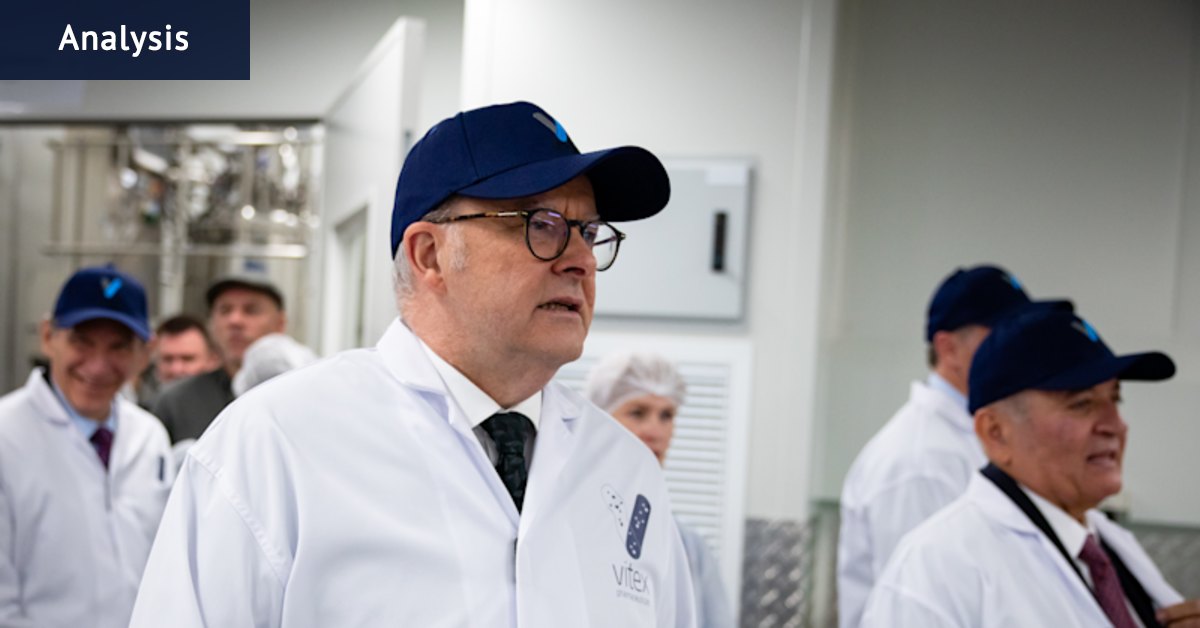
And so it was with prime minister Anthony Albanese, looking chuffed at a new pharmaceutical manufacturing facility in Eastern Creek on Friday, where he donned a lab coat and learnt about gummy and pill production.
What was noteworthy was the location. This was his second stop in western Sydney, having earlier spoken at the Western Sydney Leadership Dialogue’s (WSLD) Airport City Summit.
Both events reveal a renewed focus on the region heading into an important period for Albanese and the Minns Labor government; both relying on key western Sydney seats and fighting off a surging One Nation seeking to stake a foothold in the region.
Albanese’s appearance at both events also underlined how Sydney is changing.
With at least three major infrastructure openings due in western Sydney by the end of the year – the Sydney Metro, Western Sydney Airport and the Powerhouse Museum – gravity is slowly but surely moving westward. And the PM knows this.
Speaking to the Herald, Albanese said what is happening in western Sydney is “nothing less than an ambitious and timely reimagining of our city and what it represents”.
The changes meant the focus of the city was no longer locked onto the “CBD and the harbour” but “increasingly looking to western Sydney where most of our residents live, and businesses have opportunities to grow”.
WSLD chairman Christopher Brown pitched to the PM for a high-speed rail line from Newcastle to go to Parramatta, instead of Central.
Brown claims the change would save the government $15 billion because it would avoid the complexity of building a line through the heart of Sydney, waving away Central as part of the “18th-century transport option”.
“We’ve got a 21st century city with a brand-new airport. We don’t want to be anyone’s stage two. We are stage one for Australia now,” a beaming Brown said.
While Albanese would not be drawn on the idea, he didn’t shoot it down either.
The west continues to grow as an economic and demographic powerhouse, accounting for much of Sydney’s population growth. WSLD claimed that by 2061 the job gap between the west and the city/inner south would have shrunk significantly.
The region’s gross regional product is approaching $200 billion, representing about 24 per cent of the state’s total output and placing it firmly as the country’s third-largest economy, behind Sydney city and Melbourne.
In the past five years, the region has grown at 3.8 per cent, far higher than the Sydney average of 2.5 per cent. The same goes for jobs, where the west expanded at 2.3 per cent a year, compared to only 1.2 per cent for the rest of the city.
A lot of that growth has been driven by a skyrocketing population, with some suburbs recording double-digit growth in the past five years.
That reality is reshaping the political outlook in the area, with the speed of the growth remaking suburbs and shattering assumptions about how electorate seats will swing.
What does remain consistent is the migrant population in the region, which continues to act as a welcoming first stop for many generations of immigrants.
So it was fitting the Vitex pharmaceutical facility opening Albanese attended was built by the Chami family, whose patriarch emigrated from war-torn Lebanon in the ’70s.
He and his family have built their company from scratch to the point where they now have a sparkling new $250 million facility that represents the most significant investment in Australian pharmaceutical manufacturing in more than two decades.
All in western Sydney.
“This is modern Australia,” Albanese said at the ceremony. “Someone coming here from humble beginnings, recognising where they’ve come from, but being patriotic about what they are building here in Australia. And future generations getting a start in life that is better than our forebears, that’s what we all want, that’s what aspiration is about.”
Start the day with a summary of the day’s most important and interesting stories, analysis and insights. Sign up for our Morning Edition newsletter.
 Mostafa Rachwani is a Parramatta reporter at The Sydney Morning Herald. He was previously the Community Affairs reporter at Guardian Australia.Connect via email.