It’s not easy being Supergirl. Milly Alcock – the latest actress to don the cape, skirt and boots – has recently been trolled by keyboard warriors and even former TV Superman Dean Cain. The trolls have mocked – of all things – the Australian actress’s looks and taken umbrage with her pithy red-carpet comments about Supergirl’s sexuality (“She’d probably go both ways”) and who’s stronger, Supergirl or her cousin Superman (Supergirl is “objectively” stronger, said Alcock).
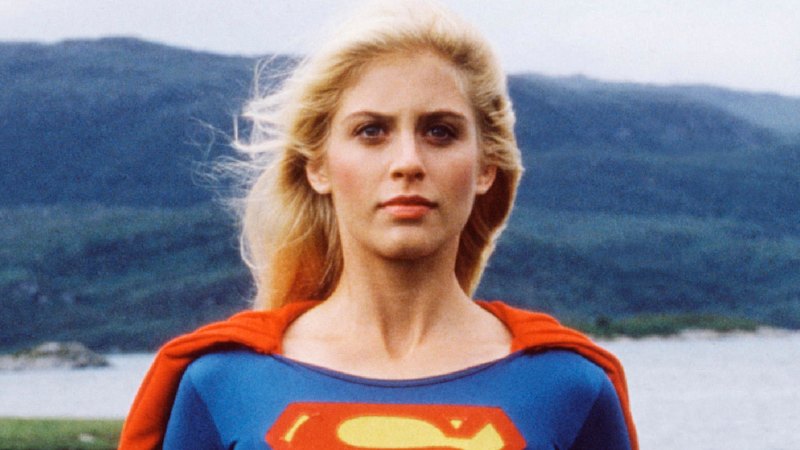
The Alcock backlash is news to the actress who played Supergirl in the original 1984 film. “Hopefully she’ll ignore that,” says Helen Slater. Now 62, Slater is very much looking forward to Alcock’s take on the character, reimagined for 2026 as a drunken party girl. She sees Supergirl as myth-like, and “myths can hold these different variations. It’s just fun to see.”
It wasn’t easy being Supergirl in 1984, either. And not just for the taxing wire-work required to make you believe a girl could fly (“I remember hitting a tree … I was fine, no damage”), but for the sheer weight of the film she was carrying. Supergirl was Slater’s feature debut, a spin-off of the genre-defining Superman series and a $US35 million blockbuster in its own right. She was just 19 when Supergirl landed. “I felt the weight of it because of the publicity campaign,” says Slater, who was plucked from obscurity and thrown into the limelight. “I felt the whole weight of the experience because I was from New York but I was living in London. I was by myself. There was a heaviness to it.”
Milly Alcock – who gained acclaim for her role as Princess Rhaenyra Targaryen in the 2022 HBO Game of Thrones prequel House of the Dragon – has at least had the super seal of approval from the Man of Steel himself, with the incumbent Superman (David Corenswet) making a cameo in the new film, which has been met with mixed reviews.
Slater’s Supergirl, though, had to fly solo. Christopher Reeve – the one true Superman – had been tipped to make a cameo in Supergirl to help launch what was planned as a three-film series. But Reeve, who’d been disheartened by the slapstick direction of Superman III (1983), backed out before shooting began on the Jeannot Szwarc-directed Supergirl.
Slater thinks it was just a clash of jobs that prevented Reeve from making a cameo, though it’s true he told reporters at the time that he would never don the cape again. Instead, Slater would star alongside a frankly inexplicable cast: Mia Farrow as Supergirl’s mother; Faye Dunaway as Selena, a glam witch who dreams of world domination; Peter O’Toole as Zaltar, a space wizard with a fetching line of Kryptonian knitwear; and Peter Cook as a warlock/maths teacher named Nigel.
Supergirl crashed at the box office, and the mighty Peter O’Toole was nominated for a Golden Raspberry. Slater takes its failure in her stride. “It didn’t hurt my career,” she says. “I went on to do films straight after. But of course, no one wants a movie to not do well.”
Producer Ilya Salkind, who made the first three Superman films and Supergirl with his father, Alexander, tells me that he watched it again a few years ago and gives an honest appraisal of why it flopped. “I must admit, it’s not a good film,” he says.
‘If we just try to do Superman in a skirt, I think we’re going to be in trouble.’
Supergirl (1984) director Jeannot Szwarc
Salkind had originally planned to introduce Supergirl in Superman III, but Warner Bros nixed the idea. Superman III instead became a Richard Pryor comedy that happened to have Superman in it. But Salkind sensed Superman may have run his creative course and planned a Supergirl spin-off. Both the film and Helen Slater’s casting were announced before Superman III began filming.
Slater, a Long Island native and graduate of the High School of Performing Arts, won the part after showing up to the audition in a homemade Supergirl costume. “My mother sewed me the cape and the skirt,” says Slater. “I can’t remember what I had for breakfast yesterday but I remember that audition. I was the only one sitting there who had a costume on. It was either, ‘Uh-oh, this is either an epic fail’ or ‘Look how courageous I am’. ”

Salkind confirms that Slater beat off competition from Demi Moore and star-of-the-moment Brooke Shields to win the role. “I never heard that until recently!” says Slater. They were all part of what she describes as “a cabal of ’80s actresses” who were often up for the same roles.
“No one ever told me why I got the part,” says Slater, who once admitted that “far more beautiful, bustier, more luscious-looking girls” also auditioned. But she agrees there’s an earnestness to her Supergirl that chimes with Reeve’s overgrown boy scout. “They really doubled down on the sweetness,” says Slater about her Supergirl. “Very different to what we’re about to see with Milly.”
Supergirl was first introduced in the Superman comics in 1959, as an effort to appeal to girl readers. Real name Kara Zor-El, she hails from Argo City, which survived the destruction of Krypton. Sent to Earth, she helped her cousin, Superman, in various adventures and later got a solo comic title. And while Milly Alcock has Krypto the Superdog, the comic version had Streaky the Supercat and Comet the Superhorse.
The much-derided script for 1984’s Supergirl, by David Odell, follows the Supergirl story relatively faithfully. It’s also amusingly ludicrous. Kara travels to Earth in search of the Omegahedron, an all-powerful ball thingy that keeps the Argo City lights on. But the Omegahedron naturally falls into the hands of Selena, a witch, who stands in for the gleeful villainy of Gene Hackman’s Lex Luthor in Superman. Meanwhile, Kara takes on the alter-ego Linda Lee at a posh boarding school (indeed, one of Kara’s powers is transforming into a brunette schoolgirl) and Selena slips hunky gardener Ethan (Hart Bochner) a love potion. But the spell backfires and Ethan – definitely too old for schoolgirls – falls for Linda/Kara/Supergirl.
Though there’s a scene where she saves Ethan from a runaway digger – Supergirl’s one sequence of Superman-like heroics – director Jeannot Szwarc didn’t want the film to be about superhuman strength. For Szwarc, 1984’s Supergirl was about elegance and grace. “Something that is more lyrical,” he later said. “If we just try to do Superman in a skirt, I think we’re going to be in trouble.”
Her first flying scene, when Kara arrives and discovers her powers, was conceived as a “ballet”. Slater describes the wire-work mechanisms as “very medieval”. She was hoisted up by a crane, with two men winching a drum to make her go left and right and another man pulling a rope to make her go up and down. “Very, very panto,” jokes Slater. “Nothing elegant about that.” Interviewed then, Slater explained that she got over the fear of wire-work when she told herself: “The worst thing that can happen is you can die.”
She gained seven kilograms of muscle for the role thanks to four months of training from British stuntman Alf Joint, the same man who trained Christopher Reeve. And though Reeve’s cameo was scrapped – Supes was going to fly Kara around Earth and show her the superhero ropes – Slater and Reeve became friends after meeting at Pinewood Studios, where both Superman III and Supergirl were filmed.

She recalls that they were once sitting in Central Park West in the early hours when a small army of fire trucks screeched by. Reeve, who died in 2004, joked they had the night off. “Here’s Superman and Supergirl and there’s nothing we can do,” he said.
Slater also has fond memories of Peter O’Toole playing Kara’s Kryptonian mentor, essentially the role of Marlon Brando (as Jor-El, Superman’s father) in the original Reeve film. It is curious to think what O’Toole – lest we forget, Lawrence of Arabia himself – made of it all, having to spout space gobbledygook (“Gravitational radiation!”) and waggle his wizard’s wand before being banished to the Phantom Zone. It’s fair to say he wasn’t totally discerning at the time, with roles in some right claptrap: the Steve Guttenberg supernatural comedy High Spirits (1988) and King Ralph (1991). “Sometimes you do have bills to pay,” says Slater.
Her favourite memory of O’Toole was when she recited some Romeo and Juliet for him. “There’s so much downtime making a movie,” Slater recalls. “One day I did Juliet for him, one of the monologues I had memorised. He directed me. It was such brilliant direction. He said: ‘I want you to imagine you’re holding a dandelion between your thumb and forefinger and now do this speech again.’ It was an incredible adjustment. The poetry just came through.”
Slater recalls that she didn’t spend as much time with Peter Cook, whose casting as Nigel is positively barmy – almost as barmy as the olive-green leatherette leisure suit he wears. Cook pulled no punches, calling Supergirl “awful”. He’s the comedy foil for Faye Dunaway’s dialled-up-to-11 evildoer, whose black magic is mainly used to make Trillian from The Hitchhiker’s Guide to the Galaxy spin upside-down and to cover Cook’s face in warts. “The b—-!” he says, a genuinely funny moment.
A director’s cut version mostly extends to a bit more dialogue and Selena the witch using her evil trickery to, erm, cook a chicken. When I tell Slater that I watched the director’s cut in preparation for this article, she says: “Oh my God, you poor thing.” More tantalising for the super-fans are screen test shots of Slater in an abandoned prototype costume with a 1980s headband. She looks like she’s about to release a Jane Fonda-style workout video.
Supergirl was released in November 1984, delayed from a planned summer release due to a split between the Salkinds and original distributor Warner Bros. The reviews were box-office kryptonite. “Rent Superman rather than sit through Supergirl,” said the headline of Gene Siskel’s review. Supergirl made just $US14 million from a $US35 million budget.
Slater was in Texas making her next film, The Legend of Billie Jean (1985), when Supergirl flopped. “I was not plugged into how well it was doing or not doing,” she says. “At some point I must have heard. At 20 years old it doesn’t go in the same way. It didn’t feel personal to me. There was the theory that if it doesn’t do well, you’re not burdened with that superhero thing – for Chris [Reeve] it was really hard to break out from. Though I would have loved for it to go on.”
The planned Supergirl sequels were canned, and the Salkinds sold the film rights to B-movie merchants Cannon Films, who lured Reeve back into the cape for the notoriously dire, notoriously cheap Superman IV: The Quest for Peace.
Supergirl might have crashed at the time, but it has fans who remember it from TV repeats – and Slater’s Supergirl got the multiverse homage treatment, now standard for forgotten versions of rebooted heroes, when her CGI image appeared alongside Reeve in The Flash (2023).
Slater has discovered Supergirl’s cult comic book appeal through attending fan conventions, though she laughs as she also concedes: “That doesn’t make it a good film!”
This is an edited extract of a story first published in The Telegraph (UK)
Get the best of Good Weekend delivered to your inbox every Saturday morning. Sign up for our newsletter.
Read more from Good Weekend: