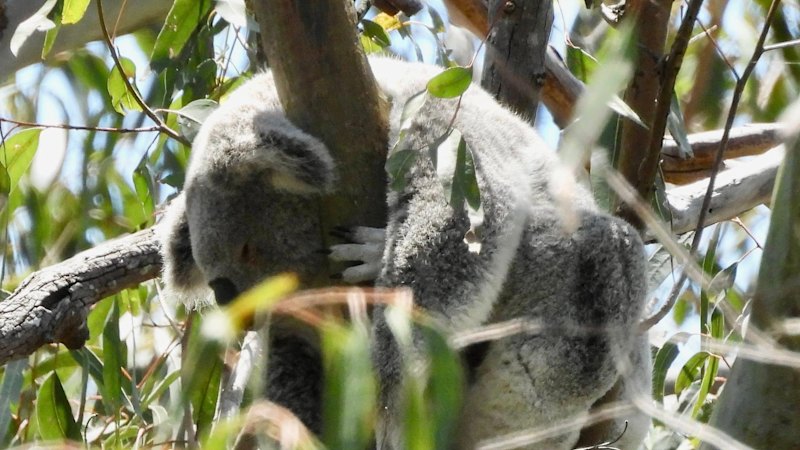

The council questioned that assessment in an August letter to Bleijie, saying it supported the project in principle, but called for the koala population to be re-examined.
Loading
“Further investigation into koala activity on the site is strongly warranted considering the high level of contradiction with the ecological report findings and the historical records from [the Atlas of Living Australia],” the officer wrote.
The Atlas of Living Australia, a database that tracks biodiversity, showed more than 3500 koala sightings within a 1km radius of the school.
Citizen scientists have logged 23 koala sightings on the block on the corner of Dundas and Delancey streets in the past year.
In a statement to this masthead, the council said there had been a significant koala population in the area for the past four decades.
“Based on this, the applicant’s conclusion of low koala usage of the site may not be supportable, and council has suggested that further investigation be undertaken,” a spokesperson said.
In April, the college submitted a Ministerial Infrastructure Development (MID) application, which can override any decision made by the council.
Public consultation for the application closed in September. The submissions, which were acquired by local activist group Redlands 2030 through a right to information request, were overwhelmingly against the school’s expansion.
Photos attached to submissions show koalas reportedly in the trees on the block, and many were critical of the school’s plans to replace 652 mature trees with 526 saplings on the campus.
Loading
Koalas were listed as endangered in Queensland in February 2022, and the state has zoned the area around the school as a koala priority area.
The block itself is also deemed a koala habitat by the state and sits inside a habitat restoration area. In 2018, the council made Ormiston its first koala-safe neighbourhood.
One of the factors the planning minister must look at is the environmental assessment of the project, which was undertaken by Brisbane based JWA Ecological Consultants for Urbis, the company running the project.
In Urbis’s MID application, the company said there would be a “net-zero loss to existing koala habitat” and the project would incorporate a koala action plan.
Ormiston headmaster Michael Hornby said the school had taken extensive measures to ensure koala safety, and JWA had surveyed koala populations to strengthen and protect the habitat corridor.
He said the plan aligned with relevant laws and was centred around community consultation.
“The safety of our local koalas has been a priority throughout the entire planning process,” he said.