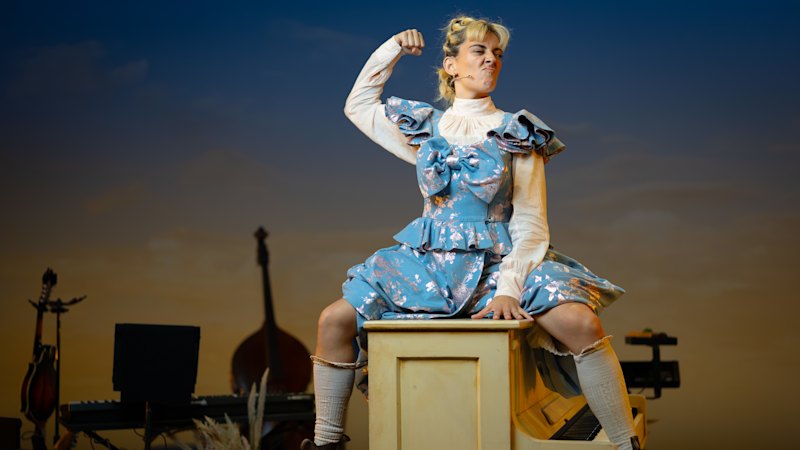

Last November, Kala Gare called out theatre patrons groping cast members passing through the audience in a previous production. Now, sitting on the grassy stage of Sydney’s Roslyn Packer Theatre, “manspreading” and proudly showing off her worker’s boots to go with her frilly provincial dress, Gare says she understands the “bravery” it takes to speak out.
It’s a quality the 28-year-old performer attributes to Sybylla Melvyn – the character she plays in the stage musical version of My Brilliant Career, adapted from Miles Franklin’s 1901 novel – who refuses to marry despite facing drought and poverty in outback Australia in the 1890s.
“[Sybylla’s] life is mapped out to be either work as a governess, a cook, or to marry and have children, and she has a deep passion for creativity,” Gare explains. “Her whole struggle, the whole show, is being like, ‘Why are there no other options? Why is that all I’m allowed, and why do my brothers get a different life experience?’”
The reason the show translates to modern audiences is that its themes of gender inequality still reverberate today, Gare says. “As females in the industry and women working, [we are] pushing through places where we don’t have the same freedoms, and that is something that is changing.
“But beautifully, we are living on the backs of women who have shouted about it.”
My Brilliant Career opens in Sydney on Wednesday. The musical, directed by Anne-Louise Sarks with a book by Sheridan Harbridge and Dean Bryant, and music by Mathew Frank, is set on a stage covered with brown grass and bright yellow flowers, under a sparkling chandelier.
The performers are dubbed “quadruple threats” because they also perform playing instruments, while dressed in colourful provincial outfits, the soundtrack also inspired by the sounds of Harbridge’s own childhood growing up in “the bush”.
“I grew up on a farm. I know that a violin-like squeaking sound of a squeaky gate or barbed wire with wind whistling through it, or the magpies that you hear when you wake up, is all of those things at once,” Harbridge says.
“The musical palette of this show is like a big old mixtape … we run from hard rock to full MT [musical theatre] ballad to beautiful, intimate moments with just Sybylla alone on the piano, to soul music to raucous pop – like, there are so many different genres that we traverse through the journey of the show.”
And despite the discomforting truth Gare shares with her character – the inequality they face as women – there’s a joy to the show.
“There’s a beautiful difficulty of sitting in the thing that it is still happening,” she says. “This show translates that into something so joyous, and that is the colour that actually encourages and empowers, and that is something I’m so proud that we do here.”