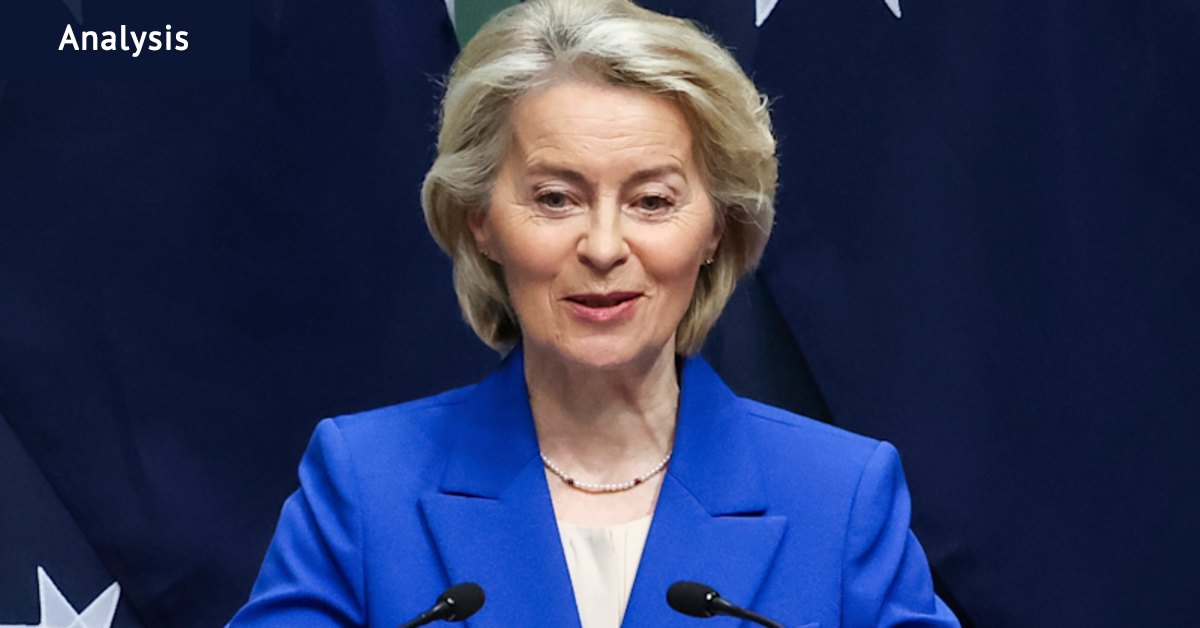

Europe’s defacto leader came to celebrate a seemingly good news story – the signing of a sweeping free trade deal with Australia – but there was no avoiding the dire state of global affairs when Ursula von der Leyen visited Canberra on Tuesday.
In the first speech to federal parliament by a female world leader, the European Commission president peppered her address with references to drinking flat whites, sampling pavlova and the “hard yakka” of trade negotiations.
However, these were mere sprinkles of levity atop a bracing message of turmoil and disruption.
“The world we live in is brutal, harsh and unforgiving,” von der Leyen said. “It feels upside down. What we knew as certainties are in question. The comfort blanket of yesterday is ripped away. It is confronting.”
Thomas Hobbes’ famously pessimistic description of life without government as “nasty, brutish and short” came instantly to mind.
Von der Leyen, who served as German defence minister for five years, was once mooted as a future leader of NATO, and her speech showed why. She is steely as well as suave.
Von der Leyen wanted her Australian audience to know the fuel price shock they are enduring because of the United States and Israel’s war against Iran is just the latest energy wake-up call.
Europeans have suffered several shocks in recent years.
When Vladimir Putin launched his full-scale invasion of Ukraine in 2022, Russian gas became a “no-go overnight” as Europeans realised they had become dangerously dependent on a dictator to keep their heaters on.
While the war in Ukraine no longer dominates the headlines, there is no sign of peace in Eastern Europe. Climate change is still ravaging the globe. Social media algorithms are distorting impressionable young minds. And, as von der Leyen stressed in a notable intervention, the challenge of dealing with China’s rise to superpower status remains – despite Australia’s normalisation of trade ties with Beijing.
“Getting China right is a strategic imperative,” von der Leyen said. “We cannot and will not absorb China’s export-led growth model and its industrial overcapacity. Last year, for the first time, every single EU member state ran a trade deficit with China. Both the threat to our supply chain security and the shock to our industrial base need urgent responses.”
Left unsaid was the fact that Europe has also had to contend with the return of a tempestuous US president who has threatened to seize Greenland, undermined NATO and imposed trade barriers on some of America’s closest allies.
It is largely because of Donald Trump’s tariffs that Europe – itself a fan of protectionism, especially for its politically powerful farmers – has rushed to strike a series of free trade deals. After 27 years of tortuous negotiations, the EU finally agreed to a free trade deal with Latin America in January; a pact with India followed just a few weeks later. Now, they’re inking a free trade deal with Australia after eight years of on-and-off negotiations.
It was just a few weeks ago that Canadian Prime Minister Mark Carney came to Canberra arguing that, after the breakdown of the rules-based international order, middle powers should join together to resist domination by global hegemons.
“In a post-rupture world, the nations that are trusted and can work together will be quicker to the punch, more effective in their responses, more proactive in shaping outcomes, and ultimately more secure and prosperous,” Carney told parliament.
Von der Leyen’s speech carried a similar call to action. “We are rearming, we are decarbonising, we are preparing,” she said. “We are becoming an independent Europe, and this means a more outward Europe, and this is why I am here today.”
Rather than rely on any one economic or security partner, diversification is crucial – even if that means compromise on red meat quotas and prosecco labels. We live in a dangerous, contested, unpredictable age, requiring concerted action on trade, critical minerals, defence and climate change. In simpler times, Australia and Europe could wax lyrical about shared democratic values and let their relationship coast. Those days are over.
Cut through the noise of federal politics with news, views and expert analysis. Subscribers can sign up to our weekly Inside Politics newsletter.
 Matthew Knott is the foreign affairs and national security correspondent for The Sydney Morning Herald and The Age.Connect via X, Facebook or email.

