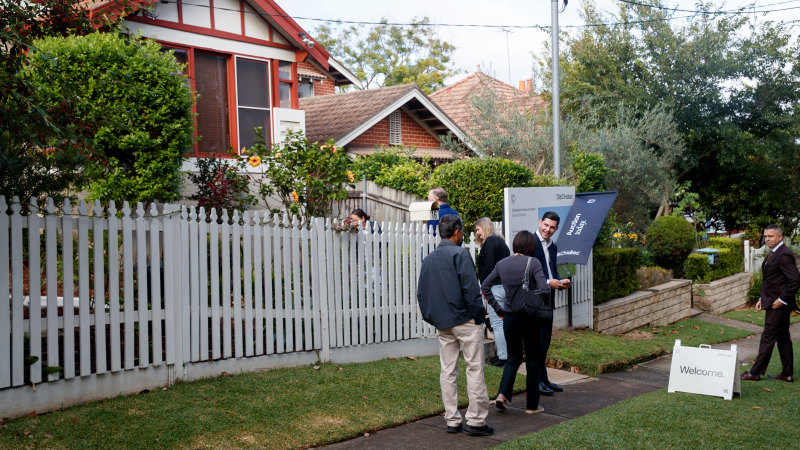

Sellers are more likely to make a profit selling their home than at any point since 2005, but for a few high-density areas profitability is far from guaranteed.
Some 95.9 per cent of Australian properties that were sold in the December 2025 quarter made a profit, data from Cotality’s Pain and Gain Report, published on Wednesday, shows.
This is up from 95.6 per cent in the September quarter, and the strongest result since March 2005.
The median gain also hit a record high, at $365,000 for the quarter.
Cotality head of research Gerard Burg said the data showed most sellers held on to their properties for about a decade, which meant profitability had more to do with long-term momentum than recent market performance.
“Things go up and down, and the longer you hold [on to your property] increases the likelihood that you can kind of smooth through those cycles and get a positive result,” he said. “The shorter the hold period, the more you are exposed to those cyclical elements.”
Properties that sold at a profit had a median hold time of 9.2 years, compared with 8.2 for a loss.
The divide was more significant for houses – in Melbourne, the median hold time for a loss was four years, while the median for a profit was 11 years. Sydney sat at 6.9 years for a loss and 11 years for a profit.
At a city level, smaller capitals such as Brisbane, Perth and Adelaide dominated overall profitability, at about 99 per cent for all three, while Sydney recorded a profitability of 93.3 per cent.
After Darwin, Melbourne was the least profitable capital, with just 91.5 per cent of property sales making a profit.
Burg said while it was tempting to look at this as a negative, it was probably a reflection of the state government’s concerted effort to increase housing supply and encourage homeownership.
“If you’re looking at that from a buyer’s perspective, particularly a first-time buyer, that’s fantastic news,” he said.
The type of dwelling also affected profitability.
Nationally, houses were more profitable than units, with 98.1 per cent of houses recording a profit compared with 92.1 per cent of units.
This translated to the areas that were more likely to make a loss: higher-density local government areas (LGA) such as the City of Melbourne (45.9 per cent) and Melbourne’s Stonnington and Port Phillip areas at more than a quarter of sales each. In Sydney, 23.9 per cent of Parramatta sellers lost money, and more than one in five in Ryde and Strathfield. The City of Sydney also made Sydney’s top 10, at 11.1 per cent loss-making sales.
Burg said that these are all areas where large numbers of apartments have been built over the past decade, which affected not just those new developments but also the value of existing properties in their neighbourhoods.
“If we look at the City of Melbourne … the median value of a unit peaked all the way back in June 2017,” Burg said.
“That tends to be the common thread that we see in Stonnington, in Port Phillip, and the surrounding areas of Parramatta as well in Sydney. These are all regions where we’ve seen that really rapid increase [in apartments] … If you are losing value over time, obviously it makes it incredibly difficult to make a profitable sale.”
Angie Zigomanis, Quantify Strategic Insights’ head of data and insights, said the limited profitability for units in these areas probably reflected the premium that buyers put on new apartments.
“When people go off the plan, there are all sorts of taxation benefits and depreciation benefits,” he said. “And all those sort of things that aren’t necessarily available to the next buyer.”
He said that unit markets in Melbourne and Sydney were quite different, with Melbourne apartments more likely to be held by investors, and Sydney owner-occupiers increasingly driven into apartments as they are priced out of houses.
“[Investors] probably take a more pragmatic view,” he said. “They’re sitting there saying: ‘I haven’t seen capital growth for five years. Maybe I’m better off cutting my losses and parking my money elsewhere, where I might actually get a profit’. That has an impact.”
Both Burg and Zigomanis thought the rolling pressures of interest rate rises and war in the Middle East might mean data for the March quarter will look more subdued than the December report.
But Zigomanis cautioned against over-reading short-term impacts, saying some sellers may have bought 60 years earlier.
Burg said the most concerning aspect for future profitability was global uncertainty.
“Risk is something you can plan for: you can take steps to mitigate it,” he said. “With uncertainty, there’s nothing … And what it tends to mean is people will sit simply on their hands more.”