
A billionaire athlete who won the Masters at just 21 years old, Tiger Woods was once considered America’s golden son of golf. But on Friday afternoon (Saturday AEDT) in Jupiter, Florida, the 50-year-old flipped his Range Rover in what is now his fourth major crash, and the second to involve a charge for driving under the influence (DUI). The latest wreck comes just weeks ahead of the Masters, in which Woods (despite his age and a plethora of existing injuries) was scheduled to play.
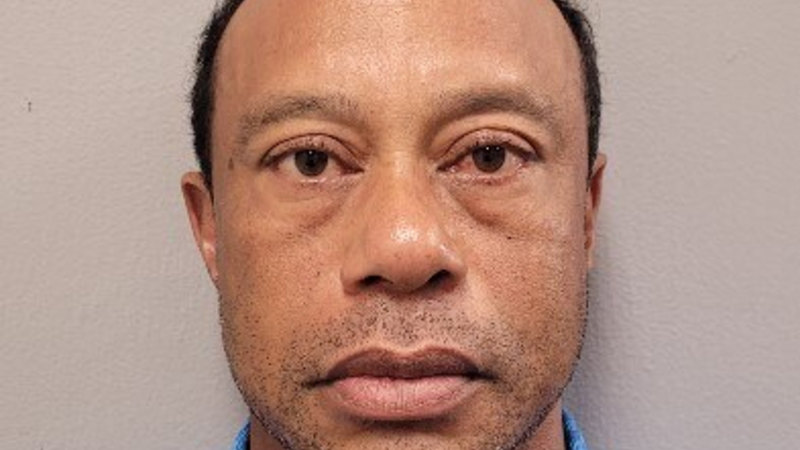
Now, instead of the glamorous pictures we would have seen as Woods attended Rory McIlroy’s Masters Champions dinner on April 7, the world is instead tuned in to see his latest grizzled mugshot.
Preceding yesterday’s crash was a 2009 rollover, in which he smashed into his neighbour’s fire hydrant and escaped with minor injuries. His now ex-wife had to free him by smashing the window with one of his clubs.
In 2017, Woods was found asleep at the side of the road with the engine running and charged with DUI – although he was allowed to plead guilty to the lesser charge of reckless driving and enter rehab. Then there was 2021’s near-fatal single-car collision, in which he flipped into a ravine and nearly lost his right leg, an injury that pundits have noticed has affected his gameplay ever since.
‘He still believes he can win. That’s what keeps him going … he’s not into the celebration of [his career], but he still thinks he can beat these guys.’
Pete Cowen, golf coach
Now, alongside his 82 PGA Tour titles, 15 Majors and 110 global wins, Woods can also count two arrests for reckless driving and two DUI charges, plus one very public extramarital scandal and resulting divorce within his vital, most-quoted statistics. It all adds up to one major question: how did it come to this?
Before he spent his career smashing golf records and keeping tabloids in business with his titillating personal life, Woods started out as many major athletes do: as a child with promise.
Born in California to Vietnam War veteran father Earl Woods and Thai mother Kultilda, Woods had a club in his hands before the age of two. His father – a potent combination of a military man and a talented baseball player – no doubt helped instil an army-like discipline which still underpins Woods’ obsessively competitive mindset. Indeed, Woods has said in past interviews that their relationship was a complicated one.
“Tiger Woods’ work ethic is unbelievable,” veteran golf coach Pete Cowen, who has worked with the likes of Rory McIlroy and Darren Clarke tells the London Telegraph. “He’s always tried to improve … he’s never stood still.”

It is perhaps this drive, though, that is keeping him going at the age of 50, despite now qualifying for the Senior Open. Many commentators in the sport wonder why he keeps gunning for titles he has won so many times before, despite being plagued with a litany of injuries. Should he not stop now and truly concentrate on his mental health and wellness?
“He still believes he can win,” says Cowen. “That’s what keeps him going … he’s not into the celebration of [his career], but he still thinks he can beat these guys. And that’s what’s made him so good.”
Hailed as a child prodigy, Woods was featured on an American television program The Mike Douglas Show at age two, putting with golfer Bob Hope, and landed his first Golf Digest write-up at the age of five, thanks to his exceptional talent. He played his first professional tournament at age 16 and went on to play for Stanford University before claiming the Masters title at just 21 in 1997, cementing his status as one of the greats when he had barely reached adulthood.
Cowen credits Woods for injecting youth interest into golf and, therefore, making it so commercially successful. “He brought golf to the masses, the kids looked up to him. He made it cool to be playing. He was untouchable. Every professional golfer should thank Tiger for what he’s done. The prize money’s gone through the roof for golf, which is down to his effect over the years. Even I’m thankful to him, and I just coach.”
‘When he started, he was quite open … he was quite affable, really. Until he realised how good he was. And then he realised you have to be selfish to become great.’
Pete Cowen, golf coach
Rory McIlroy told (London) Telegraph Sport last year about how Woods inspired him growing up. “I remember being a very little boy watching him in the US Amateur on TV when he was a teenager. And all of a sudden, he’s 50. I think many people, and certainly that massive fanbase, will feel that.”
But Woods’ success, and perhaps the pressure that accompanied it, also changed him. Cowen, who says he’s been in Woods’ orbit since the late 1990s, explains: “He’s very individual. He doesn’t like people around him, beyond his own team. When he first started, he was quite open as a young lad in 1997. He played a lot of practice rounds with [Lee] Westwood and [Darren] Clark [both of whom Cowen coached], and he was quite affable, really. Until he realised how good he was. And then he realised you have to be selfish to become great.”

Indeed, as Woods’ star shone brighter, his temper started to burn – Steve Williams, his longtime caddie and best man at his 2004 wedding to Swedish model Elin Nordegren, recalled in his 2015 memoir that Woods would “flippantly toss a club in the general direction of the bag, expecting me to go over and pick it up. I felt uneasy about bending down to pick up his discarded club; it was like I was his slave. The other thing that disgusted me was his habit of spitting at the hole if he missed a putt.”
The two ended their professional partnership in 2011, when Woods fired Williams.
Then there was his 2009 affair that was splashed across tabloid magazines in America and the UK, ultimately leading to his 2010 divorce from Elin Nordegren, the mother of his two children. After taking a hiatus from the sport in light of his personal life crumbling, he gave a televised apology in which he said: “I thought I could get away with whatever I wanted to … I felt that I had worked hard my entire life and deserved to enjoy all the temptations around me. I felt I was entitled. Thanks to money and fame, I didn’t have to go far to find them. I was wrong. I was foolish.”

Notably, Woods has since dated US skier Lindsey Vonn, who also has a reputation for being hyper-competitive, having qualified for the Winter Olympics this year at 40, only to crash out during the competition and nearly lose a leg. Woods is currently dating President Donald Trump’s former daughter-in-law, Vanessa Trump.
Post-hiatus, Woods came back and continued to make history in the sport, becoming one of the highest-paid professional athletes of all time – Forbes confirmed in 2009 he was the first to earn over a billion dollars over the course of his career.
Things seemed on a high once again – until injuries began to plague him, and the cocktail of painkillers he has allegedly used to treat them has cropped up as a potential explanation for his multiple recent car accidents.
After he was found asleep at the wheel of his car in 2017, a mix of Vicodin, Dilaudid, Xanax, Ambien and THC was found in Woods’ system. In Friday’s crash, Wood passed a breathalyser test, but refused a urinalysis, with the police sheriff saying in a follow-on press conference that Woods showed “signs of impairment”.
“The injuries are the only thing that stopped him,” surmises Cowen. “If Tiger Woods had stayed fit all his career, I think he would have surpassed 20 Majors easily. The injuries probably caused an awful lot of the problems.”
Since 2014, Woods has endured multiple lower-back surgeries and went under the knife earlier this year to fix his Achilles tendon. He’s been cut and sewn back up on multiple occasions now – all because he still believes he can win.
“At the moment, I don’t believe [he could win],” says Cowen. One wonders whether it’s time for him to focus on his mental health and pass the mantle on to younger players, including his son Charlie, who has shown promise as a professional golfer.
Cohen adds one crucial point: “But he thinks he can win.” And that, in Woods’ world, is likely the only opinion that matters.
The Telegraph, London
Get a note directly from our foreign correspondents on what’s making headlines around the world. Sign up for our weekly What in the World newsletter.