
Staff writers
Updated ,first published
The Australian sharemarket has closed in the red, weighed down by a slump in major bank shares, as the Middle East conflict continues to cast a heavy shadow over markets.
The S&P/ASX 200 closed 55.30 points or 0.7 per cent lower on Monday, at 8461.00 as the oil price continued to weigh on investor confidence. Brent crude oil, the international standard, surged as high as $US116.75 a barrel, a price it last traded at in mid-2022 amid the COVID reopening.
The increase in the price of oil came as Iran-backed Houthi militants in Yemen entered the Middle East war and more US troops arrived in the region, raising fears the widening conflict will cause further chaos for energy markets.
While the militant group didn’t say they would target vessels transiting through the southern Red Sea and the Bab El-Mandeb Strait, they have the capability to do so. The Saudi Arabian port of Yanbu, which the kingdom is using for some of its oil exports after the crucial Strait of Hormuz was effectively closed by the war, is also well within the range of Houthi missiles.
The move by the Houthis adds “upside risk mainly via shipping and Red Sea routing,” said Haris Khurshid, chief investment officer at Karobaar Capital LP in Chicago. “But unless it spills into broader Gulf infrastructure or Hormuz flows, it’s more volatility than a true supply shock,” he added. Local energy stocks advanced, with Woodside Energy adding 2.2 per cent, Yancoal rising 4.1 per cent and Santos rose 1.3 per cent.
Travel group Webjet rose 1.9 per cent after announcing the departure of chief executive Katrina Barry, who has been in the job less than two years. No replacement has been appointed.
Financial stocks retreated, with Commonwealth Bank losing 2.8 per cent, Westpac dropping 4.1 per cent, National Australia Bank losing 1.8 per cent and ANZ Bank shedding 1.6 per cent.
Mining stocks advanced, with BHP up 0.1 per cent, Fortescue gaining 1.8 per cent and Rio Tinto jumping 4.9 per cent. Gold miners also jumped, with Northern Star up 5.2 per cent and Evolution Mining rising 0.5 per cent.
Tech stocks tumbled in early trade with WiseTech falling 6.2 per cent, Zero 5.6 per cent and Technology One 3.4 per cent on the back of ongoing weakness in the sector on Wall Street.
The Australian dollar was 0.3 per cent lower at US68.71¢ at 5.05pm AEDT.
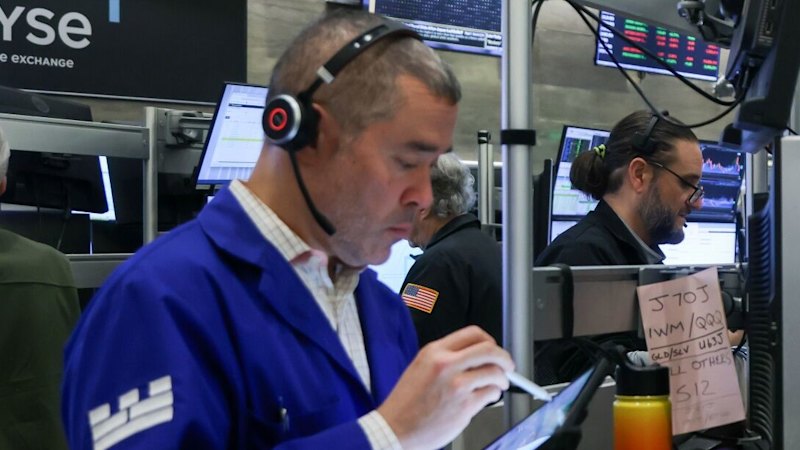
On Friday, the S&P 500 fell 1.7 per cent to close its worst week since the war with Iran began. The Dow Jones lost 793 points, or 1.7 per cent, and fell more than 10 per cent from its record set last month, while the Nasdaq composite sank 2.1 per cent.
The losses were a break from Wall Street’s pattern this week, where the US stock market flip-flopped from gains to losses each day as hopes rose and fell about a possible end to the war.
The fear in financial markets is that the war will disrupt the Persian Gulf’s energy industry for a long time. That could keep enough oil and natural gas out of the world’s markets to send a punishing wave of inflation through the global economy.
High petrol prices and the war are already hitting confidence among US consumers, whose spending make up the bulk of the economy. Sentiment among them fell slightly more in March from February than economists expected, according to a survey by the University of Michigan.
On Wall Street, most stocks fell, including three out of every four in the S&P 500. The index, which is the main measure of the US stock market’s health, is 8.7 per cent below its all-time high set in January.
Big tech stocks were among the heaviest weights on the market, including drops of 4 per cent for Amazon, 4 per cent for Meta Platforms and 2.2 per cent for Nvidia.
With AAP, AP, Bloomberg
The Market Recap newsletter is a wrap of the day’s trading. Get it each weekday afternoon.