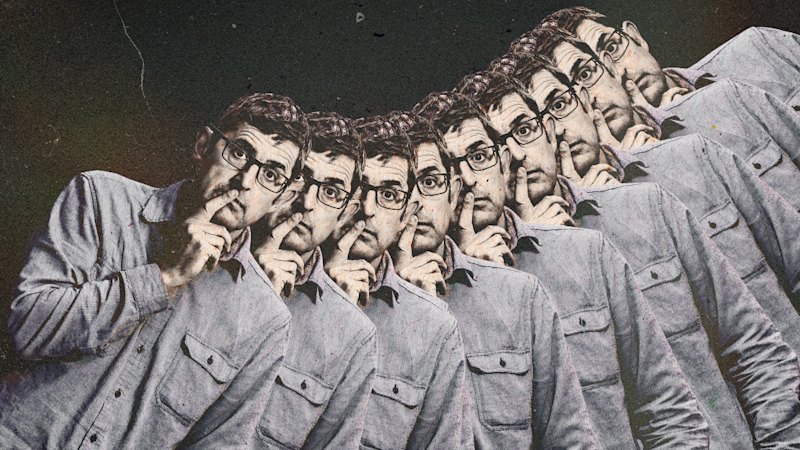
For most of the past 30 years, documentarian Louis Theroux has been delving into the lives of disgraced celebrities, white supremacists, fanatics and a ragtag of oddballs at the fringes of mainstream society. His subjects range from the flamboyant “tiger king” Joe Exotic and paedophile Jimmy Savile, to everyday people who have lost control of their lives, from fundamentalists in the backwaters of America to Zionists spearheading the illegal settler movement in the West Bank.
He’s carried this off with a style that is both distinctive and idiosyncratic, casting himself as an awkward, nerdy interlocutor who gently prises his way into his subjects’ lives and secrets. He seems endlessly curious and empathetic about people and the worlds they inhabit, regardless of how offensive, troubling or unconventional their views and vocations might be. His purpose is to better understand what makes them tick and to portray them not as exhibits of a freakshow – though some end up doing this for themselves – but as products of a world that isn’t always fair, just or equitable.
Unlike many in the business, he’s not beyond scrutinising his own journalistic and ethical practices, often returning to people and topics for follow-up documentaries that revise or correct the record.
Inside the Manosphere, his most recent work, was seen as something of a departure for the now 55-year-old. Made for Netflix after a career almost entirely based at the BBC, it explored a handful of young, male social media figures who have forged vast audiences, and even vaster fortunes, promoting dangerous ideas about masculinity and gender roles. Manosphere may well have broadened his profile and following, but its subjects and themes are Theroux’s wheelhouse. HStikkytokky, Myron Gaines and Sneako being but the latest in a gallery of delusional individuals peddling and practicing dubious lifestyles and ideologies in exchange for money and influence.
Netflix, did you say? For anyone who’s followed Theroux’s career, there may be a twinge of irony here. One of Theroux’s most notable films was made following 2020s Tiger King, until recently Netflix’s biggest show of all time, and raised critical questions about how it distorted a soon-to-be-convicted felon into a misunderstood folk hero worthy even of a presidential pardon.
But as this survey of Theroux’s best films reveals, their relevance – and the pleasure of watching them – is not restricted to news cycles or passing fads. They invite us to consider hot-button topics in ways we might not otherwise have done.
Louis and the Brothel (2003, Stan*)
The first of more than 30 one-hour specials Theroux made for the BBC has him visiting a new legal brothel in Nevada. Cue Benny Hill-like titters, but there’s nothing of the kind as he uncovers the backstories of Wild Horse Ranch’s workers, owners and customers. Everyone in Louis Theroux’s universe has a story to tell, and none more so than sex-worker Hayley, who engages in a pas de deux with the filmmaker that puts both in an awkward ethical corner. It’s more lighthearted than his later films, but doesn’t shy away from the moral complexities and bizarre transactions that underpin sex work.

The Most Hated Family in America (2007, Stan)
It takes a few mental leaps to understand the grievances of Kansas’ Westboro Baptist Church, which shot to prominence staging protests at the funerals of American marines killed in the line of duty. Theirs is a particularly odious and angry brand of homophobia and racism, sheeting blame for all the wrongs of the world at anyone and everyone who would even dare to contemplate the idea of tolerance. But it’s the way the cult’s families indoctrinate their children that prompts Theroux to engage in some eviscerating confrontations. Two follow-up films explore the dissolution of one of the church’s key families.

LA Stories (2014, Stan)
Comprising three self-contained episodes (not all of which are on local streamers), Among the Sex Offenders explores Theroux’s enduring interest in the notion of second chances and rehabilitation. Here, Theroux spends time with a handful of men and women who, having been convicted of sex offences and paroled, negotiate life on the fringes of LA society where their rights are curtailed and movements monitored. Arguably the most challenging and confronting film Theroux has made, this is lump-in-the-throat viewing.

Savile (2016, Stan)
When the dark deeds of once-beloved TV personality Jimmy Savile surfaced following his death in 2011, it was often said that he had been hiding in plain sight. Indeed, when Theroux made his first film about Savile in 2000, he only alluded to the strange behaviour he witnessed. Sixteen years later and drawing extensively on the earlier material, Theroux seeks to understand what he missed and what he could have done to expose Savile’s heinous crimes. Savile is more than a reckoning with one man’s paedophilia; it goes to the very heart of how people in positions of power, esteem and wealth can project an “aura of invulnerability” to insulate and protect themselves.

Shooting Joe Exotic (2021, ABC iview, Stan)
As with Savile, Theroux embarks on a reckoning of his own in this timely riposte to the Tiger King mania that swept the globe in 2000. Theroux first filmed the self-styled zookeeper and low-life who came to be known as Joe Exotic in 2011’s America’s Most Dangerous Pets. It’s evident in the excerpted snippets of the earlier film that Joe and his followers are profoundly bent and Theroux might not have probed as deeply as he could have. It’s not Theroux’s wont to throw stones, but the film bristles with unease at how Tiger King misrepresented Joe and Carole Baskin, the animal rights activist who Joe plotted to murder and for which he is now serving time.

The Settlers (2025, ABC iview)
In all of his films Theroux prefers engagement – even if it’s cat-and-mouse variety – over confrontation, but there’s at least two chilling moments in this recent film about Israel’s settler movement when his approach is tested. One happens when a soldier demands the film crew stop filming in Hebron, another when he meets Daniella Weiss, the fiery figurehead of a settler organisation. Made following October 7, 2023 and the military invasion of Gaza, hair-raising tension courses through The Settlers as it conveys the irreconcilable divisions of the contested occupied territories.
*Stan is owned by Nine, publisher of this masthead.
Find out the next TV, streaming series and movies to add to your must-sees. Get The Watchlist delivered every Thursday.