
Wendy Tuohy points out that grandmothers are cutting work hours, sometimes at the peak of their careers, to do free childcare (“Grandmothers cut work hours to do free childcare”, March 29). This has been so for years. I did it when I could have reached the peak of my career; those grandchildren are now in their mid to late twenties and are having their own children. I’m still working as a consultant in my chosen field at 77, so it didn’t affect my trajectory, but just adjusted it. I’m observing the mothers of this generation, including my CEO daughter, doing exactly the same thing, but they have the advantage of technology and juggling the care with online meetings, baby monitoring devices, even taking the children to work when necessary, and at times great grandma stepping in for short bursts. Women always find a way to lift up the next generation, and we are great at multitasking. Go for it grandmas and grandpas, it’s enormously rewarding.
Jenny Gilder, Bligh Park
Schooling gets personal
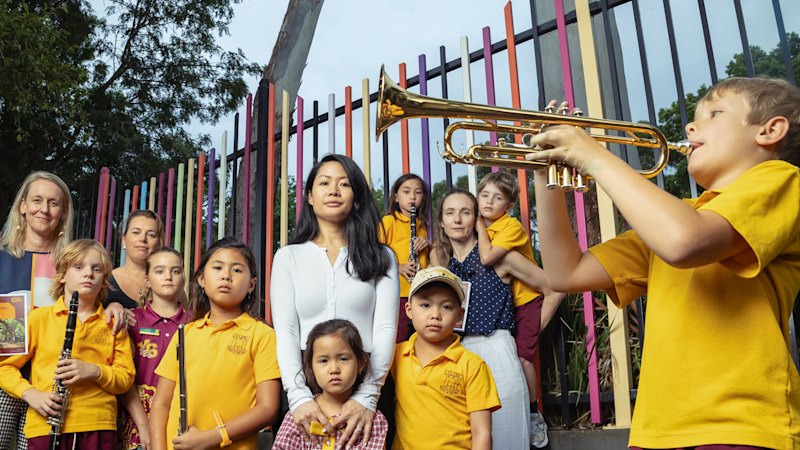
As the old Castrol line used to go, “oils ain’t oils” (“Public parents fighting the flight to private school”, March 29). Public schools ain’t public schools either. Some are clearly better than others, and there is a reason for that. Better promotion helps, and so do higher standards. The Glebe P&C initiative is admirable. But marketing only goes so far. Schools in more affluent suburbs benefit from parents who are more academically engaged and push their children harder. That attracts families from outside the catchment. I know of one migrant family who settled in Killara purely because of the local public school. They couldn’t afford private education, but they had done their research. Driven parents cluster around high-performing schools, which become more sought after still. In England, parents pay a premium to buy within a favoured catchment. As demand rises, catchments shrink. Public schools are meant to be open to all. In reality, access to the best ones depends on where you can afford to live. John Kempler, Rose Bay

Psychopathy Corp.
Some years ago, an excellent documentary titled The Corporation was doing the rounds. One particularly frightening point made concerned testing the behaviour of corporations against the UN’s characteristics of psychopathy and concluding that corporations typically behaved like psychopaths. Reading Caitlin Fitzsimmons’ article (“How AI’s climate lies are wreaking havoc”, March 29), particularly Dr Jeremy Walker’s submission details … surely it’s time to curtail corporations before they destroy the planet in their obscene quests for profit. Wayne Duncombe, Lilyfield
Electric dreams into reality
Last Sunday’s “5 minutes with Fitz” really fits the bill, the power bill, that is (“To end this crisis, put pedal to the metal on renewables”, March 29). As long-standing energy expert Professor Ty Christopher points out, Australia should be accelerating the drive to renewables if we want to improve our energy security. We’re already headed in the right direction. In the last quarter of 2025, Australia’s energy supply from wind, solar and battery storage hit a milestone of over 50 per cent, and it’s cheaper. Unfortunately, the companies controlling our energy generation also control the wholesale prices. That’s what affects our power bills. Our country is blessed with ample wind and sunshine for solar and wind power. We should be looking to reduce our dependence on fossil fuels. I call on both sides of politics to take a serious look at electrifying our transport and energy supply.
Anne O’Hara, Wanniassa (ACT)
Head knock-on effects
The Sun-Herald article on children avoiding contact sports stated that the evidence linking repeated head injury with long-term neurological conditions was “growing and sometimes conflicting” (“The injury affecting one in seven kids that parents don’t know how to manage”, March 29). It’s not conflicting, and it’s misleading to say so. The evidence is solid. I was taught about dementia in boxers when I was a medical student in the ’70s. We have known for over 20 years about repeated head injury in footballers and chronic traumatic encephalopathy. A multibillion-dollar claim has been settled by NFL players in America, and there is a major AFL class action here in Australia at present. Children’s brains are more susceptible, and repeated concussive head injury from contact sport as a child will contribute to risk later on in their lives, so parents’ fears are quite justifiable. John Frith, Paddington
Adoption changes
The correspondence about forced adoptions brought back my own, more optimistic memories of that era (“Drugged and terrified, I heard small cries in the distance. The nurses had taken my baby away”, March 22). In the early 1970s I was a junior doctor working in the obstetrics department of the old Royal Newcastle Hospital. The hospital had a dedicated obstetric service for young, unmarried, pregnant women. It was the only non-religious service in the state, had its own social workers and there was no pressure on the patients to either keep their babies or have them adopted out. It was social norms of the time that determined their decisions. Interestingly, many of the women who had their babies adopted out returned within 12 months, pregnant again and often to the same partner, and on this occasion, they kept their babies. How times have changed – thankfully. Dr Craig Lilienthal, Wollstonecraft
Hitting the jackpot
Jacqueline Maley points to the trebling of the number of US billionaires between 2010 and now (“Being ultra-rich isn’t as fun as you think”, March 29). In Australia, that increase has been more than 14-fold; from 13 in 2010 to 188 last year. It seems our systems are even more conducive to collecting excessive wealth than the so-called land of opportunity. Lesley Walker, Northcote (Vic)
- To submit a letter to the Sydney Morning Herald, email letters@smh.com.au. Click here for tips on how to submit letters.
- The Opinion newsletter is a weekly wrap of views that will challenge, champion and inform. Sign up here.