THEATRE
Till The Stars Come Down
KXT on Broadway, Ultimo
April 1, until April 11
Reviewed by JOYCE MORGAN
★★★★½
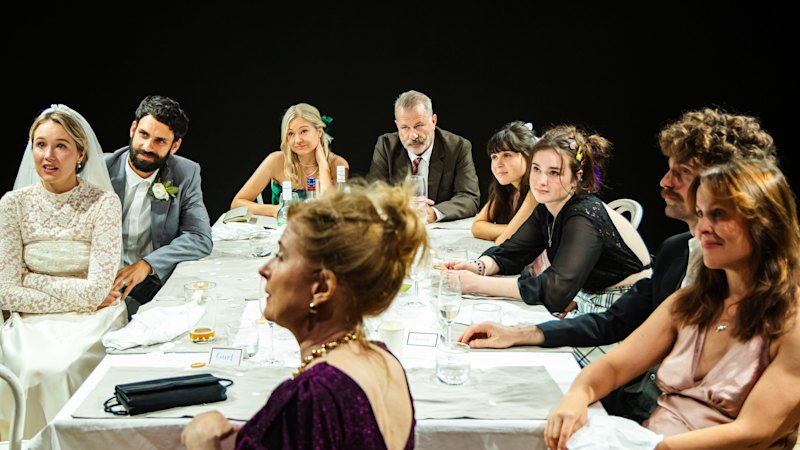
Three sisters gather for the wedding of the youngest. Add a potty-mouth aunt, awkward speeches and a wardrobe malfunction, then marinate in vodka.
The set-up feels familiar, but what takes it far beyond the predictable is how it hilariously – yet gently – interweaves the lives of ordinary people with the fault lines of class, family, politics, immigration and climate change. And all without a whiff of didacticism.
A drama centred around three sisters inevitably evokes Chekhov’s Three Sisters. But this isn’t a trio of sophisticated landed gentry living in languid, provincial isolation, but three passionate working-class white women living in a hollowed-out former mining town in England’s east Midlands.
There, they laugh, dance, fight, get drunk, get horny, tear each other apart and dance some more. The title is from a line in W.H. Auden’s poem Death’s Echo.
It’s raucous, messy and brilliantly crafted by British playwright Beth Steel.
Steel has drawn on the down-at-heel region where she grew up, the daughter of a miner. Her hometown was hit by pit closures in the mid-1980s and voted overwhelmingly for Brexit a decade ago.
Yet all this bubbles in the background. As this 2024 play opens amid hair rollers, hairspray and mugs of tea, bride-to-be Sylvia (Imogen Sage) is being readied with help from siblings Hazel (Ainslie McGlynn) and Maggie (Jane Angharad).
Sylvia is getting hitched to a once-penniless now successful Polish immigrant Marek (Zoran Jevtic).
Hazel quips: “Polish … that’s not a language, that’s a Wi-Fi password. It’s just Zs and Ws.” Her casual racism soon becomes more overt.
The first act of this ensemble piece introduces the sisters and their fabulously salty Aunty Carol (Jo Briant).
The men are a far cry from the self-made Marek. The sisters’ father Tony (Peter Eyers), his estranged brother Pete (Brendan Miles), and Hazel’s husband John (James Smithers) are all on the scrap heap.
Some hold tenaciously to the past. Instead of a toast to the newlyweds, Pete recites the names of long-closed pits like an incantation of the dead.
Hazel’s growing resentment is targeted at the immigrants she blames for taking jobs.
While the play’s setting is as specific as the accents (which were inclined to slip around), the problems besetting this family are not. A community where jobs have vanished and resentment of immigrants festers – we could be in Hanson-land.
Sharply directed by Anthony Skuse, the production has strong performances from its central women. As bride Sylvia, Sage belatedly stands up to McGlynn’s bigoted, bitter Hazel. Angharad is outstanding as conflicted Maggie, the sister with four marriages behind her.
With the lion’s share of one-liners, Briant’s Aunty Carol times astutely her blend of witty and shrewd observations.
Jevtic’s Marek made the most of his underwritten role. Peter Eyers’ Tony displayed great tenderness in his affecting scene with his granddaughter.
Part soap-opera, part tragedy, this vivid production is filled with flesh-and-blood characters comically, painfully struggling for a future in a rapidly changing world.
MUSIC
Behind me is the dark
Apex Ensemble
ACO On The Pier, April 1
Reviewed by PETER McCALLUM
★★★★
Gyorgy Ligeti’s music became famous through the ethereal, weightless sections in the soundtrack of Stanley Kubrick’s film 2001: a Space Odyssey (1968). Listeners who had scratched their heads at atonal music without melody or toe-tappable rhythm when heard in the concert hall, now suddenly got it when experienced against the cold of interstellar space.
That was two years before his Chamber Concerto (1970), which was the culmination of innovations he had developed during the 1960s after fleeing Hungary and encountering European modernism. As the final work in Ensemble Apex’s concert of varied and intriguing sonoristic soundscapes under conductor Sam Weller, it was, in some respects, both culmination and progenitor.
Shivers on Speed by German-Austrian composer Brigitta Muntendorf dealt with unpredictable fragmented impulses and quivering repetitions across an ensemble of six instruments, alternating between hesitant murmurs and splintering thuds that at times became frightening and frenetic.
By contrast, Januaries, by Australian-born, UK-based Lisa Illean, explored sun-drenched sounds that were dry, intense and spare. Evoking memories of childhood summers in Queensland, it began with an undulating quiet wailing figure, and kept sentiment and sweetness at a distance to create a sense of presence enlivened by glistening moments.
Hrim by Icelandic composer Anna Thorvaldsdottir struck a different tone, beginning with softly howling woodwind and misty stirring tremelos. Passages of sustained high and low notes produced a sense of depth and dark colour interrupted by sudden loud sounds and fading wispiness.
Ligeti’s Chamber Concerto began with curdled textures on woodwind, quickly thickening to rustling sounds on strings. There is a brief outbreak of emphatic unison melody which vanishes as quickly as it emerged. The second movement dwelled on more sustained sounds, introducing warmth from the brass and chords with prominent octaves which evoked quiet stasis. The third movement, impressively controlled by Weller and the ensemble, explored Ligeti’s fascination with mechanical ticking textures (famously exploited in Poème symphonique for 100 metronomes).
In the last movement, some of Ligeti’s spirit and humour erupts briefly as members of the ensemble broke through with brief cadenzas, which darted exuberantly liked unleashed dogs. The movement ended with a wry sideways glance.
It was a program of dedicated concentration from Ensemble Apex, which made thoughtful connections across countries and generations, as though the promises of the postwar avant garde were being finally redeemed by the promising composers of our own time.
 Joyce Morgan is a theatre critic for The Sydney Morning Herald. She is a former arts editor and writer of the SMH and also an author.Connect via X.