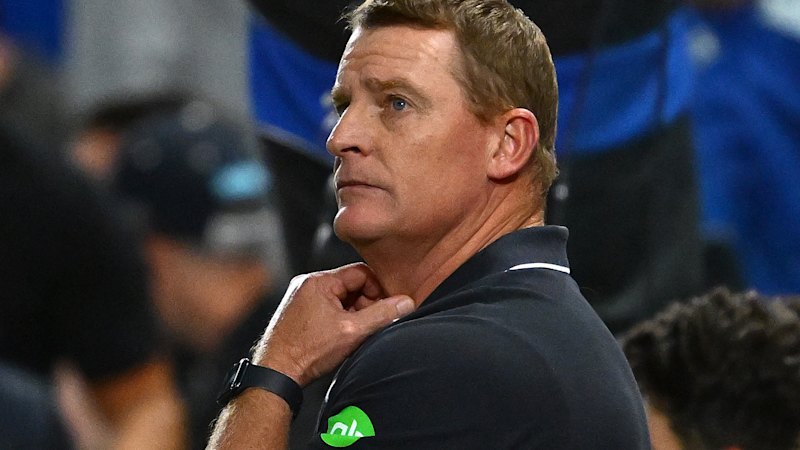
The notion that nothing will change at Carlton until Michael Voss is removed as coach is misleading.
It’s more accurate to acknowledge that much at Carlton is being changed except, for now, the senior coach.
After such a poor start to the season, where the Blues remain overly reliant on scores from stoppages and can’t protect leads, that unfortunate step – Voss’ removal – now appears inevitable.
The wins and losses column, the manner of defeat and the inability to shift the way the team plays will likely lead to Voss’ demise. But the club is not worse due to his presence within it.
That’s worth remembering amid the more hysterical claims from some, though not all, of a justifiably frustrated and wounded supporter base.
Longstanding servants of the club believe the environment is more conducive to high performance than it was when Voss took over. This is an important shift, with high-end talent Jagga Smith, Harry Dean and soon enough Cody Walker needing to be developed in such a way that the cycle of failure at the Blues is broken.
The club Voss coached on Friday is barely recognisable from the one that made an awkward post-match presentation to departing ruckman Tom De Koning when he played his 100th and final match for the Blues in their win against Essendon in the last round of 2025.
Just 10 players from that Carlton team in the final round last season played on Good Friday.
Comparing that figure of 10 with the number of players who played in both round four this weekend and their team’s final game in 2025 of other clubs shows the enormity of the change.
Collingwood and Fremantle had 18 players from their 2025 losing final play in round four. The Swans and the Kangaroos had 17 players who played both the final round and this weekend, while Adelaide had 16 lose their last final and play on Good Friday. The Brisbane Lions had 16 premiership players from 2025 on the field against the Magpies.
Even Melbourne – who are often praised for pulling the trigger on their coach last year, where the Blues didn’t – had 15 in Sunday’s match (nine of them premiership players) who played in the last round of 2025. Carlton’s number is even lower than Richmond (13), Port Adelaide and West Coast (11).
Synergy and continuity matters. Anyone who spends any time coaching and playing knows that.
The truth is, on Good Friday, North Melbourne had more talent who had played together for longer than Carlton. That made them more likely winners before the ball had been bounced, as well as less vulnerable than the Blues in last-quarter moments when communication and connection was essential.
The Blues’ fall away on Good Friday came later in the game than it did against Melbourne, and appeared, on watching the final quarter, based on some bad luck and key moments when fear of losing overwhelmed their decision-making.
For one, losing Jacob Weitering to concussion was significant as North Melbourne took five marks inside 50 in the final quarter. It left the Blues with Lewis Young, Wade Derksen and Lachie Cowan as aerial strength in defence. On paper, in future that top trio will be Weitering, Harry Dean and Harry O’Farrell.
Second, there were two poor defensive efforts at stoppage from the normally diligent George Hewett that led to stoppage goals. The reality is Carlton lack pace and fast feet at stoppage.
Then there was a lack of poise, leading to rushed kicks. At least eight kicks were smothered off the boot in the final quarter as Carlton players threw the ball on the boot in hope.
Finally, there was a lack of control when tackling. Sam Walsh gave two free kicks away by hanging on to his opponent for too long after they lost possession. This was a case of trying too hard, a characteristic of a team feeling the pressure of losing leads.
Compare that to the calmness of North Melbourne veteran Luke Parker, who took two intercept marks in defence and hit Paul Curtis inside 50 with a bullet pass after running past to receive a handball.
Parker had class around him to take advantage of his experience. His Blues counterpart Patrick Cripps, who was excellent in the final quarter, didn’t have that luxury.
Likewise, North coach Alastair Clarkson had five top-five draft picks since 2022 (average games experience 41.6) to (literally) poke and prod, compared to Voss’ one in Smith – who was playing just his fourth match.
Carlton know they have to change the way they play and are trying to find the players who can do that. That is not an overnight job.
They have a new football manager Chris Davies, virtually a new CEO Graham Wright and a second-year president Robert Priestley. They parted ways with their national recruiting manager Mick Agresta and their coaching panel has changed dramatically.
Importantly, they have a selfless coach who is putting the club first and demonstrating what character traits are required to succeed in this brutal business.
It’s likely the hierarchy will decide they can find a coach better-placed to teach the modern game, which has dramatically moved away from stoppage to transition in Voss’ time.
He hasn’t been perfect, but the club has changed for the better under him.
Cashing in on that shift is the challenge ahead for Carlton.
Melbourne’s Melksham
Three weeks ago, veteran Jake Melksham was teaching St Kilda youngster James Barrat a lesson in a VFL practice match on a Sunday morning at Moorabbin.
On Sunday, he made his first appearance at AFL level for the season and proved he remains one of the smartest and most dynamic players in the game as he led his adopted club to an upset win over the precocious Suns.
Melksham’s career began in 2010. He was suspended in 2016 as one of the 34 Essendon players banned for breaching the anti-doping code and then picked a bad time to lose form in 2021 as the Demons won a flag with him named as an emergency. His ACL injury on the eve of the 2023 finals series was another blow, robbing him of the chance to fight for a flag.
But he has kept presenting and is now a fan favourite, and on Sunday had four goals, an assist to Kysaiah Pickett and a contender for mark of the year against the Suns at the age of 34.
He may not have played in a flag, but his leadership example alongside Jack Steele, Tom McDonald and Max Gawn is one of the key reasons Melbourne are defying predictions to find themselves finals contenders while transitioning their list under Steven King.
And his mark will compete against Sydney’s Isaac Heeney and Richmond’s Maurice Rioli for mark of the week.
Forget banning the speccy. This should be fixed first
Port Adelaide defender Aliir Aliir was virtually impassable as he challenged teammate Zak Butters for best-on-ground honours against Richmond on Saturday.
He has an ability to edge opponents under the ball to outmark them and did so repeatedly against the Tigers.
But on occasions, that habit inadvertently created a dangerous situation for his peers when he would push from the back of a pack while players were unbalanced and collapsing on each other.
The umpires need to be harder on players doing this and pay a free kick against for push in the back more regularly than they are inclined to do at the moment. The act – which is not solely the domain of Aliir – is more likely to cause injury than a knee in the back of the head when taking a high mark, and about 1000 times less necessary.
Four umpires should be able to position themselves to spot the nudges and then be brave enough to pay the infringement.
Time to turn off the coach’s spray?
Alastair Clarkson has been accused of being too nice as he cajoled the young Kangaroos through their formative years. But the fierce reminder he gave Colby McKercher of his defensive responsibility at three-quarter-time on Friday was a sign that era has passed – and expectations and demands have risen.
It’s a fine line for a coach because, let’s face it, there aren’t many options for the player on the receiving end when it comes to choosing a reaction.
McKercher did accept the spray from Clarkson as being part of football, and clearly the coach made a judgment his player could cop it without it affecting their relationship. But the fact that perceptions of it were largely positive came down to the fact the Roos won – and the four-time premiership coach’s experience.
It’s not just about Clarkson. Giants coach Adam Kingsley gave a spray last year that was aired pre-season. Adelaide’s Tex Walker gave his teammates one at half-time on Friday night. Hawks coach Sam Mitchell put it on Jack Scrimshaw at quarter-time last season, while Port Adelaide’s Zak Butters indicated he might have copped a gentle reminder of his job at half-time on Saturday. Lions coach Chris Fagan told Will Ashcroft he needed to get going last week, without the dramatics.
We love watching the drama and it’s easy in hindsight for anyone who has played sport to laugh at the sprays they have been on the end of when time has passed.
But I’m genuinely unsure whether such moments actually have the impact they are presumed to have, or if they’re just a part of football no one is prepared to question.