Staff writers
Updated ,first published
Australia’s sharemarket slumped in early trade as a fragile Middle East ceasefire risked being destabilised by Israel’s bombardment of Lebanon.
After oil prices plunged and sharemarkets surged worldwide on Wednesday following President Donald Trump’s announcement of a two-week ceasefire in the US-Israeli war against Iran, the market’s key index, the S&P/ASX 200, slipped 0.5 per cent – or 45.2 points – on opening Thursday, deflating optimism that pushed it to a 20-day high the day before.
Iran reacted to Israel’s strikes on Hezbollah, the largest since the war began, by halting the passage of ships through the strait of Hormuz, further testing the ceasefire.
Energy stocks regained their tempo as the price of oil ticked up.
Brent Crude, the international standard, gained more than 2 per cent to near $US97 ($138) per barrel. It had briefly topped $US119 when worries about the war with Iran were at their highest, but it’s still above its roughly $US70 price from before the war.
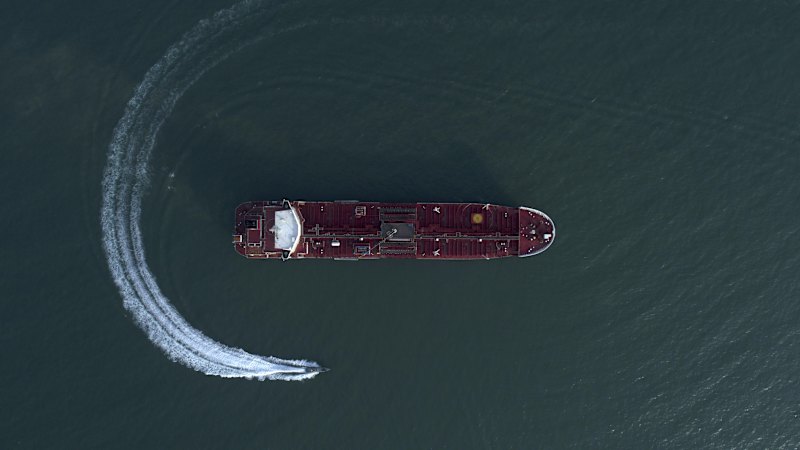
The next moves for oil prices will likely depend on how many oil tankers can start exiting the Strait of Hormuz and how easy their passage is.
By 10.30am on the local bourse, Woodside had gained nearly 4 per cent, Santos was up 2.45 per cent and Yancoal jumped a similar amount. The big four banks held their ground with National Australia Bank up the most, 1.72 per cent, and the others following with smaller gains.
Financial markets have been prone to sharp and sudden reversals because of deep uncertainty about what will happen next in the war.
Heavyweight miners and the tech sector followed that playbook.
Both piled on gains Wednesday, but on Thursday BHP’s stock slumped 1 per cent and Rio’s shed more than 2 per cent. Gold miners also lost lustre. Evolution Mining shed nearly 4 per cent and Northern Star fell 1.42 per cent.
After soaring nearly 10 per cent the previous session, Wistech slumped 7.7 per cent. Fellow tech traveller Xero fell 6.83 per cent.
Overnight in the US, the S&P 500 leapt 2.5 per cent after Trump announced a two-week ceasefire with Iran, less than 90 minutes before a deadline he had set for it to open the Strait of Hormuz and allow oil tankers to exit the Persian Gulf.
The Dow Jones Industrial Average rallied 2.8 per cent, and the Nasdaq composite soared 2.8 per cent following even bigger gains in European and Asian stock markets.
To be sure, stock prices are still below where they were before the war. And oil prices are still significantly higher because the threat remains that the war could continue and keep oil produced in the Persian Gulf area blocked in the Middle East.
“There remains a high degree of uncertainty as to how the situation in the Middle East unfolds,” NAB analysts said. “For now, we wait for news from the first round of peace talks which will take place on Saturday in Islamabad.”
So far in the war, Trump has set several deadlines for Iran to open the Strait of Hormuz, a main thoroughfare for oil to reach customers worldwide from the Persian Gulf, and has threatened big repercussions if Iran doesn’t, only to delay them.
“There is a reason to be optimistic, but it is still too early to tell, because, as you know, after all, it is Trump,” said Takashi Hiroki, chief strategist at MONEX.
It’s similar to a year ago, when Trump threatened stiff tariffs on imports from other countries on “Liberation Day.” After a couple of delays, his administration eventually negotiated lower tariffs with many countries, though they were still higher than those before his second term. That led some investors to allege Trump “always chickens out,” or “TACO,” if financial markets show enough pain.
When oil prices were screaming higher because of the war, some traders were betting on the possibility that the Fed would have to raise interest rates to keep a lid on inflation. Now, they’re seeing a roughly 1-in-3 chance that the Fed could resume its cuts to rates in 2026, according to data from CME Group.
In Asia, where countries are more reliant on oil from the Middle East, South Korea’s Kospi stock index surged 6.9 per cent. Japan’s Nikkei 225 leapt 5.4 per cent, and Hong Kong’s Hang Seng jumped 3.1 per cent. European stock indexes rose nearly as much. Germany’s DAX returned 5.1 per cent, and France’s CAC 40 rallied 4.5 per cent.
With AP
The Business Briefing newsletter delivers major stories, exclusive coverage and expert opinion. Sign up to get it every weekday morning.