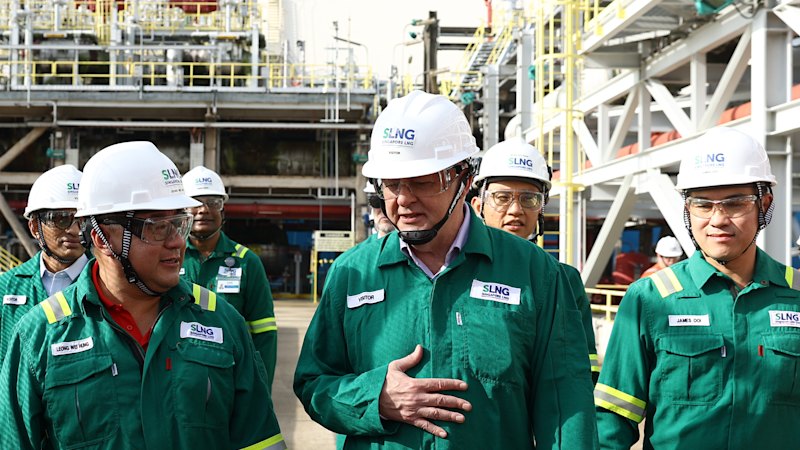
Australia’s massive gas-export terminals are running at near-total capacity, leaving little room to boost production and limiting the Albanese government’s ability to offer additional shipments to Asian trading partners in return for priority access to their petrol, diesel and jet fuel supplies.
Prime Minister Anthony Albanese and Singaporean Prime Minister Lawrence Wong struck an energy-security pact on Friday, under which Singapore all but guaranteed the continued flow of refined fuels to Australia, while Australia reaffirmed its commitment to the steady supply of liquefied natural gas (LNG) to the city-state.
The deal is part of a broader federal strategy to buffer Australia from the global energy crisis triggered by the war in the Middle East, which has disrupted the transit of oil, refined fuel and LNG across the globe.
Australia, which imports about 80 per cent of its liquid fuel from Asian refineries, is aiming to leverage its role as a reliable, top-tier LNG exporter to the region as it seeks to strike agreements with other Asian governments to ensure ongoing access to their increasingly scarce shipments of fuel.
However, industry data suggests Australia’s ability to do much more than pledging to honour existing gas-supply contracts will be constrained by the reality that the nation’s biggest LNG projects – plants that super-chill natural gas down to a liquid so it can be loaded onto ships – are already running at almost full-tilt.
Queensland’s LNG production units, known as “trains”, were running at 94.6 per cent capacity, according to figures from Australian energy consultancy EnergyQuest, while Western Australia’s were at 98 per cent.
“Most of the LNG trains in Australia run at capacity – very few can actually swing,” EnergyQuest chief executive Rick Wilkinson said.
Iran’s closure of the Strait of Hormuz – a vital oil and LNG shipping route – and drone strikes on a Qatari gas hub have together knocked out up to 20 per cent of global LNG supply. Countries across Asia that rely on Qatari LNG to power their heaters and electric grids are desperate to find replacement cargoes to head off shortfalls and have been looking to Australia – the world’s third-largest supplier of LNG, behind Qatar – to make up for the drop-off.
Australia’s ability to continue being a reliable LNG supplier is “highly valued” in the current market, Wilkinson said. He said giving assurances that contracts would be honoured may itself be enough to provide leverage in bilateral government talks to secure fuel from nations including Japan, Korea and China.
Speaking in Singapore, Albanese said more Australian production fields were being developed that could boost supplies to Asia “over a period of time”. But with little to no spare LNG volumes to add to the Asian spot market, Australia’s capacity to alleviate the worsening regional gas crunch is limited in the short term, experts said. Australian LNG producers could perhaps ramp up to deliver an extra “three or four cargoes” in a market that often ships more than 90 cargoes a month, Wilkinson said.
The WA-based LNG operations with flexibility to provide an additional cargo include Woodside Energy’s jointly owned North West Shelf project, and Shell’s floating Prelude facility, data shows. Of three Queensland LNG projects, the Santos-led GLNG venture has the most spare capacity to deliver additional volumes to Asia. However, it has not developed enough of its own gas reserves to turn into LNG, meaning it would need to buy gas that would otherwise be kept for Australian customers, which could increase domestic prices. Santos’ Darwin LNG plant has ramp-up capacity but has been shut for maintenance until later this month.
News last week that the US and Iran had agreed to a ceasefire sent oil markets falling, raising hopes it could be the “beginning of the end” for Australia’s painful run of energy petrol and diesel price rises, which have topped $2.50 a litre for regular unleaded.
The government and fuel industry have managed to diversify their supply chains and secure oil and fuel from other parts of the world, as far afield as Europe and North America. But unless Australia can successfully negotiate extra deliveries, an imminent supply crunch is still a risk, as Asia runs low on the crude oil needed to feed its refineries.
On Thursday, Energy Minister Chris Bowen said fuel suppliers Ampol and Viva Energy agreed to a scheme to encourage them to buy all the fuel they could. Taxpayers would guarantee their losses if they bought more expensive cargoes ahead of price falls, he said.
“This arrangement will enable the companies to make a purchase that would have been non-commercial and to go out and buy that fuel for Australians,” Bowen said.
The Business Briefing newsletter delivers major stories, exclusive coverage and expert opinion. Sign up to get it every weekday morning.
 Nick Toscano is a business reporter for The Age and Sydney Morning Herald.Connect via X or email.