
Amy Chozick
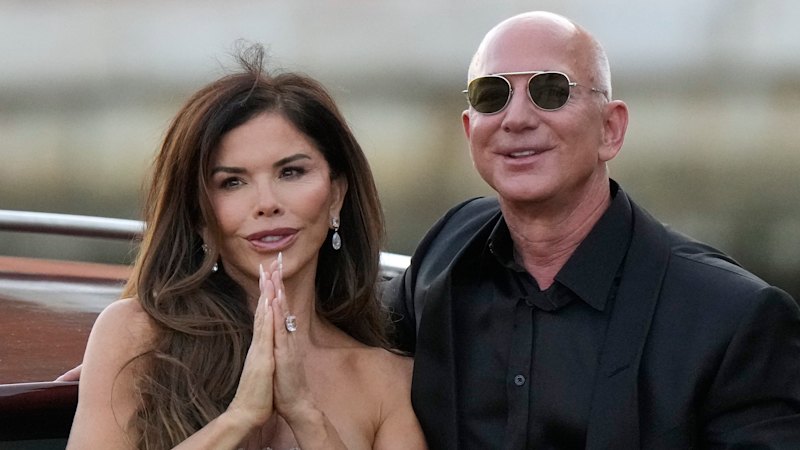
A lot of things make Lauren Sánchez Bezos ridiculously happy. Helicopters. Fashion. Protecting the narwhal. Her little sister, Elena. Her five best girlfriends. And, of course, her husband, Jeff Bezos.
She and Bezos do everything together. On a typical day, the newlyweds wake up around 6am in their new, roughly $US230 million ($330 million) compound on Indian Creek, an exclusive private island in Miami often called Billionaire Bunker.
The couple watch the sunrise and drink their morning coffee. They play pickleball. Six days a week, they work out for an hour with a private trainer. “He looks good, doesn’t he?” Sánchez Bezos said of Bezos, in an interview in Miami in January.
By now, it is hard to conjure the version of Bezos that existed before. Mildly awkward; faintly hermetic in Seattle. The logistical mastermind of two-day shipping. Now, the world’s third-richest man is gym-hardened, frequently shirtless, captured mid-laugh in paparazzi photos, canoodling on his megayacht, a man who has discovered joy, love and cosmetic dermatology.
Sánchez Bezos has, in turn, adopted some Jeff-isms, like Amazon corporate rituals — such as requesting memos no more than six pages long before meetings at the Bezos Earth Fund, where she is the vice chair.
‘They are to quiet luxury what Las Vegas is to the Mormon Church.’
Graydon Carter, Vanity Fair editor
You would think that marrying into obscene wealth would transform a person, but in this case, Sánchez Bezos appears less changed than her husband; the world has long been her Everything Store. Even before she married Bezos, whose net worth is estimated to be roughly $US250 billion, Sánchez Bezos liked to think she was 20 per cent happier than the average person.
“If baseline is here,” Sánchez Bezos said, holding her hand about chest height, “I’m up here” (with her other hand above her head).
Her happiness is infectious, undeniable, world-historical. But when one of the world’s wealthiest people radiates this much happiness, is it celebration, or provocation? Is she just rubbing it in?
There’s a perception that Sánchez Bezos started rolling with the A-list only after marrying Bezos, but it’s actually the other way around. Back when Bezos’ connection to Hollywood largely consisted of his deep involvement with adapting a television version of J.R.R. Tolkien’s The Lord of the Rings, Sánchez Bezos was already known in Los Angeles as a networker who counts Kris Jenner, Katy Perry and Leonardo DiCaprio among her close friends.
Last June, Bezos and Sánchez Bezos wed in a lavish three-day bacchanal in Venice, Italy. To some, it was a tone-deaf display of staggering wealth at a time of historic inequality.
Sánchez Bezos gets choked up talking about what the public didn’t see: the toasts by all their children; the high school friends of Bezos whom nobody bothered to photograph.
This is a frequent lament from her: that people don’t see the couple’s actual life. “What you see is 5 per cent of my life,” Sánchez Bezos said. (In 2024, Bezos said he “gave up on being well understood a long time ago”.)
After years defined by financial crisis, pandemic lockdowns and moral earnestness, unabashed rich-person exuberance is back. The Bezos’ marriage seems, at times, as much a cultural inflection point as a love story — the moment American money stopped apologising and decided it might as well enjoy itself.
“They are to quiet luxury what Las Vegas is to the Mormon Church,” said Graydon Carter, the long-time Vanity Fair editor.
From the outset, the couple have embraced spectacle. When The National Enquirer dropped an exposé of their affair in 2019, Bezos came out slugging. He accused the tabloid’s parent company of political motives, arguing that his ownership of The Washington Post, with its “Democracy Dies in Darkness” posture during President Donald Trump’s first term, had made him a target.
Today, the talk is less about his adversarial relationship with Trump and more about his supposedly cozy one. Bezos personally intervened to stop a planned endorsement of Kamala Harris by the masthead, according to newsroom employees. He attended Trump’s inauguration last year, seated front and centre. Amazon paid roughly $US40 million to license Melania, a documentary about the first lady.
Bezos’ former wife, MacKenzie Scott, has given much of her fortune to liberal causes, but he has long held broadly libertarian views. Last year, Bezos instructed the Post’s opinion pages to advocate “personal liberties and free markets”.
When I asked her opinion of Trump, Sánchez Bezos, who is breezy and agile at pivoting back to the fun topics, waved me off. “I am not talking politics,” she said. “No, no, no, no, no. No way.”
People close to Sánchez Bezos often argue that it’s not fair to criticise her for her husband’s political and business decisions. But that is the downside to being a conjoined organism to a master of the universe: It all has to do with you.
In January, the couple made the couture rounds in Paris. Sánchez Bezos was dripping in vintage Dior with fur and diamonds. She stepped out of a chauffeured Mercedes alongside Anna Wintour. The trip happened to coincide with an announcement that Amazon planned to lay off 16,000 employees.
A few weeks later, the Post, which Bezos bought in 2013, laid off about a third of its newsroom. Former NBC host Chuck Todd said Bezos was “leaning into the evil, rich-guy stereotype”. And Sánchez Bezos was considered to be complicit. During Paris Fashion Week, Blakely Neiman Thornton, an internet celebrity and fashion critic, called her “capitalism’s concubine” in a post.
The constant criticism wears on her, Sánchez Bezos says. When asked about the layoffs at the Post, she said: “I was a journalist, and I know how important journalism is. But I don’t make those business decisions.”
Another day in January, I met Sánchez Bezos at the Santa Monica Airport in California, near where she keeps a sleek black Bell 429 helicopter. If there’s one thing she wants people to know, it’s that she is a helicopter pilot, a rarity in the male-dominated industry. She and Bezos fell in love when she flew him around in a helicopter like this one.
“I feel most myself in the air,” Sánchez Bezos said. “It’s like controlled excitement.” (It’s also a bit of a press strategy for her: She took a Vogue reporter on a trip like this one, too.)
The daughter of middle-class Mexican-American parents in Albuquerque, New Mexico, Sánchez Bezos always exhibited a driven, buzzing restlessness, which she now chalks up in part to her attention deficit hyperactivity disorder diagnosis.
In 2012, at 42, she got the itch to fly, and later founded Black Ops Aviation, an aerial production company. The day we met, it was overcast, but Sánchez Bezos was optimistic. “The clouds aren’t that dense!” she said, settling into the pilot’s seat. “We can cut right through them!” She banked past the Hollywood sign and over verdant hills dotted with mansions and tennis courts.
In September, Sánchez Bezos headed to a school in Connecticut to read to kindergarteners from her first book, The Fly Who Flew to Space, about Flynn, a dyslexic fly.
The book is in some ways autobiographical: Sánchez Bezos struggled in school and always thought she was dumb, until a college teacher recognised that she had dyslexia. Today, she reads papers about nuclear and geothermal power as part of her work at the Bezos Earth Fund. “She wants to have an opinion and speak about these things intelligently,” said Tom Taylor, CEO of the fund and a long-time Amazon executive close to Bezos.
The non-profit has distributed at least $US2.4 billion in grants, making Bezos “among the biggest climate philanthropists around”, said David Callahan, author of The Givers: Wealth, Power, and Philanthropy in a New Gilded Age.
And yet, he added, Bezos’ charitable work lagged compared with his tiny cadre of peers. “He’s a big philanthropist, just not relative to his fortune,” Callahan said.
And Bezos is frequently compared with his former wife, Scott, who has upended traditional philanthropy, giving away roughly $US26 billion of her fortune, quietly and with few conditions.
In 2022, Bezos said he would give away most of his fortune, then roughly $US124 billion. Today, he has more than double that amount. Sánchez Bezos would like to expand the couple’s footprint, but says “philanthropy is a job. You have to vet everyone, make sure the money is being used in the right way”.
This tension may be at the heart of what unsettles some of Sánchez Bezos’ critics. She embraces philanthropy, but also the pleasure that comes with wealth — the visibility, the proximity to power, the fashion, the fun.
She is fluent in fame. But power is a whole other language, especially as one half of a couple whose reach rivals that of a nation-state. She wants to spread happiness, but happiness can’t scale. Happiness can’t pay the rent.
This article originally appeared in The New York Times.
The Business Briefing newsletter delivers major stories, exclusive coverage and expert opinion. Sign up to get it every weekday morning.