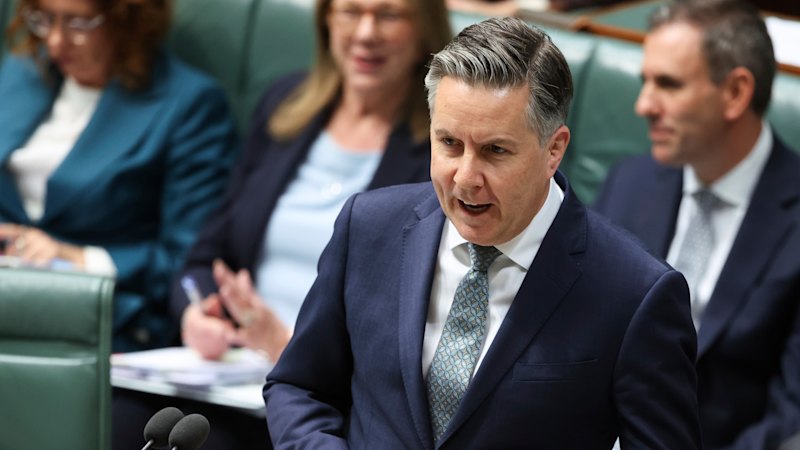
Health and Disability Minister Mark Butler will use a keynote speech next week to reveal Labor’s plans for slowing down growth in the $50 billion National Disability Insurance Scheme, as the Coalition lends its support to cracking down on unregistered providers in the program.
The opposition’s assistant NDIS spokesman, Henry Pike, who recently took on the role in Angus Taylor’s new shadow ministry, told this masthead he wanted the government to start by clamping down on leakage from the scheme with a better payment system and stronger provider registration regime.
While the Coalition indicated it would work with Labor to achieve those changes, both Pike and the Coalition’s senior NDIS spokeswoman, Melissa McIntosh, accused the government of banking savings in the budget without outlining how it would achieve them.
“If the government is projecting billions in savings, it should be transparent about how those savings will be achieved. The current trajectory suggests increasing pressure on participants rather than structural reform,” Pike said.
More details will be revealed when Butler addresses the National Press Club in Canberra next week to outline Labor’s NDIS plans before the May budget, which includes three packages – on savings, tax reform and productivity – that are framed around intergenerational equality.
This masthead last week revealed that lowering growth in the NDIS would be a centrepiece of Labor’s budget savings plan, spurring a political debate over the scheme’s future as the government sought to reduce its annual growth rate from 10 per cent, at present, to 6 per cent or lower within four years.
Large NDIS providers were encouraging the debate, with some arguing it was the government’s last chance to change course before the scheme buckled under its own weight, while crossbench MPs warned the government must slow down its plans until it could demonstrate there was support to catch people outside the scheme.
Butler was not ruling any options in or out ahead of the government’s announcement – including a push from some Labor MPs and One Nation leader Pauline Hanson to means-test the scheme – but Prime Minister Anthony Albanese on the weekend said means testing was not on the cards.
“We support the universality of the system. Eligibility should be about people’s disability and enabling them to fully participate in society,” he told the Australian Financial Review.
McIntosh on Monday said the uncertainty was causing great distress. “The Coalition is ready to work with the government to strengthen the NDIS because it needs to be about quality, not quantity … I know the anxiety this is causing many parents across Australia,” she said.
Pike told this masthead the major focus of Labor’s reforms needed to be wasteful spending rather than individual plan budget cuts. “The [National Disability Insurance Agency] has acknowledged that up to one in 10 dollars in the scheme may be paid improperly. This needs to be the major focus for any reforms,” Pike said.
He said the NDIS needed a modern, real-time payment system that could verify all claims before funds were released. While the agency improved its payment system in 2022, handwritten invoices and errors still featured.
“We also need to step up provider registration through a tiered risk-based model and find ways to truly tackle the proliferation of red tape across the scheme which is costing providers, participants, and taxpayers hundreds of millions,” Pike said.
The government had been consulting on a tiered enrolment system for NDIS providers, given just 6.5 per cent of the scheme’s 277,000 operators were currently registered with the government. Labor would start by requiring certain high-risk providers, such as supported independent living providers and digital platforms, to register from the middle of this year.
But the peak body for large non-profits, National Disability Services, said Butler should go further with a universal registration system for all operators in this year’s budget, alongside a tiered pricing regime that rewarded higher-skilled work.
Butler flagged he wanted to boost integrity in the scheme, such as by improving its pricing and registration regimes, but also articulated that more substantial changes would be required to bring down its growth trajectory to 6 per cent or lower.
“One, you can constrain the number of people who are on the scheme, so the eligibility for the scheme, or you can constrain the growth or the cost of particular plan budgets, or a combination of those two things and that’s really the work that we’re undertaking right now,” he said last Friday.
Cut through the noise of federal politics with news, views and expert analysis. Subscribers can sign up to our weekly Inside Politics newsletter.
 Natassia Chrysanthos is Federal Political Correspondent. She has previously reported on immigration, health, social issues and the NDIS from Parliament House in Canberra.Connect via X or email.
 James Massola is chief political commentator. He was previously national affairs editor and South-East Asia correspondent. He has won Quill and Kennedy awards and been a Walkley finalist. Connect securely on Signal @jamesmassola.01Connect via X or email.