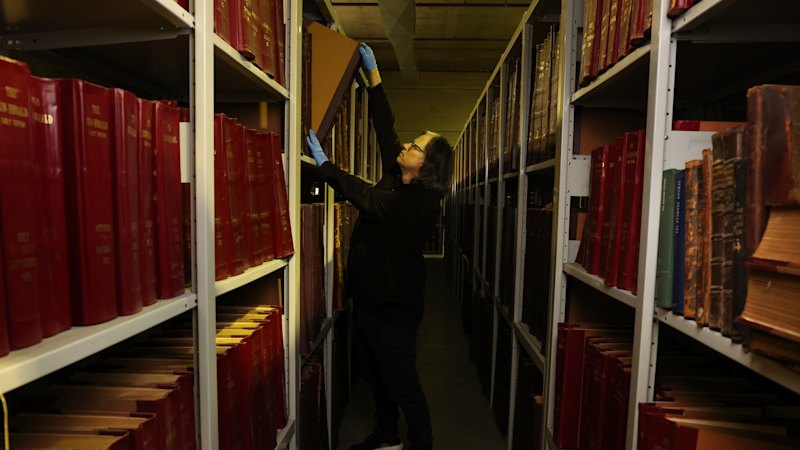
In a secret climate-controlled facility in Sydney’s west, photo specialist Harry Hollinsworth is working through The Sydney Morning Herald’s archives to save photos that brought history to life.
The Herald celebrates its 195th birthday on Saturday, April 18 and Hollinsworth is part of a five-year digitisation project that is creating a single online archive of Nine Entertainment’s media companies to mark the Herald’s bicentenary in 2031.
The chief executive of Nine Entertainment, Matt Stanton, said there was “intrinsic value” for Nine, as Australia’s leading media organisation, in digitising our archives to protect them for the future.
“The history of Australia, its democracy and its success as a nation is deeply interwoven with our media. Digitising these records protects this history and enables future generations to explore our rich stories of Australia, serving as a reminder of the importance of local media and homegrown journalism for many years to come.”
The director of the Digital Archive project, Stephanie Foran, said the goal was to bring 200 years of history as told in video, film, photojournalism and articles into a single and searchable archive.
“We are digitising Australian history as told by our reporters, photographers and television broadcasts across every masthead and broadcast channel,” she said.
The database will include 150,000 hours of broadcast television ranging from The Graham Kennedy Show and Nine News to A Current Affair and 60 Minutes; millions of photos and negatives in various formats, and large sections of the Herald, The Age and The Australian Financial Review, including 500,000 pages of microfilm from 1951 to 2000, and other mastheads including The Sun.
Nothing about the process of preparing material for digitisation has been straightforward.
Over the years, some photos have disappeared while others were sold. The project will focus on material yet to be preserved. (The National Library’s Trove has digitised the Herald from 1831 to 1955.)
Foran said it involved wrangling more than a dozen different formats used to store material. This ranges from film and videotapes – in one and two-inch, U-matic and Betacam formats – to printed photos and hard copy articles, and materials stored on CD, DVD, microfiche and microfilm.
Old legacy magnetic tapes suffered from “sticky shed syndrome” where moisture made the binder gummy. Tapes had to be baked like a cake for a final successful playback.
Prior to digitisation, Hollinsworth was trying to save some of the 11 million negatives also at risk of destruction.
Toxic vinegar syndrome, which smells as bad as it sounds, threatened to destroy masses of large format acetate images taken from 1950 to 1957.
Some were beyond rescue. “I had to throw entire boxes out,” he said. He has scanned the negatives most at risk of crumbling. “It is a bit like painting the Harbour Bridge,” he said. “Once you think you are finished, you have to go back to the beginning again.”
Wearing a mask and PPE to avoid the fumes, Hollinsworth saved 1900 images including many of the Melbourne 1956 Summer Olympics, those documenting the visit of Hollywood stars Liz Taylor and Mike Todd, and Dame Shirley Bassey who turned 21 in Sydney.
Only one image survived from a photo shoot of Maureen O’Hara, the Irish-American red-headed movie star known as the Queen of Technicolor with the kind of fame associated today with Nicole Kidman. It was of O’Hara holding a koala at Taronga Zoo.
Page 1 of the first edition of the Sydney Herald, as it was called then, published on Monday, April 18, 1831 featured news and classified advertisements – the so-called “rivers of gold” that kept the Herald’s former owners, the Fairfax family, afloat for years.
Thomas Barker advertised that he was “enabling the supply of biscuits to the colony”.
Shipping news competed with crime, courts, politics, entertainment, disasters including a fatal drowning, road closures, employment, disputes over wages, crop failures, and pubs and clubs.
The colonial secretary announced that prisoners of the Crown had obtained tickets of leave.
And page 2 included a poem by staff titled The Press – a promise to spread the light of knowledge, to penetrate the cloistered cell, and fan the flame of a generous age so “darkness yields to light”.
It is hard to visit the archives without getting distracted. Piles of drawings by cartoonists like the late Larry Pickering and George Molnar are piled in one spot. Drawings and copies of The Potts, the longest-running cartoon strip ever, are on a shelf.
Human resources files for former staff and photos of young cadet journalists are mostly in the right spot. (Mine was not.)
Hollinsworth, though, said he couldn’t stop looking at the old classifieds’ bizarre health claims, including one recommending Indian cigarettes for asthma.
But the image that nags his brain is the one of a Nazi flag flying outside the German consulate near Circular Quay at the beginning of WWII. It was later taken down by returned servicemen.
Foran said the archival project had just begun. “The future is built on a well-indexed past,” she said. The goal is to digitise as much as possible and streamline metadata so it can be used in the future in ways we have yet to imagine, she said.
Start the day with a summary of the day’s most important and interesting stories, analysis and insights. Sign up for our Morning Edition newsletter.
 Julie Power is a senior reporter at The Sydney Morning Herald.Connect via X or email.