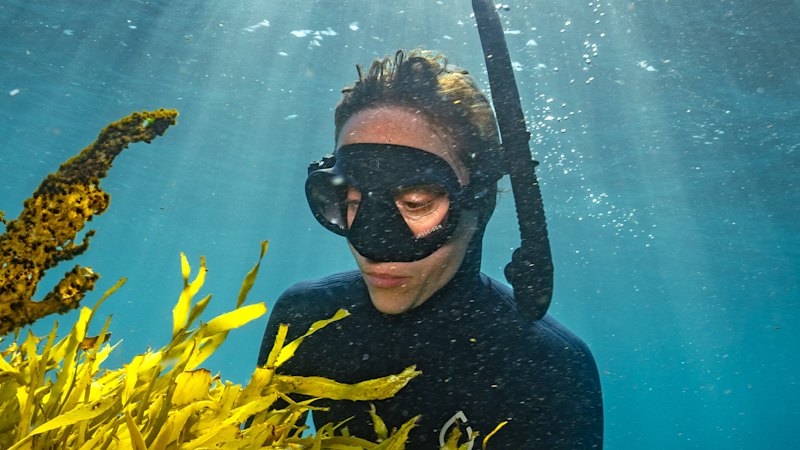

Sydney’s underwater forests are making a remarkable recovery, enabled by cleaner coastal waters around the city and a helping hand from scientists.
Operation Crayweed is an initiative of the University of NSW and the Sydney Institute of Marine Science to restore crayweed (Phyllospora comosa) – a type of golden-brown seaweed that often lives alongside golden kelp.
Ecologist and project co-ordinator Dr Claudia Santori said the two seaweeds look different – crayweed has delicate fronds while golden kelp has broad leaves – but both formed a forest canopy that provided habitat for marine animals.
While golden kelp still exists along the Sydney coastline, however, crayweed was wiped out along 70 kilometres from Palm Beach to Cronulla, despite persisting further north and south. Santori said the local extinction was most likely because of water pollution in the decades before the construction of the deep ocean outfalls in the early 1990s.
“What they have in common is they create these beautiful forests because they create canopy and the fishes can swim in and amongst them, and the invertebrates can live underneath,” Santori said. “It creates this sort of beautiful, three-dimensional habitat that is very typical of the Great Southern Reef in the southern part of Australia.”
The Great Southern Reef, which spans 8000 kilometres from the NSW-Queensland boarder around the underside of the continent and halfway up the coast of Western Australia, has rocky reef and seaweed forests to fill the same niche as coral reefs in tropical northern waters.
Santori said crayweed was beautiful and worth restoring in its own right, but also provided slightly different habitat to golden kelp. Abalone, for example, were 20 times more plentiful in crayweed than other species of seaweed, she said.
The NSW government has licensed 20 sites for crayweed restoration. The earliest sites were restored up to a decade ago, with six sites now considered established, and seven sites still in progress.
This masthead went snorkelling with Santori at the restored site at South Coogee, near Wylie’s Baths, and saw both types of seaweed as well as purple coralline algae and colourful fish, including a resident blue groper.
Santori said the restoration work involves bringing in adult crayweed tied on to metal mesh mats. The female and male seaweed breed – with pollination occurring through the water column – and the babies or “craybies” colonise the natural rock. Once the offspring successfully breed themselves, the scientists remove the mats and let nature do the rest.
While South Coogee is considered a restored site, a few mats to top up the crayweed were recently installed at a community event.
NSW Minister for Lands and Property Steve Kamper said this helped engage the public in the environmental work.
“Efforts like the naming of this underwater kelp forest near Wylie’s Baths help highlight the utmost importance of healthy marine ecosystems to the iconic beaches and wildlife Australia is famous for,” Kamper said in a statement.
Santori said the water was much cleaner than in the 1980s, when poorly treated sewage was pumped directly off the cliffs. This provided a rare opportunity because the restoration work could occur without the stressor still being present, she said.
 Caitlin Fitzsimmons is the environment and climate reporter for The Sydney Morning Herald. She was previously the social affairs reporter and the Money editor.Connect via email.