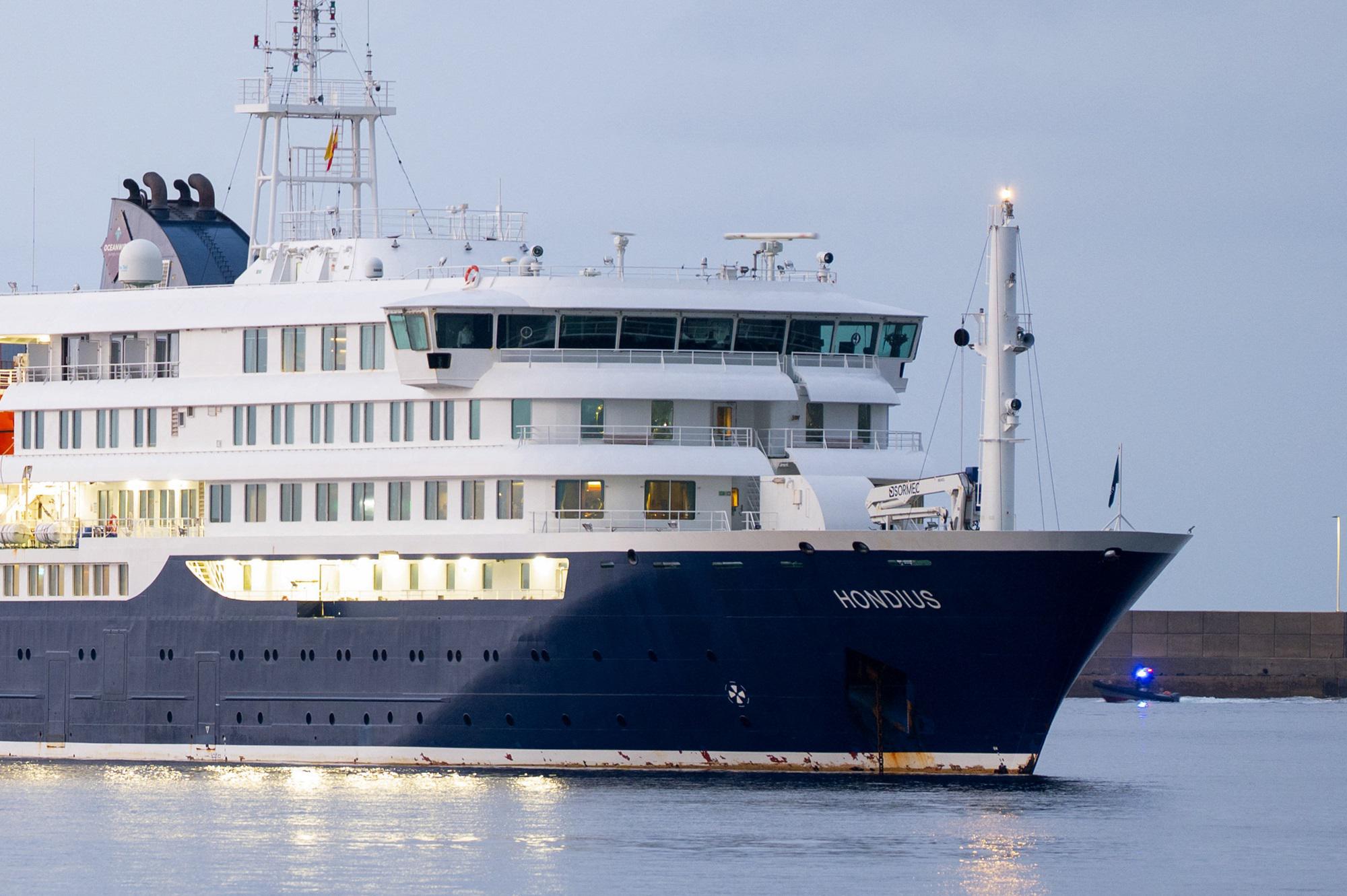
THE rat virus cruise ship has finally anchored in a Tenerife dock despite port workers and locals threatening to sabotage its evacuation plans.
But the 22 Brits needing rescue could still be on the plagued vessel for around eight more agonising hours before they are finally taken to a repatriation flight as a high-stakes health operation gets underway.
Doomed MV Hondius arrived at the island shortly after 5.30am as Foreign Office health officials anxiously waited on the ground.
Nearly 150 people on board spent days fearing for their lives while holed up inside the floating death trap off the African island group.
Authorities now face a race against time to get all the passengers and crew off before bad weather hits the island.
Medics will sail towards the birdwatching ship and screen all the passengers and crew on board before a high-stakes and time-consuming operation to get them off safely.
BUG OUTBREAK
‘Patient zero’ of deadly rat virus outbreak revealed as bird watcher

RAT BUG SPREAD
Another ‘rat virus’ case confirmed as Brits on cruise ship to be flown to UK
It comes as…
Only those not showing symptoms of the rat plague hantavirus will disembark, starting with the Spanish who will fly to a military hospital in Madrid.
Cleared passengers and a “limited number of crew” will begin disembarking from around 8am.
They will be brought to land using Zodiac craft and launch boats, while luggage will remain on board.
The Hondius will then continue on to Rotterdam, trying to avoid the looming storm
Non-Spanish passengers will be taken off in groups of five by nationality once their planes are ready.
Asymptomatic Brits will be bussed 10 minutes to the Tenerife South airport, where a Titan Airways jet chartered by the foreign office will take them home.
The plane left Stansted airport at 10am and is due to arrive at 3am.
They will fly back to the UK and isolate for 45 days at Arrowe Park hospital in the Wirral, Merseyside – the same hospital used to isolate those returning from China after the Covid outbreak.
Three people from the ship have died after getting the bug, and there have been three other confirmed cases – including British crew member Mark Anstee, who is being treated in a Netherlands hospital after being airlifted from the vessel.
But riot police were on standby all day to intervene after port workers and locals threatened to stop the high-stakes global health operation.
Furious protesters demonstrated outside the Canary Islands parliament on Friday and threatened to blockade the twitcher boat if their health concerns were not met.
Members of the Tenerife Port Workers (TPT) union have rallied against the Spanish government’s decision to allow the Hondius to dock at the port of Granadilla in the island’s south.
TPT union spokesperson Elena Ruiz said: “We are prepared to block the port if we don’t get answers to our concerns.”
Locals also considered blocking the single access road to the port.
Dozens of police including a riot van patrolled the port and the entrance.
A source said: “Authorities have secured the area and are ready to be deployed if they need to be to make sure the process is completed.”
The protests threatened to make the evacuation process even longer, which could ruin the whole operation because of oncoming bad sea conditions.
Disembarking the passengers is likely to be a lengthy process to make sure there is no risk to others on the island.
But local governors claimed the complex operation had a short window of opportunity and could have to be scrapped if it is not completed within 24 hours.
Regional Canary Islands government spokesman Alfonso Cabello warned bad weather meant the “window is very limited”.
He insisted the ship would have to continue with passengers still on board if the evacuation was not completed before the bad sea conditions on Monday – otherwise they would be stuck until the middle of May.
Workers had been toiling since the early hours yesterday to prepare the site for the MV Hondius’ arrival. It included a field hospital being set up with supplies and stretchers.
The World Health Organisation’s director general meanwhile desperately tried to calm tensions yesterday by telling locals in an open letter he knows they are “worried”, but insisted: “This is not another Covid.”
Tedros Adhanom Ghebreyesus wrote in an open letter to concerned locals: “I know you are worried. I know that when you hear the word ‘outbreak’ and watch a ship sail toward you shores, memories surface that none of us have fully put to rest.
“The pain of 2020 is still real, and I do not dismiss it for a single moment.
“But I need you to hear me clearly: this is not another Covid. The current public health risk from hantavirus remains low.”
He said that Tenerife was chosen “because it has the medical capacity, the infrastructure, and the humanity to help [those on board] reach safety”, adding: “Because I believe that so deeply, I will be there myself.”
And he reiterated in a press conference last night that local concerns were “legitimate”, but added: “We have all experienced Covid. That trauma is still in our minds.
“People will have questions, concerns, that’s what I tried to address in my letter to the people of Tenerife.”
Last night, patient zero was identified as ornithologist Leo Schilperoord, 70, who boarded the ship with his wife Mirjam, 69.
He is believed to have caught the virus from an Argentinian rat after they visited a landfill site on March 27.
The birdwatching hotspot is home to a rare species of Patagonian bird, including the white-bellied seedsnipe.
The couple, from small Netherlands village Haulerwijk, had been on a five-month trip around South America.
Leo was the first patient to die of the virus on board the ship.
The captain announced the horrifying news the next day, but said he believed the passenger died of “natural causes”.
“I am told by the doctor that we are not infectious,” he can be heard saying in footage recorded by Turkish travel vlogger Ruhi Cenet.
Two weeks later, his wife Mirjam got off the ship with his body but died trying to board a plane to the Netherlands from South Africa.
Just one day later, a 69-year-old British man was evacuated with a high fever, shortness of breath and signs of pneumonia.
He is currently being treated in an intensive care unit in Johannesburg.
Health officials tested the stricken Brit for hantavirus after other, extensive tests returned negative.
The diagnosis was officially made on May 2, three weeks after the first passenger died.
That same day, a third passenger – a German woman – died on the ship after suffering symptoms that can be caused by hantavirus, and her body remains on the ship.