In just three breathtaking minutes Australia’s Delta Goodrem delivered a Eurovision performance destined for the history books, booking a slot in this weekend’s final and restoring Australia’s standing in the world’s oldest music competition.
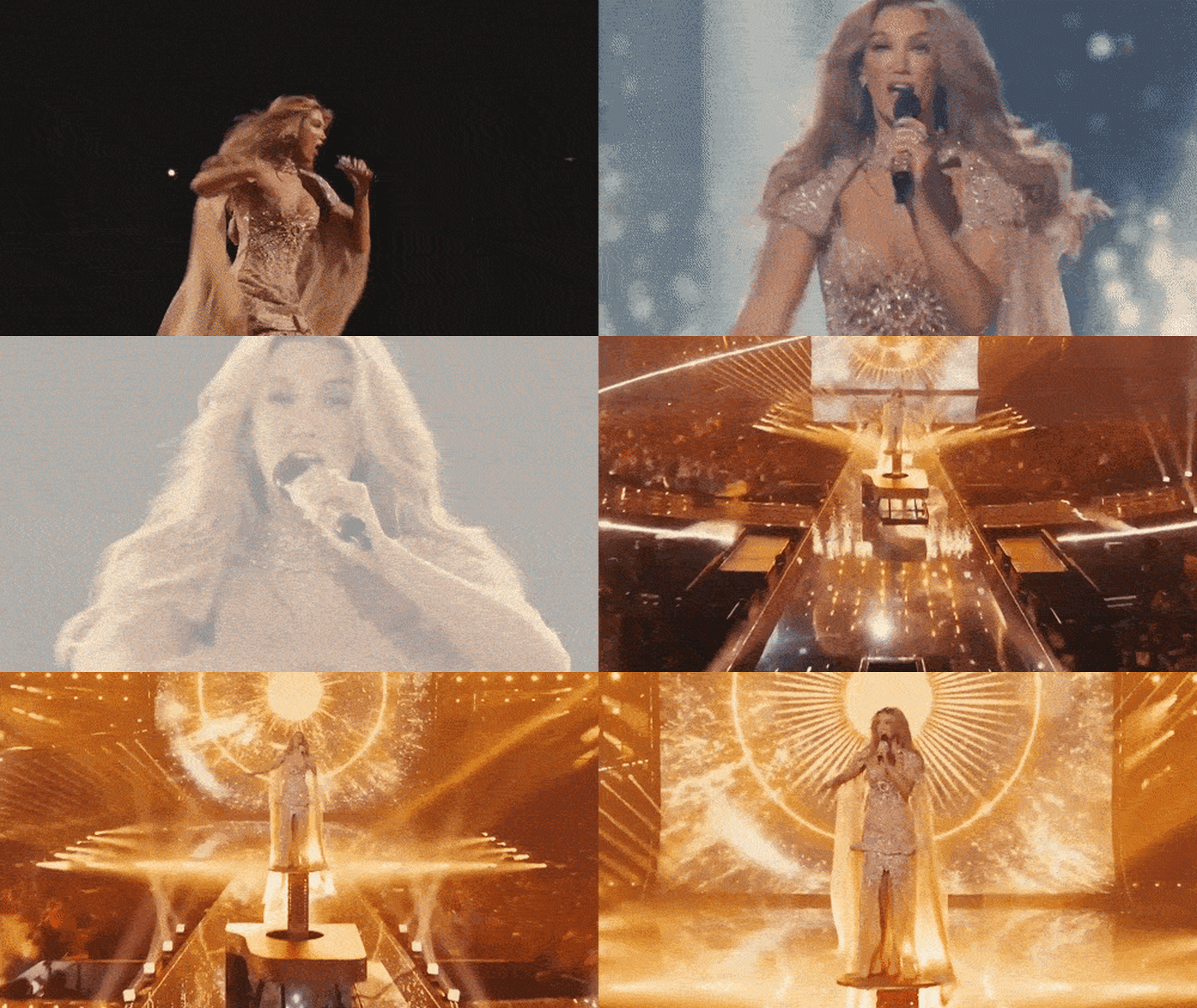
Performing to a crowd of 16,000 in Vienna, Austria – and an estimated TV audience of almost 40 million people worldwide – she moved through a moonlit stage singing Eclipse, finishing her performance in an explosion of shimmering gold representing the sun.
Though video glimpses and still images of Goodrem’s performance have appeared online since her rehearsals earlier this week, the live performance on Friday morning (AEST) was the first time the elaborate stage performance was seen in full.
The brainchild of staging directors and producers Dan Shipton and Ross Nicholson, the performance has drawn an enormous reaction on the ground in Vienna. Eclipse was co-written by Goodrem with Jonas Myrin, Ferras Alqaisi and Michael Fatkin.
The view from the side of the stage revealed the magic behind Goodrem’s “ascent” for the final verse of the song: the production crew moving her past a moonlit harpist, to a shimmering gold piano and then buckling her into a slowly ascending pedestal stage to rapturous applause from the audience.
On the TV screen, the crew remained unseen, and the transitions were seamless. The secret sauce, however, was a specialised piece of stage automation, the Versa Ribbon Lift, which uses coiled ribbons of high-strength steel to create a high vertical riser on a relatively small stage footprint.
The technology has also been used by pop superstar Beyoncé at the music festival Coachella and at a 2023 concert in Dubai.
During the final thrilling part of Goodrem’s performance, the safety lines on the riser were concealed in the folds of her hand-crafted gold gown, whose sparkle was enhanced by 7000 Swarovski crystals, which took more than 500 hours to sew by hand.
Crucially, Goodrem’s performance confirmed Australia’s place in this weekend’s Eurovision grand final. We are one of 10 countries which now progress from this second semi-final. The others were Bulgaria, Ukraine, Norway, Romania, Malta, Cyprus, Albania, Denmark and Czechia. That means Azerbaijan, Luxembourg, Armenia, Switzerland and Latvia leave the competition.
The semi-finalists now join the 10 successful countries from the first semi-final – Greece, Finland, Belgium, Sweden, Moldova, Israel, Serbia, Croatia, Lithuania and Poland – and will meet four of the so-called “Big Five” – the biggest members of the European Broadcasting Union: France, Germany, Italy and the UK – and the host country, Austria, who all get an automatic slot in the final.
The fifth member of the Big Five, Spain, withdrew from this year’s competition, protesting the inclusion of Israel following the war in Gaza, and what it saw as the European Broadcasting Union’s failure to censure them. Four other countries joined the boycott: Iceland, Ireland, the Netherlands and Slovenia.
That Goodrem has progressed to the grand final is perhaps unsurprising. She is a seasoned stage performer with three decades of experience behind her, a skilled instrumentalist and an accomplished singer-songwriter.
She also comes to this year’s Eurovision equipped with the competition’s two most important assets: a compelling song and thrilling and innovative stage design. Both are vital in a successful Eurovision strategy.
But in truth our passage through the second semi-final was far from certain. Australia has been in Eurovision since 2015. In the decade since, we have failed to qualify three times: Montaigne in 2021, Electric Fields in 2024 and Go-Jo in 2025.
Back-to-back shock eliminations in the past two years were particularly damaging to the perception that Australia is an uncertain player in a European song contest to begin with. It was not enough to qualify as a Eurovision “curse”, but failing to launch in two consecutive years was strategically fraught.
This year’s contest sits in an unsteady intersection of problems, ranging from objections to Israel’s inclusion, to concerns that the voting system is vulnerable to vote-harvesting campaigns intended to rumble an already numerically fragile voting system.
Notably, Austria’s most famous Eurovision winner, Conchita Wurst, released a thinly veiled political statement overnight “withdrawing from the Eurovision context”. Though the statement did not go into detail, Wurst said: “My connection to the [Eurovision Song Contest] remains, as part of my history, not as the place for my next steps.”
In the context of the geopolitical undercurrents to this year’s event, the announcement was seen by many as a sign of deeper tensions within the competition’s relationship with participating countries, and high-profile artists associated with the seven-decade-old Eurovision brand.
Earlier this week, police in Vienna said they were anticipating protests, including “blockades and disruption attempts”. But so far, the streets of Vienna have been relatively quiet. Most of the protest activity is expected to focus on this weekend’s final. Drones have also been banned within 1.5 kilometres of the key venues, including the Wiener Stadthalle.
All of those issues are also converging as the EBU is looking to launch a spin-off event, Eurovision Song Contest Asia. The inaugural edition will be held on November 14 in Bangkok, Thailand, with 10 countries confirmed as participants: Bangladesh, Bhutan, Cambodia, Laos, Malaysia, Nepal, Philippines, South Korea, Thailand and Vietnam.
A US adaptation, the American Song Contest, aired in 2022 with all 50 US states, five territories and Washington DC competing. That iteration was not successful, launching to about 2.8 million viewers in the US, but drifting down to 1.6 million. Blame for its failure was largely put down to its inability to stand out in a TV market saturated with talent shows.
The 2026 Eurovision competition features artists and songs from 35 countries performing in 20 languages. Per the contest’s rules, songs must be original, no longer than three minutes and performed live.
SBS will air the Eurovision grand final live at 5am AEST on Sunday. Semi-final 1 will be repeated at 7.30pm AEST tonight; semi-final 2 and the grand final will be repeated at 7.30pm AEST on Saturday and Sunday respectively.
 Michael Idato is the culture editor-at-large of The Sydney Morning Herald and The Age.Connect via X or email.