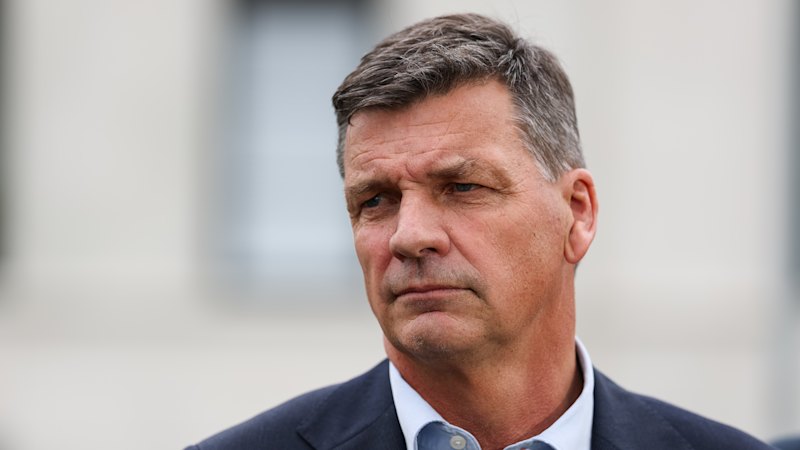
Angus Taylor’s promise to deliver $22.5 billion in tax relief to Australians has a $12.5 billion black hole in it, according to new costings prepared by Labor, raising questions over how the opposition will pay for the cut if it wins government.
The dispute over income tax figures heightens what has become a major political battleground after Labor on Tuesday delivered a budget that pared back major tax concessions linked to housing, decisions Taylor said he would repeal, describing them as “pulling up the ladder of opportunity” on young Australians.
According to the Labor estimate, prepared using the Parliamentary Budget Office’s “small model of Australian representative taxpayers” (SMART) tool, the true cost of Taylor’s pledge to index tax rates is $35 billion over four years, rather than the $22.5 billion estimate.
But the opposition used the Parliamentary Budget Office’s “build your own budget” tool, rather than the SMART tool, to prepare its estimate of the cost of indexation.
A Coalition source did not dispute the figure derived from the SMART tool by Labor, but argued that its estimate is also correct, because of the timing of when taxpayers would receive the money back if indexing were implemented under a Taylor-led government.
Effectively, ordinary taxpayers would not see a tax cut in their take-home pay, the source said, but rather they would receive a cheque from the tax office at the end of the financial year.
Taylor’s office declined to comment.
Taylor did not mention this detail when he pledged “generational” tax reform in his budget reply speech on Thursday night, which would see the lowest two tax brackets linked to inflation from 2028 with higher brackets included in later years.
He said the move would deliver about $250 tax back to an average taxpayer in the first year and $1000 to all taxpayers by year four.
“From 2028-29, we will index the bottom two income tax thresholds to inflation. That will fully protect 85 per cent of income earners,” Taylor said on Thursday.
Labor’s estimate of a significantly higher cost to Taylor’s pledge to index tax rates, and the fact that Taylor did not mention that taxpayers would have to wait for their tax cut, raises fresh questions about the detail of the policy and is a potentially embarrassing blunder for the federal opposition.
Over eight years, the government estimated the cost to the budget bottom line of indexing tax thresholds to inflation would be about $167 billion by 2035-36.
Further, the government said the only way the opposition’s figures for the cost of indexing tax rates could be correct is if the Coalition were to scrap the $250 Working Australian Tax Offset – a tax cut for people who earn money from working, rather than investing – that Labor announced in its budget on Tuesday night.
Linking tax brackets to inflation is known as indexation and ensures that, as people’s wages rise with inflation each year, they do not get forced into a higher tax bracket over time.
The Coalition has not said how it would pay for the pledge.
Malcolm Fraser’s government indexed tax rates in 1977, but the huge cost of the decision saw the then Coalition reverse course within a couple of years and no government has attempted it since.
The government’s costing of the opposition’s tax policy assumes the tax thresholds would be indexed at about 2.5 per cent each year, which is the midway point of the Reserve Bank’s target band for inflation.
Labor also argues that the indexation policy, if implemented by a future Liberal government, would be inflationary, particularly when inflation was already high.
On Friday, the Australian Chamber of Commerce and Industry acting chief executive David Alexander cautioned the Coalition to think carefully about its migration and tax indexation policies.
Alexander said indexing tax rates could “improve transparency in the tax system”, but warned the Coalition to be cautious of the “fiscal consequences” of such a measure.
The chamber welcomed announced changes to the instant asset write-off threshold, with the Coalition seeking to raise it to $50,000 for businesses with a turnover under $10 million. Labor raised the cut-off to $20,000 in Tuesday’s budget.
 James Massola is chief political commentator. He was previously national affairs editor and South-East Asia correspondent. He has won Quill and Kennedy awards and been a Walkley finalist. Connect securely on Signal @jamesmassola.01Connect via X or email.
 Shane Wright is a senior economics correspondent for The Sydney Morning Herald and The Age.Connect via X or email.
 Nick Newling is a federal politics reporter for The Sydney Morning Herald and The Age.Connect via X or email.