What in the World, a free weekly newsletter from our foreign correspondents, is sent every Thursday. Below is an excerpt. Sign up to get the whole newsletter delivered to your inbox.
Venice: I’m watching dozens of glamorous people on the Grand Canal as they arrive in sleek motorboats for a party in one of the palazzos near the Rialto Bridge.
The Venice Biennale is about to begin, and events are under way all over the city for serious followers of contemporary art. But I’m looking for a group of urban guerillas.
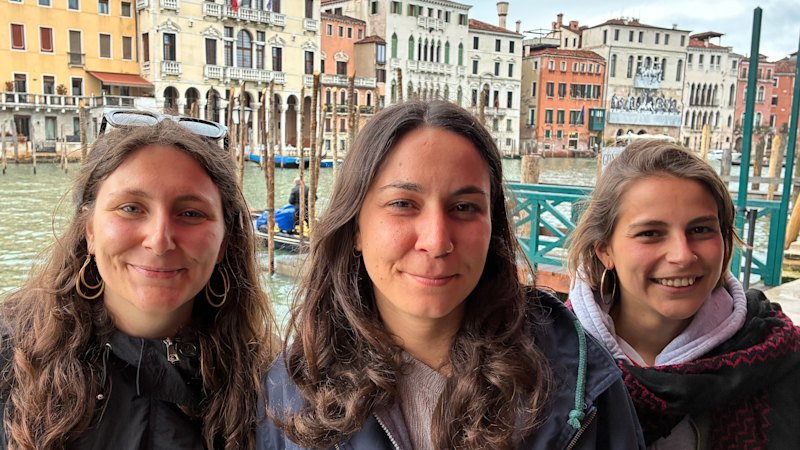
Across the canal from the party, I find Federica Toninello and her friends in an empty space at the Rialto fish market, where they are setting up microphones and speakers for a meeting about the housing shortage. It is 6pm and the market stalls are empty; in their place are rows of seats for residents worried about their city.
“We know that the economy of the city depends on tourism,” Toninello tells me before the crowd arrives. “The problem is that tourism is the only economy in this city.”
She has lived in Venice for almost 12 years and struggles to pay for a place of her own. So, she and others look for rundown buildings that have been locked off by the local government. And they move in.
“One of the problems is social housing,” she says. “On the island alone, there are, more or less, 1000 houses that are kept closed. They are behind a gate, so you cannot get into them, and they are not assigned to people. The reason the authorities give is that they don’t have the money to restore the houses, for the maintenance.”
That is why Toninello is a member of the Assemblea Sociale per la Casa, or ASC, the group meeting at the fish market. It believes that some of the derelict houses have been kept closed for 30 or 40 years. Its members move in and renovate in the hope they can live rent-free, at least for a while.
The idea that houses stand empty in Venice seems utterly bizarre. I’ve come to this meeting after catching the Line 1 vaporetto – the public water bus – down the Grand Canal from near St Mark’s Square, which is choked with crowds. Visitors spend so much money here that you would expect every spare room to be full and the larger cupboards to come with fold-out beds.
But the numbers tell the story. The city’s population has fallen from 175,000 in the 1930s to less than 50,000 today, according to global data platform Statista. As people leave or die, buildings in the quieter areas lie empty – including public housing. Not every home is a palazzo on a canal.
Meanwhile, the tourists keep coming. At least 5.9 million stayed in 2024, according to the City of Venice Tourism Department. The influx has doubled since the turn of the century, and this number undercounts the crowd because it does not include the day trippers who come by car, bus, train or cruise ship. In the argument about over-tourism, Venice is the prime exhibit.
The genteel decay of a quiet Venetian alley can look wonderful on a postcard, but it can also be a sign of vacant housing in a city that is losing its people.
“We get into the houses that are kept closed and cannot be assigned to people because they need a lot of renovation,” Toninello says. “We add to it, we restore it. It’s a very grassroots operation. But it’s not easy to live in this way because you never know what can happen. There’s a lot of criminalisation of the people that occupy, but they have no other solution because the public houses are kept closed and because the rents in the private market are too high.”
The local community still exists, despite the pressures from tourism. Sitting at a café in the Giardini district one morning, I listened to Italian women greeting their neighbours as they walked their dogs along the pavement. Their voices were like music. I couldn’t help wondering about a sad future for Venice, where its people depart and the only customers at the cafe are tourists.
Today, Venice only works thanks to a large and growing temporary workforce. Queueing at the Rialto wharf at 11.30 one night, I watched migrant workers fill the Line 1 vaporetto until it was standing-room only. They were mostly men in their twenties from the Indian subcontinent, finished for the day at the restaurants and checking their phones without a glance at the view. They got out at Piazzale Roma, where you can transfer to a car or a bus to the towns outside the lagoon. This is life for a kitchenhand or a waiter: the workers cannot afford to live in the city they support.
Locals worry about Venice turning into a form of Disneyland. It can be a bit like this in St Mark’s Square, which is full of tour groups, but the square is not about the shops. The Basilica and the Doge’s Palace are magnificent homes to history and art, and nobody should want a world in which they cannot be seen. I could not afford a coffee in the square when I last visited, in 1996, so I was determined to have one this time. I stopped at Caffe Lavena and listened to a piano quartet play Italian classics. The espresso was €12 – about $19. I didn’t regret it.
The big event in Venice last year, the wedding of Jeff Bezos and Lauren Sánchez, highlighted the extreme wealth of its elite visitors – and Toninello was one of those who objected to the display. The city has an impressive way of parting visitors from their money, but cost is one way to limit tourist numbers. It is hard to see any other way working. The “Venice Access Fee” for tourists is €5 at present, but that’s barely a sip of coffee. It is bound to rise.
Everywhere you look, the views are stunning. But if Venice is the future of tourism, it is not a pretty sight.
We all know that travel is a troubled business: we change the places we love by loving them so much. What stands out in Venice is the way the community shrinks as the tourist trade expands. So who will guard against rampant over-tourism? The best mechanism is an active voting public who can throw out leaders who care more about tourist dollars than local services. But what if voters have to leave? As more people are priced out of the city, the Disneyland danger closes in.
It is hard to know what visitors should do to protect Venice, even as they enjoy it. So I ask Toninello.
“Try to look for the more local things,” she says. Spend money at local stores, for instance. One of the concerns is that essential services, such as pharmacies, close down because they are priced out by stores that sell to tourists, or the big chains. This is how neighbourhoods lose their amenities and their character.
“Also, try to stay in the city, behaving like you’re in a city,” she adds.
It is about respecting the place, slowing down, and not making things harder for those who live there. After all, it is the locals who make Venice a living city. And that is a lesson for tourism the world over.
Get a note directly from our foreign correspondents on what’s making headlines around the world. Sign up for our weekly What in the World newsletter.
 David Crowe is Europe correspondent for The Sydney Morning Herald and The Age.Connect via X or email.