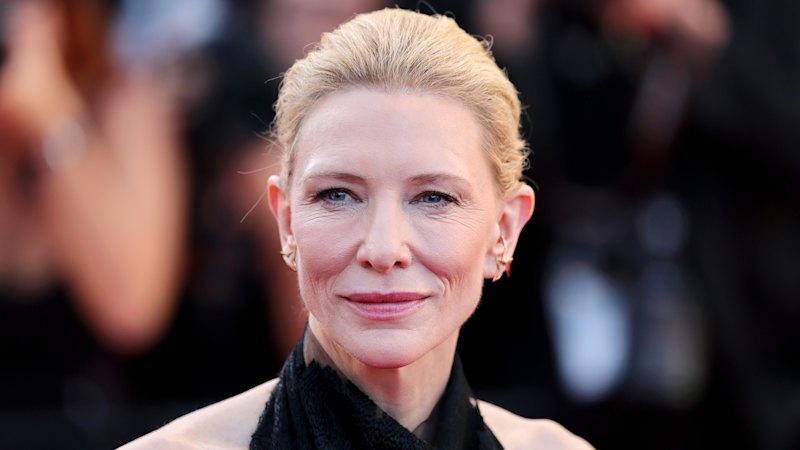
Cannes: Cate Blanchett said the #MeToo movement “got killed very quickly” in Hollywood, speaking on Sunday (French time) at the Cannes Film Festival.
She also said that actors should be open to working with “problematic” artists if they made an effort to repair any harms caused.
In a wide-ranging staged conversation at the “Rendez-vous with Cate Blanchett” event, Blanchett lamented that the tide of #MeToo has been turned in Hollywood, where she has been outspoken about gender equality.
“It got killed very quickly, which I think is interesting,” Blanchett said.
“There are a lot of people with platforms who are able to speak up with relative safety and say this has happened to me. And the so-called average woman on the street, person on the street, is saying MeToo. Why does that get shut down?”
In 2018, when she was president of the jury in Cannes, Blanchett took part in a red-carpet protest. She and 81 other women appeared on the steps of the Palais des Festivals, symbolically representing the number of female directors who had been selected for Cannes’ competition lineup. Over the same period, 1866 male directors had been selected.
“I’m still on film sets and I do the headcount every day. There’s 10 women and there’s 75 men every morning,” Blanchett said at the weekend event in Cannes.
“I love men, but what happens is the jokes become the same,” she said. “You just have to brace yourself slightly, and I’m used to that, but it just gets boring for everybody when you walk into a homogeneous workplace.”
Blanchett, who won a best actress Oscar for her role in the 2013 Woody Allen film Blue Jasmine, also said at Cannes that performers should work with “problematic” artists caught in scandals if they were willing to address the harm they had caused.
“We all do things that are foolish that we regret. It’s what we do with that, and if we double down and keep and keep behaving in that way, maybe it’s time to stop working with that person,” the London Telegraph reported her as saying.
“But if that person has atoned for it, and in fact, their work can become deeper, if they can become richer and kinder and truer and more inclusive, then I think that’s great.
“I think people can change, and so I’m much more of the school of being open to the possibility that people evolve.”
Allen has previously been accused of abusing his adopted daughter Dylan Farrow. He denies the claims and has not faced court over them.
In 2018, Blanchett told The Guardian that she knew nothing about the allegations when she took on the Blue Jasmine role.
Speaking in general terms at Cannes, Blanchett addressed the issue of working with an artist without knowledge of any allegations against them.
“I think when those things are made public, it’s very disconcerting if you found that you’ve worked with someone, or are working with someone, who has behaved in ways that are reprehensible.
“And there are a lot of secrets that we all hold that we don’t tell one another and, when those secrets become public, it’s somehow quite difficult to deal with,” the Telegraph reported her as saying.
“But I do think it’s an eternal question, and I think there’s how much a person is enabled to behave that way, and you want to look at the circle of people around that person who are perpetuating that behaviour, and also someone who has genuinely atoned for that behaviour and changed their behaviour.
“Martha Stewart says, ‘If you stop changing, you’re through.’ She really, really believes in change, and I’m with her.”
With AP
Must-see movies, interviews and all the latest from the world of film delivered to your inbox. Sign up for our Screening Room newsletter.
 Chris Hook is Culture News Editor Sydney for The Sydney Morning Herald and The Age.