
Updated ,first published
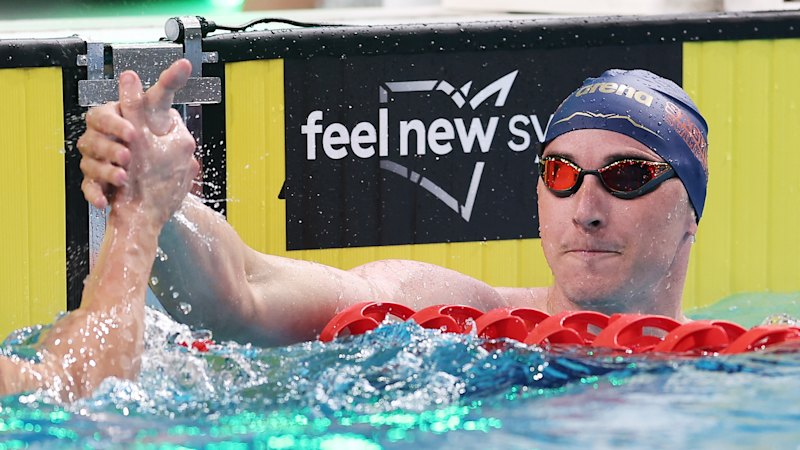
Australian swimming star Cam McEvoy has laughed off the performances at last month’s Enhanced Games but admits he is concerned about an erosion of public confidence in clean sport after athletes using drugs failed to break world records.
Athletes competed for large sums of prizemoney in swimming, athletics and weightlifting at the inaugural Enhanced Games in Las Vegas while openly taking banned substances such as peptides and testosterone.
Enhanced Games organisers claimed Greek swimmer Kristian Gkolomeev “broke” McEvoy’s world record when he clocked 20.81 seconds in the 50m freestyle, earning a $US1 million ($1.4 million) bonus on top of two $US250,000 race victories for a total payday of $US1.5 million for 67 seconds of racing.
McEvoy’s former Australian teammate James Magnussen finished last in the 50m and 100m freestyle races at the Enhanced Games. The 35-year-old’s 50m time of 22.35s in Vegas would have also left him in last place in Wednesday night’s 50m freestyle final at the Australian swimming trials, well behind McEvoy (21.32) in first place.
Jamie Jack, brother of Olympian Shayna Jack, qualified for his first Australian team with a second place finish in 21.52, ahead of Flynn Southam (21.72) in third. It came as 18-year-old Sydneysider Ollie Moclair (21.79), Ben Armbruster (21.80), Isaac Cooper (21.90) and Tom Nowakowski (22.06) all posted faster times than Magnussen.
“Not too bad. I wanted a little faster,” McEvoy said of his result. “Commonwealth Games is the plan for peaking.
“[Australia’s depth] is crazy. It’s a pretty exciting landscape. I think by Brisbane our 50s are going to be a powerhouse.”
Jack said he burst into tears after FaceTiming his sister, who was resting at a nearby hotel ahead of her 50m and 100m freestyle races this week.
“I just started bawling my eyes [out],” Jack said. “I wasn’t sure when I was going to cry, but I knew it would be some time tonight. She just said how proud she is of me.”
The Enhanced Games attracted widespread ridicule, with critics pointing out Gkolomeev was the only athlete to swim faster than an official world record despite having performance-enhancing substances in his system and wearing a banned supersuit that provided a significant advantage.
The money on offer would have been a bitter pill to swallow for McEvoy, who lowered the official 50m freestyle world record to 20.88s in March as a clean athlete.
“It’s like someone putting fins [flippers] on and doing a 50 freestyle,” McEvoy said on day three of the trials for the Commonwealth Games and Pan Pacific Championships. “It’s an exhibition swim, very much outside the scope that is regular sport. It is marketing, so to speak.
“Across the sports, they didn’t have the top people there. It brought in a lot of views, it dominated the algorithm for a little bit of time, but largely the world of sport will move on. It is what it is.
“They shifted the way they portrayed it halfway through the competition. It went from world records to PBs [personal bests].
“I’ve just been trying to lock into what I’ve been doing.”
What frustrates McEvoy most is the suggestion that because multiple world records were not broken, clean athletes competing under anti-doping rules might not be playing by the rules.
“One thing I am disappointed in is that there was a lot of erosion of public confidence in the response to the Enhanced results when people outside of sport … make conclusions like, oh, they didn’t break the records. It’s a lot more nuanced than that,” he said.
“I think that erosion of the public confidence in clean sport … has been really disappointing to see.”
McEvoy, the reigning Olympic and world champion, has beaten Gkolomeev and Ben Proud, who also swam at the Enhanced Games, on multiple occasions in recent years.
Asked whether he would have eclipsed Gkolomeev’s 20.81s had he been allowed to wear a supersuit, McEvoy laughed.
“I’ve done a 25 [metre race] with that suit [in practice] and it was significantly faster with the suit than without,” he said. “I was too young and tiny to wear them in 2009 [before they were banned], but yeah, I’ll leave it at that.”
The Enhanced Games have also reignited debate about athlete compensation, particularly after IOC president Kirsty Coventry reiterated her view that it was not the organisation’s role to pay prizemoney at the Olympics.
“I don’t believe in paying athletes prizemoney at the Olympic Games, as this would benefit only a very small number of athletes,” Coventry said last month. “I do believe our role as the IOC is to find ways to directly support a large number of athletes on their journey to becoming Olympians.”
In a social media response to Coventry’s comments, McEvoy suggested a model featuring a $10,000 appearance fee and medal bonuses of $100,000, $60,000 and $25,000 for gold, silver and bronze.
“That would be around $180 million, which is only 1.5 per cent of the quadrennial revenue [$12 billion] the IOC generates,” McEvoy wrote.
The four-time Olympian hopes the discussion continues.
“I think it was definitely a silver lining that the conversation [is now in the public domain],” McEvoy said.
“It definitely opened up potential pathways of opportunity for things like the Olympics and Olympic sports in general to maybe have better pathways to earn more revenue or something like that. I hope that momentum doesn’t fizzle away. The timing of certain comments wasn’t exactly the best.”
Meanwhile, Sam Short pulled off one of the swims of his career by breaking his Australian record in the 800m freestyle and becoming the fastest man in a textile suit and third fastest in history.
His time of 7:36.73 was an improvement on his 7:37.76 from the 2023 world championships when he picked up a silver medal. Wednesday night’s effort was fast enough to win gold at the Paris Olympics and 2025 world championships, both events which Short was affected by illness during or in the lead-up.
The world record of 7:32.12 is held by China’s Lin Zhang but was in a supersuit.
“That 7:32 is arguably the most untouchable world record,” Short said.
News, results and expert analysis from the weekend of sport sent every Monday. Sign up for our Sport newsletter.
 Tom Decent is the chief sports writer for The Sydney Morning Herald.Connect via X or email.