
When a celebrated British actor asked three eminent Australians why their country produced so many successes in theatre and film, one word stood out.
“Grit,” said Suzie Miller, the playwright, whose Prima Facie was a global sensation and whose Inter Alia is a box office smash in London.
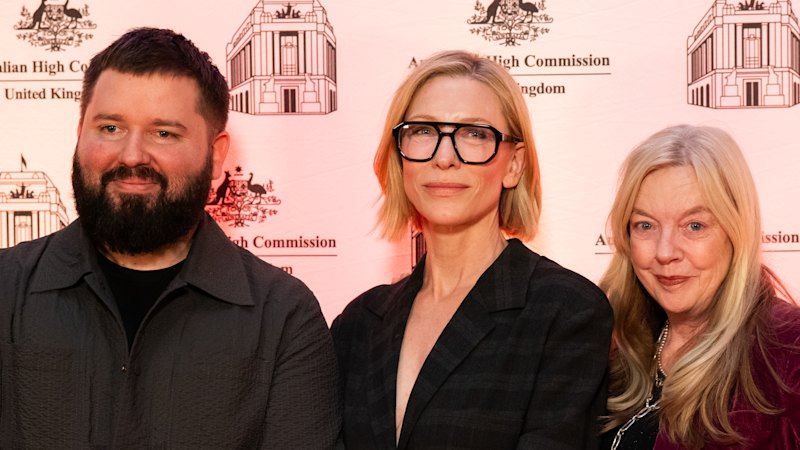
Miller was speaking alongside actress Cate Blanchett and director Kip Williams at the Australian High Commission in London on Friday night, where they shared their love of theatre and their tales of finding work far from home.
The host of the panel conversation, David Harewood, president of the Royal Academy of Dramatic Art, said he was stunned at the long list of Australians who had achieved so much overseas.
“Sometimes you can see clearer from the margins,” said Blanchett, when she reflected on her early years of trying to succeed from a distant country.
When she arrived in London, she said, she felt she had to overcome a kind of handicap because of the way she spoke and the country she was from.
“I was tolerated culturally, and it was brutal,” she said. “I mean, I still worked, but I worked hard. I thought, I’m going to have to prove myself because I’m not necessarily invited to the table. I’m from the colonies.
“There’s many people, Australians in the room, who would have felt the same.”
The discussion was held at Australia House – an ornate building on The Strand that has a side hussle as a backdrop in films including the Harry Potter series – to mark another milestone in Australia’s ascent of the London stage.
Blanchett is nominated for best actress in British theatre’s annual Olivier Awards on Sunday night, for playing Arkadina in Chekhov’s The Seagull, while Miller is nominated for best new play with Inter Alia.
Williams was feted at the Oliviers two years ago when his play The Picture of Dorian Gray won two awards, including best actress for Sarah Snook.
Hosted by Australian High Commissioner Jay Weatherill, the event was also a partnership between RADA and its Australian counterpart, the National Institute of Dramatic Arts in Sydney. Blanchett, Miller and Williams are all NIDA graduates; its chief executive, Liz Hughes, gave the vote of thanks after they spoke.
Miller summed up why Australia seemed to be over-represented in world theatre in terms of its size.
“I sometimes think it’s down to, kind of, old-fashioned grit. It’s hard to live in Australia. It’s hot, it’s difficult, you’ve got to fight for yourself a bit,” she said.
“But I think that is the skill set that you need in this industry. You have to get down and do the work.”
All three shared their thoughts on the high-wire act of theatre. Williams described rehearsals as a combination of “thrill and terror” because every day was a leap of faith. When things went well, said Miller, her overwhelming feeling was relief.
Blanchett suggested public debate could learn from some of the raw honesty of a rehearsal.
“What I love about theatre in rehearsal rooms – and we don’t actually find it in everyday life very often – is that kindness is not a way of evading a problem, and oftentimes you can’t,” she said.
“You have to be brutal with one another, and respectful. And that atmosphere exists in rehearsal rooms, and I wish it existed more in public life, where we can have brutally honest ‘come to Jesus’ conversations without the Jesus bit.”
After the pandemic, Williams said, the theatre industry needed to work even harder to bring people back to live performance following several years when people had to stay at home.
“It really forced you, as theatre makers, to consider why you’re asking an audience to come into a theatre,” he said.
The answer, he said, was to create an experience that audiences cannot get on Netflix or TikTok. Although he did not say this, he has clearly taken this approach with The Picture of Dorian Gray and his latest production, Dracula, which is now being staged in London with Cynthia Erivo playing all 23 roles.
Miller summed up the reason that theatre can still electrify an audience in a world when it is easy to stay at home or watch a mobile phone screen.
“We’ve been gathering around fireplaces for the whole of civilisation – well, before that even – and telling stories as a way to make sense of our world,” she said.
“And, actually, when you take the fireplace and the assembly away, we lose something, we lose something very, very human.
“Getting that back has actually been something that people have come back to the theatre for – because they appreciate that now.”
On that concluding theme, those in the room did something else people in London have been doing for the whole of their civilisation. They chatted over drinks.
Get a note directly from our foreign correspondents on what’s making headlines around the world. Sign up for our weekly What in the World newsletter.
 David Crowe is Europe correspondent for The Sydney Morning Herald and The Age.Connect via X or email.