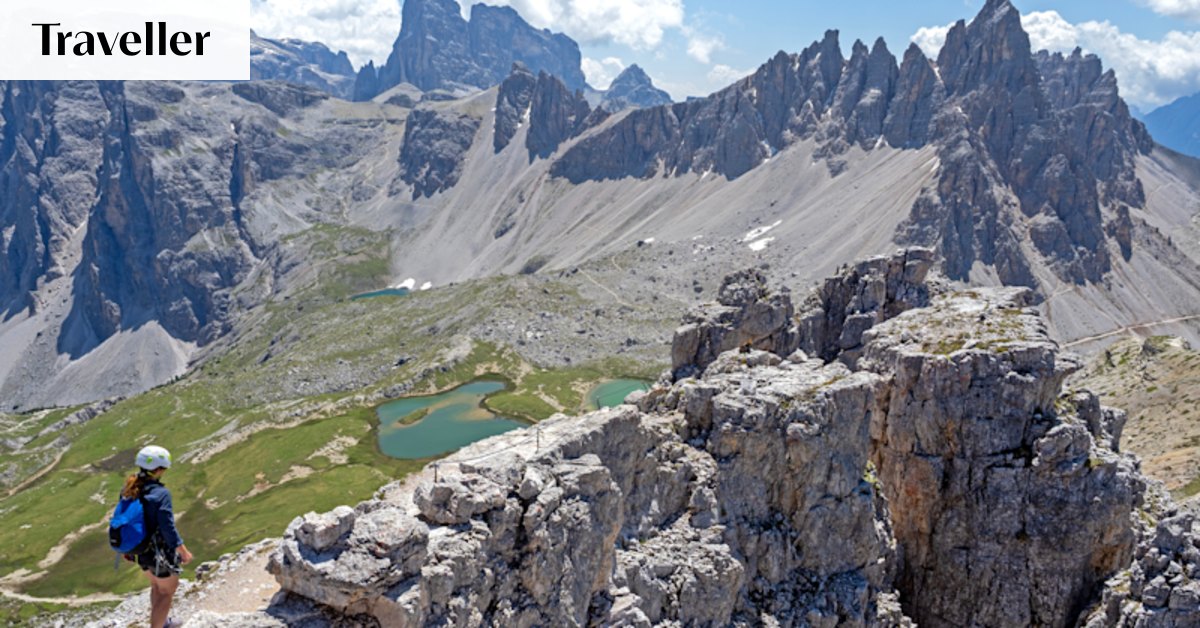

On the cliffs of the Dolomites, perception can be far from reality. High on a rocky peak near the famous Tre Cime di Lavaredo mountain, I’m hanging from a cliff, my toes balanced on a thin metal rung, with nothing beneath me but air. Looking down provokes tiny moments of terror, and yet I’m about as safe as when seated in a meadow below.
Though I appear to be rock climbing, I’m stuck to the rock as strongly as lichen on one of around 600 via ferrata (iron path) routes that lace these northern Italian mountains. These protected routes, which use fixed equipment such as ladders, wire bridges, iron rungs and cables bolted to the cliffs, are now found on mountains across the world – Australia’s first via ferrata opened on Mount Buller in 2023 – but they originated in the Dolomites during World War I to help move troops across otherwise inaccessible terrain.
I’ve come to the Dolomites for a week to explore this elevated world. My base is the Val Gardena, a valley best known as a ski centre but also the perfect primer to via ferrata.
Around the valley’s slopes are nine via ferrata routes, from one of the easiest in the Dolomites to cliff epics. It’s on the former – the Gran Cir – that I begin.
Sign up for the Traveller Deals newsletter
Get exclusive travel deals delivered straight to your inbox. Sign up now.
This rocky peak is just a few minutes’ walk from the top of the Dantercepies cable car. At the head of a scree gully, I step into my harness and begin to ascend the mountain on a narrow ledge. A metal cable runs along the cliff beside me, and my harness is equipped with two lanyards with carabiners, which I clip to the cable.
This day, only about half the people on the Gran Cir are even equipped with gear, such is the route’s ease. Visually, it appears intimidating – a giant molar of rock – but it’s little more than a glorified scramble and a chance to trial via ferrata techniques and build confidence.
Standing almost beside the Gran Cir is my next via ferrata goal, the Piccolo Cir. Though its name implies ‘small’, it’s a step up in challenge and exposure from the ‘big’ Cir.
Despite that, it’s a popular route, one on which even novices choose to test themselves, and soon I’m in the most unlikely of queues, hanging from a rock face. The delays aren’t unwelcome, providing a chance to pause and take in the scenery – the mighty Sassolungo, the mountain that dominates the Val Gardena; the sharp-tipped Odles peaks; and the vast drop between my legs – as I climb to the armchair-sized summit.
There are other via ferratas in the Val Gardena, including a climb that ends beside the balcony deck of a refuge restaurant atop the Col Rodella, but it’s the Tre Cime di Lavaredo, the Dolomites’ most famous mountain, that calls.
While the Tre Cime itself has no via ferratas, the neighbouring Torre di Toblin does. In World War I, this imposing peak, like the turret of a castle, was used as a guard post by Austrian soldiers watching over the alpine plain below for enemy troops. A wartime cave bunker marks the start of the climb, and another will be passed on the descent.
My climbing partner is a former mountaineer and rock climber, and as she begins her way up the cliff, I’m waiting to hear comforting words about its ease.
“This is proper climbing,” she calls instead, and my heart sinks. But up I head behind her. The first 20 metres is the most complex of all, hunting for holds in the rock, but beyond here the climb settles into a long series of metal ladders, iron rungs and cracks in the cliff.
At times, the ladders lean beyond 90 degrees, my backside seemingly hovering over oblivion. But slowly, rung by rung, rock by rock, I ascend towards the summit. Finally, I step over an edge and I’m atop the Torre di Toblin, with the abstract peaks of the Dolomites arrayed around me.
The views of the Tre Cime, from Locatelli Refuge and the Forcella Lavaredo below me, are probably the most famous in the Dolomites, and yet this view is each of them magnified, staring face to face at the Tre Cime rather than up onto them.
Now I just have to get down.
THE DETAILS
Fly
The nearest major airport to the Dolomites is Venice. Emirates flies to Venice from Melbourne and Sydney, transiting in Dubai. See emirates.com
Climb
The Val Gardena tourism board publishes an e-book guide to the via ferratas around the valley. Hire equipment is available through Intersport in the Val Gardena. See valgardena.it, valgardenasport.com
The writer travelled at his own expense.
 Andrew Bain is a Hobart-based writer and author who has been writing about travel and adventure for more than 25 years, and is most at home in the outdoors and remote places.