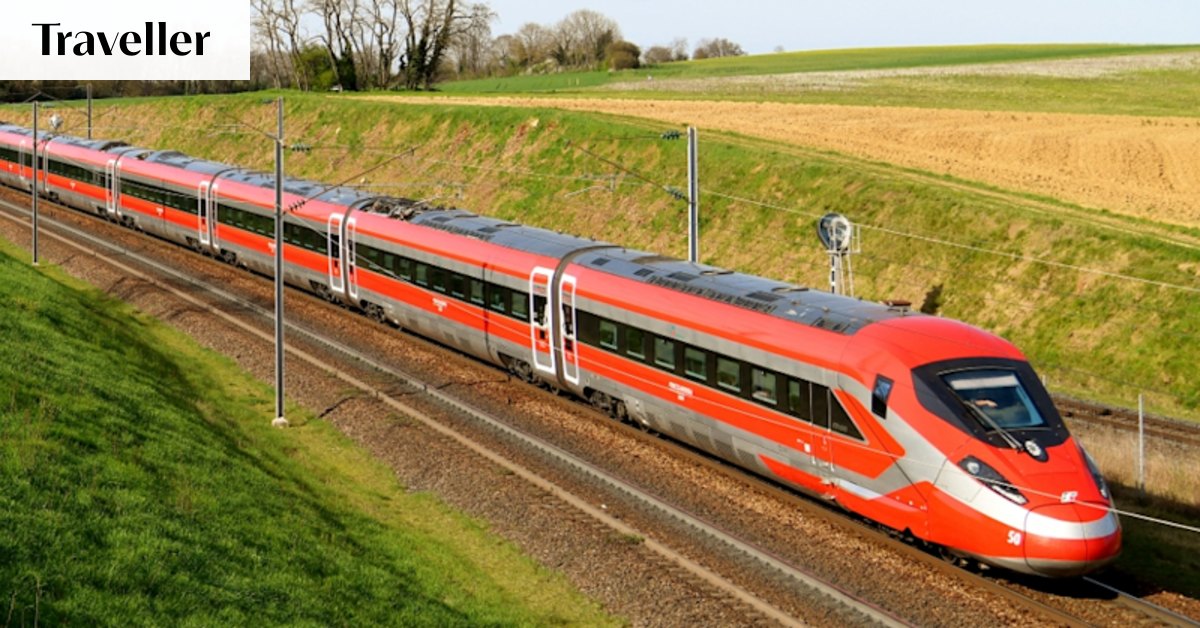

The train: Frecciarossa, Paris to Marseille
- Distance 775 kilometres
- Operator Trenitalia
- Class Business class
- Frequency Four times a day
In 2020, when French national rail operator SNCF lost its monopoly on French train lines, Italy wasted no time getting in on the action, launching a high-speed service between Milan and Paris the following year. New routes including Paris-Lyon have since been introduced.
In June 2025, the first Frecciarossa high-speed rail service began on the classic capital to coast route between Paris and Marseille. The move reflects Italian national operator Trenitalia’s intention to provide serious competition to the TGV on its home turf.
With a scheduled time of three hours and 21 minutes, the Frecciarossa journey is 15 minutes longer than the TGV inOui service leaving a quarter of an hour earlier from the same station – Gare de Lyon. That’s probably down to top speeds: the TGV is capped at 320km/h, while the Frecciarossa (Italian for red arrow) is capped at 300km/h.
Sign up for the Traveller newsletter
The latest travel news, tips and inspiration delivered to your inbox. Sign up now.
The trip passes by in a blur of bucolic French countryside shrouded in a mist of autumn colours and, whereas the aforementioned TGV service is delayed by 40 minutes, the Italians smugly pull into Marseille Saint-Charles station on the dot.
The seat
Here’s where the Frecciarossa offer becomes really interesting. Passengers can choose between three classes as opposed to TGV inOui’s two (standard and first) and TGV Ouigo’s one-class-fits-all budget ethos. The three classes are standard, business and executive. The standard and business class fares are about 10 to 20 per cent cheaper than the French inOui equivalent (for instance, $80 compared to $120 in standard, and $140 compared to $182 for business/first).
I’m in business – what would be first class on the TGV – and have scored the holy grail of single traveller train seats: a solo window. Part of me wishes I’d splurged on the “executive class”, an exclusive carriage of just 10 seats ($322). Like at the pointy end of the plane, the door is closed early to this last carriage. Behind it, the crew is preparing to serve a complimentary menu designed by chef Carlo Cracco, who helms the Michelin one-star Ristorante Cracco in Milan, paired with Italian wines.
Boarding
What do you get when you mix French and Italian travel infrastructure? Chaos, more often than not. Today is no different as a large huddle of passengers spills across the concourse waiting for a platform announcement that is failing to materialise as the clock ticks down to our scheduled departure. We are finally told where to go with 11 minutes to spare — and, with the electronic boarding gates out of action, there are just two conductors controlling every ticket. Despite this inauspicious start, the train manages to pull out of the station on time.
Baggage
Passengers are permitted to bring two suitcases and one item of hand luggage on board. Sports equipment such as bicycles count for one piece of baggage. There’s little by way of surprise on the storage front: racks above the seat and shelves at the entrance to the carriage. There’s a dedicated storage area for oversized baggage in cars two, three and four.
Food + drink
I might not be one of the lucky 10 in executive class, but a trolley service comes around minutes into the journey proffering a welcome snack, included in my business class fare. There is much more than a bag of peanuts – I’m laden with a glass of Italian wine, a bottle of water, a salami and cheese focaccia and something sweet for dessert. The train attendants pass two more times during the journey with coffee. Those in standard class don’t receive free treats, although carriage three is a bar car selling snacks and hot meals. There’s no eating area, so everything needs to be taken back to your seat.
One more thing
It would be too much to ask, of course, to be able to book this on SNCF Connect (sncf-connect.com), France’s default train ticket website. Instead, you’ll have to book directly on the trenitalia.fr website or via Trainline (thetrainline.com).
The verdict
Despite none of the announcements being in Italian (they are in French and English instead), the Frecciarossa is a delightful touch of Italy without setting foot in the country – and a worthy challenger to the TGV. It’s also another reminder of the quality of rail travel in France. If you’re travelling from Paris to the Mediterranean coast, why would you fly when you can catch a fast train?
Our rating out of five
★★★★½
The writer was a guest of Trenitalia.