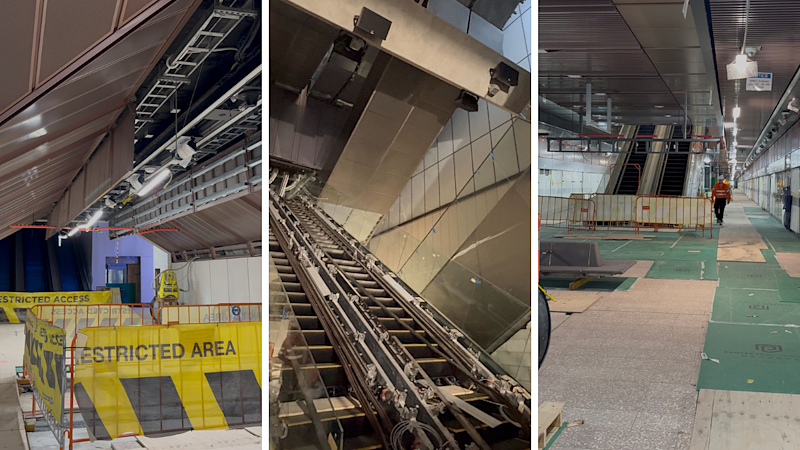

During budget hearings this year, Newton blamed the delays on a range of factors, including 148 days of industrial action taken by workers in 2024.
On Saturday, Newton said the project was “well past halfway” complete as the year neared its end, and said the delivery authority had largely completed construction across the four CBD stations.
“There’s been a lot of work happening through effectively keyhole surgery at the ground level [and] below ground,” Newton said.
“This next 12 months, we’ll see a lot of the construction work and the architectural [works] done.
“Meanwhile, we’re planning for the next phase which is the testing and commissioning, and it’s a very complex project, with a lot of moving parts.”
Newton said above-ground elements, including the Albert Street “green spine”, a pedestrian plaza spanning between Elizabeth and Mary streets, through the inner-city.
Cross River Rail Delivery Authority chief executive Graeme Newton.Credit: Catherine Strohfeldt
“Significant progress has been made – there are already sections of it have already been opened up,” he said.
“In the early part of next year we’ll see the first section open up down to Charlotte Street, and then the next section will open up progressively as it is made safe for pedestrians to move through.”
Newton said parts of Brisbane CBD near the green spine would be roped off across December and into January to enable more intensive works on the street level, and said train travel would also be restricted.
Loading
“This is really the best time of year to do it … we’re relocating tracks, signals, overhead lines – that work just can’t be done with trains moving across it,” he said.
CRR’s general manager of communications Russell Vine said the spacious design of the tunnel and stations will create “a giant underground boulevard” and avoid the claustrophobia of a lot of underground infrastructure.
“It allows the stations [to be] really generous with space, so sometimes you go in underground stations and they feel quite enclosed,” he said.
“If you go to say the Elizabeth line in London, or if you go to the new metro line in Sydney, or if you go to Melbourne, quite curvy, here we’re really angular and great, and that’s because the architect who designed the stations wanted it to be an homage to the verandah of a Queenslander house.”
Start the day with a summary of the day’s most important and interesting stories, analysis and insights. Sign up for our Morning Edition newsletter.