
I say I do not believe in God, yet as I age, I take great joy in Pascha (Passover, or Pecha), Eastern Orthodox Easter. Jesus rises twice in our house — last week as a Catholic, this Saturday at midnight as Orthodox.
“It’s not just you guys that have Easter,” my wife said on Friday, digging at our Greek superiority complex. But we know that really, we’re the first. (Saul, or Paul, had to write to the Corinthians, Thessalonians and Ephesians – if the Greeks didn’t take up the new creed, a kind of Judaism-lite for gentiles, the Romans never would have.)
In Spain, they eat potaje – chickpea and bacalao (codfish) soup – followed by torrijas – Spanish-style French toast. My late communist father had no time for the church: “tools of the state. They always side with power,” he’d say. Yet, Pascha mattered even for him. His name, Anastasios, means resurrection, and Easter Sunday is his name day.
“Jesus was a radical rabbi socialist and fought against Rome … don’t listen to your grandmother, the Romans killed him, not the Jews,” my father would say. My mother took the late 1960s “love is all” view. “Jesus was like John Lennon.” As a kid, I associated Lennon and Lenin with Jesus.
My parents, as children, lived through the Nazis’ carnival of horror in Greece, and then as teens, the bloody fratricide of the Greek Civil War. “Where was God when the Nazis burned churches filled with civilians, or when the royalists hung partisans … the dead were Jesus,” my father would say loud enough for my grandmother to hear. She called him “Atheos”. My grandma sought to protect my sister and me from his “bad ideas”.
Later, as a young adult, I’d remind my father how Archbishop Damaskinos saved thousands of Greek Jews by Christianising them. The SS-Oberführer Jürgen Stroop threatened him with a firing squad. Damaskinos replied, “It is traditional to hang clerics in the Greek church.” The Nazis left in a rage. “Oh well, one good priest …” my father would say.
As a kid, the 40 days of fasting – no meat, milk, butter, some fish, and by Holy Week, no animal products – killed me. “What … no Coco Pops!” I’d freak. Mum secretly fed me milk and Coco Pops in the morning. I could have wasted away as a chubby kid in early 1970s Adelaide if not for her. I try to fast for Greek Holy Week.
On “Megali Pempti” or Big Thursday, I dye eggs red. On Saturday, my son and I attend Anastasi, resurrection. We arrive at 11.45pm, armed with candles – lambathes wrapped in foil – to receive the “holy light”. We join in a Byzantine chant, Christos Anesti (“Christ has risen”). My son, Anastasios, in my mind my father’s resurrection, never met him; my father died at 62.
Residents complain about the noise, traffic, and all the “weird wog shit”, as someone once shouted. I do all this so my son knows our faith is about identity. We Greek Orthodox are tethered to something ancient, intangible and unique.
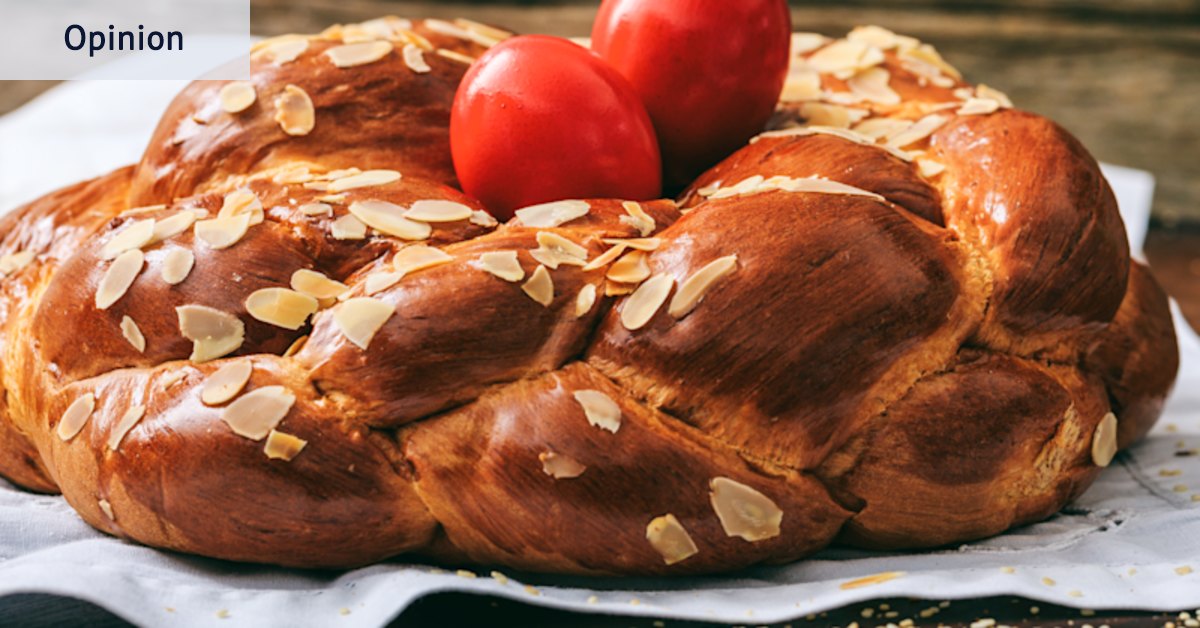
After church, we head to someone’s house, family and friends, to break the fast. We eat avgolemono soup – egg and lemon soup – compete at breaking red-dyed eggs, and enjoy wine, halva, koulouria, and tsoureki – sweet bread with mahlab, like Jewish challah.
On Easter Sunday, smoke from charcoal spits climbs from backyards across Melbourne as Greeks feast on Pascha. Thankfully, the slaughter of lambs, also a Passover tradition, happens in distant abattoirs. I was 13 when my uncle, Harry, brought home a lamb for Easter. The cousins and I called him Lamby. One day in Holy Week, Lamby disappeared. He had to “go back to the farm”, my uncle said. We then realised Lamby was turning over charcoal on a spit for Easter.
Why does an atheist do this? Ethnicity? History? Tradition? Family? In part. But more to tear at the fabric of contemporary life. Orthodox Easter, be it Greek, Lebanese, Ethiopian, or Serbian, is an otherworldly experience. Cantors sing Byzantine melismatic chants that meld with Eastern incense. We are all in a church unchanged for 2000 years. Whether in Jerusalem, Athens, Addis Ababa, Istanbul, or Melbourne, our church remains a liminal space, time-out-of-time, linking us all.
Fotis Kapetopoulos is a journalist for the English edition of Neos Kosmos, a leading Greek-Australian masthead.
Get fascinating insights and explanations on the world’s most perplexing topics. Sign up for our weekly Explainer newsletter.
 Fotis Kapetopoulos is a journalist for the English edition of Neos Kosmos, a leading Greek-Australian masthead.