
Vildana Hajric and Matthew Burgess
Updated ,first published
Australian investors are bracing for another turbulent session as the US war in Iran enters a fourth week with no signs of easing.
President Donald Trump issued a 48-hour ultimatum to Tehran on Sunday to reopen the Strait of Hormuz or face strikes on its power plants, a deadline that expires Monday evening in New York.
But Iran responded that any such attack would prompt it to shut the waterway indefinitely and target US and Israeli energy infrastructure across the region, signalling that both sides are at risk of escalating the conflict.
The Australian sharemarket is set to fall, with futures on Saturday pointing to a loss of 156 points, or 1.8 per cent, at the open, but these were set before Trump’s latest escalation. The Australian dollar was trading at US70.10¢ at 9.22am AEDT.
Trading in US equity futures, Treasuries and crude resumes Sunday evening (US time) after a week that saw stocks and bonds sell off in tandem, gold notch precipitous declines and Brent crude end at over $US112 a barrel, its highest in almost four years. Bitcoin also fell as investors pulled back from risk assets, with the cryptocurrency dropping below $US69,000 on Sunday.
“Pulling back on this war is not Trump’s sole decision,” Matt Maley, the chief market strategist at Miller Tabak, said in an interview. “Uncertainty has been increasing for three weeks and the uncertainty took a big jump now. Even if people don’t sell, they are not going to be buying — and if there’s no bids, it creates a vacuum.”
Another climb for oil prices shook stock markets, as hopes collapsed for a possible cut to interest rates this year by the Federal Reserve.
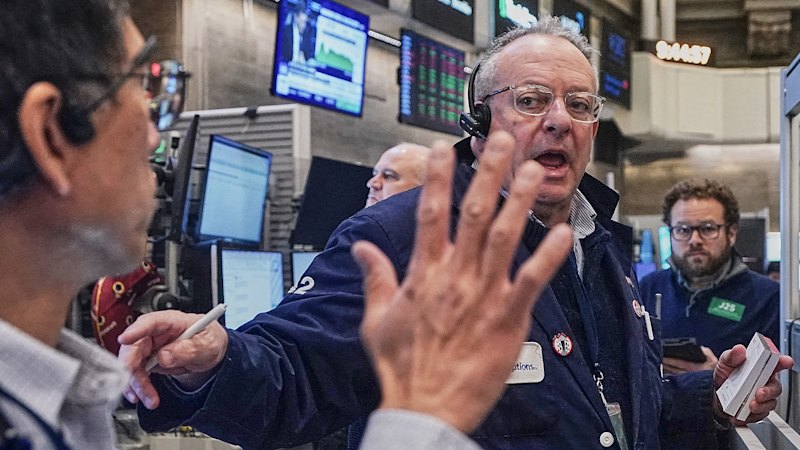
On Wall Street on Friday, the S&P 500 fell 1.5 per cent to close its fourth straight losing week, its longest such streak in a year. The Dow Jones dropped 443 points, or 1 per cent, and the Nasdaq composite tumbled 2 per cent.
The market’s losses deepened after oil prices erased an early dip and accelerated on Friday afternoon (Saturday AEDT). Brent crude, the international standard, rose 3.3 per cent to settle at $US112.19 per barrel. Benchmark US crude gained 2.3 per cent to $US98.32 per barrel. Oil prices are expected to rise again when trading resumes this morning.
Stocks also bent under the weight of leaping yields in the bond market. Higher yields make mortgage rates and other borrowing more expensive for US households and companies, slowing the economy, and they grind down on prices for all kinds of investments. Treasury yields have been jumping on worries the war with Iran will cause a long-term spike in oil and natural gas prices that drives up inflation.
Worries have gotten so high that traders have cancelled nearly all their bets that the Federal Reserve could cut interest rates this year, according to data from CME Group. Some even think the Fed could raise rates in 2026, a nearly unthinkable scenario before the war began.
“I think it would be market shaking,” Ann Miletti, head of equity investments at Allspring Global Investments, said about a rate hike. But she also said that if oil prices stay high for a long time, they would likely drag so much on the economy that the Fed would not raise rates.
Lower interest rates would give the economy and investment prices a boost, and they’re something President Donald Trump has angrily been calling for. Before the war, traders were betting heavily that the Fed would cut rates at least twice this year.
But lower rates risk worsening inflation. And investors now see little room for central banks worldwide to cut interest rates to help their economies. Besides the Federal Reserve, central banks in Europe, Japan and the United Kingdom also held their interest rates steady this past week.
The price of Brent crude has zigzagged sharply on its way from roughly $US70 per barrel before the war began to as high as $US119.50 this week. Big swings have struck hour to hour as financial markets try to handicap how long the war will last and how much damage it will do to oil and gas production in the Persian Gulf.
The US stock market has a history of bouncing back relatively quickly from past conflicts in the Middle East and elsewhere, as long as oil prices don’t stay too high for too long. Oil prices aren’t at a red-flag point yet, Miletti said, but “we’re getting close if the duration is long enough.”
“If three months from now, we’re in a similar situation, not only myself but a lot of other investors will be much more cautious,” she said.
On Wall Street, Super Micro Computer lost a third of its value and tumbled 33.3 per cent to help drag the US stock market lower. The US government accused a senior vice president of the company and two others affiliated with it of conspiring to smuggle billions of dollars of computer servers containing advanced Nvidia chips to China.
The company said it has been cooperating with the investigation and is not a defendant in the indictment. It placed its two accused employees on administrative leave and terminated its relationship with an accused contractor.
Roughly three out of every four stocks in the S&P 500 fell. Stocks of smaller companies, which can feel the pinch of higher interest rates more than their bigger rivals, led the way lower. The Russell 2000 index of smaller stocks fell a market-leading 2.3 per cent.
When bonds are paying more in interest, they make other investments less attractive in comparison. That’s particularly the case for things like gold, which pay their investors nothing at all. Gold’s price finished the week at $US4,574.90 per ounce, hurting its reputation as a safe place for money during uncertain times. Earlier this year, gold was setting records and briefly topped $US5,400 per ounce.
AP
The Market Recap newsletter is a wrap of the day’s trading. Get it each weekday afternoon.