
A rare super El Nino could form later this year, which could result in “globally catastrophic” extreme weather and a spike in global temperatures lasting into 2027.
An El Nino typically associated with a hot, dry spring for Australia is likely to form towards the end of winter, international forecasting agencies suggest.
European models suggest a 20-25 per cent chance of it being an intense event, known as a super or very strong El Nino, which has only occurred three times since 1980 and each time was followed by a year of record-breaking heat globally.
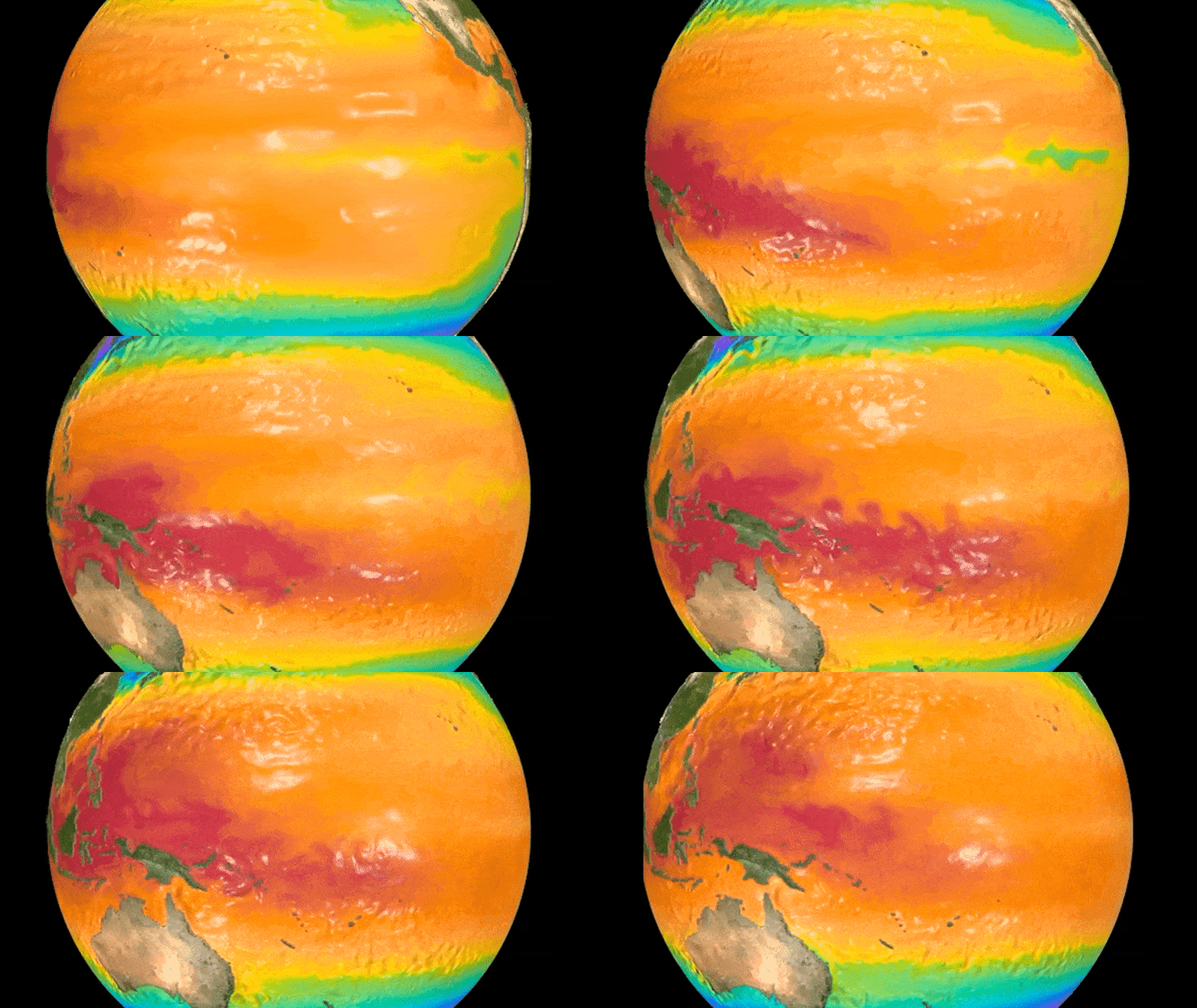
UNSW Scientia Professor Matthew England, a climate scientist specialising in oceanic modelling, said there was a significant anomaly of warm water moving to the eastern Pacific Ocean that could lead to a super El Nino, though it was not certain.
“It would be a globally catastrophic event if it’s a super El Nino because we know that those super El Ninos can bring horrendous flooding rains to Latin America, severe drought and bushfire to Australia, Indonesia, and parts of Asia, and it even teleconnects to Antarctica … and can lead to more rapid rates of ice shelf melt,” England said.
“It’s a global phenomenon, it’s extreme in magnitude in terms of how far it reaches, and the amount it changes our climate patterns, and it costs us deeply because there are disruptions to what we do, everything from fisheries to heat extremes to flooding, rains and drought.”
The European Centre for Medium-Range Weather Forecasts models give a 98 per cent chance of at least a moderate El Nino, an 80 per cent chance of a strong El Nino and a 20-25 per cent chance of a super El Nino.
The National Oceanic and Atmospheric Administration’s National Weather Service in the United States gives a 62 per cent chance of an El Nino forming in June to August and persisting until the end of 2026. It also gives one in three chance that the El Nino would be strong in the October to December period.
The predictions remain uncertain because of the “autumn predictability barrier”, which means that the climate system in the tropical Pacific is naturally less predictable in March and April. The forecast should firm up between late May and June, once the ocean and atmosphere begin to interact more strongly.
NOAA acknowledges the lower accuracy of forecasts at this time of year, but says the “increasing odds of El Nino are supported by the large amount of heat in the subsurface ocean and the expected weakening of the low-level trade winds”.
The El Nino-Southern Oscillation (ENSO) is a global climatic pattern based on the sea surface temperatures in the Pacific Ocean that shifts between an El Nino, neutral, and La Nina. In Australia, an El Nino usually brings hotter, drier conditions, while La Nina is associated with rain, though this pattern can be disrupted by other weather systems.
The Bureau of Meteorology defines a very strong El Nino, also known as a super El Nino, as an intense event where the sea surface temperature (SST) anomaly is more than 2.4 degrees and the southern oscillation index is more than 25. Globally, many forecasters define the intensity of El Nino based only on sea temperatures.
The BoM says the current La Nina is close to its end, but it does not yet have an ENSO prediction for later this year.
Since 1980 there have been three super El Ninos. The 1982-1983 El Nino was very strong based on both metrics, while the 1997-1998 and 2015-2016 El Ninos were very strong based on sea surface temperatures.
The 2015-2016 El Nino was the biggest yet, with the SST anomaly peaking at 3 degrees in November 2015. The previous record was 2.8 degrees SST anomaly in January 1983.
Each time, the year that followed the onset of the El Nino – 1983, 1998 and 2016 – smashed the record for the world’s hottest year in recorded history.
The current hottest year in history is 2024, which followed a moderate to strong El Nino year, and the past 11 years are the 11 hottest on record.
Australian National University professor of climate science Sarah Perkins-Kirkpatrick said La Nina stored heat in the oceans, while El Nino released it into the atmosphere. It could take a season or two for that heat transfer to occur, so it was often the following year that experienced record heat rather than the year the El Nino started.
The effect was on top of climate change, Perkins-Kirkpatrick said, and the approximately 1.5 degrees of atmospheric warming since pre-industrial times meant even cooler La Nina years were now hotter than average.
“If climate change didn’t exist, 2024 would have been a really hot year, but I couldn’t guarantee it would have been our hottest year on record,” Perkins-Kirkpatrick said. “It was actually weaker than the 1983 El Nino.”
England said atmospheric temperatures were variable from year to year, while ocean temperatures rose steadily. Many scientists looked at the ocean temperatures as the clearest signal since the oceans absorb 91 per cent of the heat from global warming, he said.
Get to the heart of what’s happening with climate change and the environment. Sign up for our fortnightly Environment newsletter.
 Caitlin Fitzsimmons is the environment and climate reporter for The Sydney Morning Herald. She was previously the social affairs reporter and the Money editor.Connect via email.