
When Navy veteran Luke McCallum broke protocol to lead the 2024 Anzac Day procession on the newly laid parade ground at the Australian War Memorial in Canberra, stepping out on his prosthetic leg ahead of the president of the ACT RSL, the moment was “transformative”.
Not only was it the first time the former IT specialist sailor had marched as an amputee, but the date marked 20 years since a suicide bombing in Iraq claimed the lives of three US servicemen who had been working closely with McCallum’s unit. That event is now commemorated in the memorial’s museum, the extensive – and divisive – renovation of which is the subject of a four-part SBS documentary, A New Anzac.
“Even within Defence and Navy, [that event] didn’t, even at the time, get much attention,” says McCallum, whose injuries were result of a training accident during his deployment. “I got quite bitter and angry about this for so long, but now that the memorial will have the story of that day, it will recognise the loss, and the ongoing impacts to those of us who were there.”
The $580 million upgrade to the memorial, ordered in 2018 by then-prime minster Scott Morrison, has attracted controversy since its inception, with the auditor-general in 2024 pinpointing issues regarding ministerial oversight and conflict of interest. The documentary instead focuses on the engineering aspects, and on the new exhibits. For McCallum, seeing some of the items on display from the 2004 Middle East tragedy take its place in the museum was a watershed moment.
“This was a significant event in the history of our service in the Middle East that’s finally going to be brought to the public,” says McCallum, who is now a bilateral amputee and multi-sport para-athlete. “It’s made it easier for me to be able to talk about it.”
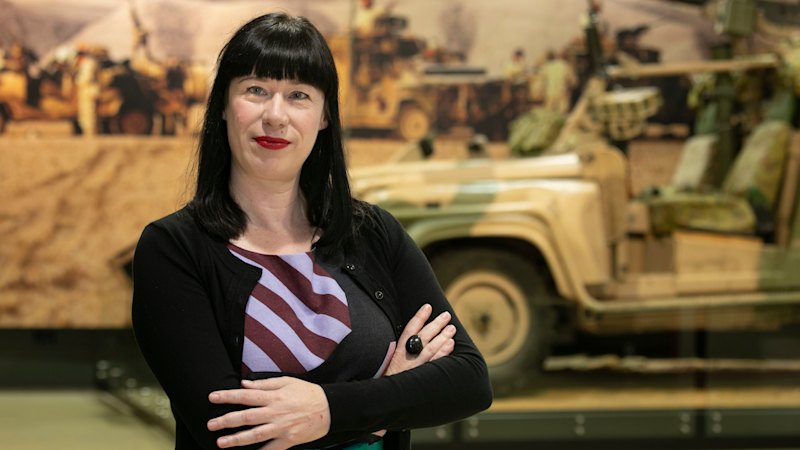
This is just one of the stories of Australia’s post-World War II defence and peacekeeping history that the memorial’s director of gallery development, Bliss Jensen, is proud to have curated.
“We’re looking to present multiple perspectives,” says Jensen. “Up front and centre is, of course, the impact of war on veterans. But the legacy of war is, for the first time, being explored throughout diaspora communities – those new Australians who have fled war where Australians have served.”
Some exhibits depicting refugees fleeing war zones in horrific conditions are extremely distressing. There is space given to the anti-war movement, with items and images from the 2003 “No War” Sydney Opera House protest featured. The gallery includes Army veteran Kat Rae’s winning 2024 Napier Waller Art Prize entry Deathmin, which is sculpture featuring a stack of papers pleading for help from the Department of Veteran Affairs, by her late Army veteran husband, Andrew.
Also in the gallery is war artist Peter Churcher’s painting of Navy veteran Emma Conway, which depicts the now decorated firefighter as the sole female mechanical technician, or “stoker”, in the engine room of the HMAS Kanimbla when the ship was deployed to the Persian Gulf in 2001.
“That girl [in the painting], has gone on a significant journey through life, and it was nice to be able to step back into that space and recognise that it made a difference,” says Conway. “At the time, you don’t consider what you’re doing as part of history. You’re just doing the work. But to have the stories of myself and my colleagues in the War Memorial, it’s actually a big deal.”
In the series, Conway refers to herself and her colleagues as “ordinary people”.
“None of us can achieve what we achieve by ourselves. I hope that [viewers] see us as people who’ve come together,” she says. “In any situation, in any circumstance, when Australian and New Zealand people come together, we can achieve amazing things. And it’s a reminder that, in the worst of times, we can be at our best. It’s happening every day. If we can show the people behind the stories, hopefully, people see that their decisions in their everyday world make a difference.”
 Bridget McManus is a television writer and critic for Green Guide. She was deputy editor of Green Guide from 2006 to 2010 and now also writes features and interviews for Life & Style in The Saturday Age and M magazine in The Sunday Age.