
Steven Spielberg’s 1982 film E.T. the Extra-Terrestrial is an enduring classic for many reasons: it used groundbreaking animatronics, had a banging John Williams score and featured flying bikes. But what truly helped it stand the test of time was its emotional core.
Elliott, a young boy in California, befriends an alien stranded on Earth. Instead of seeing the extraterrestrial like everybody else – as an otherworldly threat – Elliott sees a lost, misunderstood creature who needs help. For the adults watching, it’s a heartwarming tear-jerker. But for younger audiences, it’s much more.
“It’s 100 per cent teaching empathy. You really feel what the people on-screen are feeling, and you bring that into your life outside the cinema,” says Reece Goodwin, senior film and TV curator at the Australian Centre for the Moving Image (ACMI).
E.T. is one of many films that helps younger audiences better identify and understand feelings, both within themselves and others. This, in turn, strengthens their emotional intelligence – although many children wouldn’t know what emotional intelligence is, or why it’s such an important life skill. Meanwhile, an increasing number of parents consider any form of screen time the enemy.
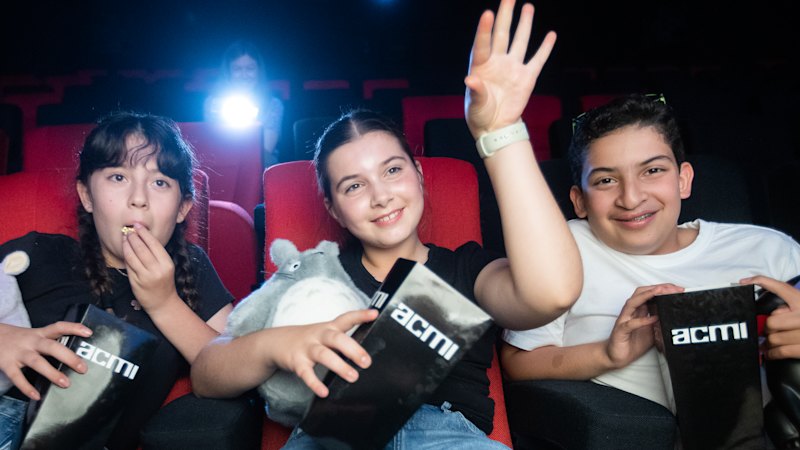
To combat this, ACMI launched Kids’ Flicks with Feelings, regular sessions in which children watch a carefully selected movie and then reflect on how it made them feel.
“Film is so important. It’s a unique way to follow somebody else’s experience that might be really different from ours for 90 minutes or two hours. You get to see the world through their eyes for that time and really experience what they’re feeling,” Goodwin says, adding the program’s audience has tripled between 2023 and 2025.
While emotional intelligence comes naturally to some children, Goodwin says others can build it over time. Film plays a vital role in this, as young audiences pick up on emotional cues, all of which can then be carried into their own lives and relationships.
For 12-year-old Florence Romstad-Contreras, Meet Me in St Louis (1944) introduced her to the feeling of frustration triggered by injustice. “When the father in the movie announces that the whole family is moving to New York – it feels so unfair,” she says.
In Coco, she discovered the nuance of grief, and the power of honouring passed loved ones through memory. “The song Recuerdame is lovely, and watching the elderly Coco sing it while thinking about her father is so sad! So many tears have been shed watching this movie.”
Goodwin points to Bridge to Terabithia, a film screened as part of Kids’ Flicks, which follows a young boy as he grapples with immense grief after the sudden death of his close friend. Not only does this movie help children better identify feelings of sorrow, Goodwin says, but it can also gently introduce them to the inevitability of loss.
“It might be the expression on their face, the tone of their voice. It could be the way they move their bodies. All of these things give us clues, and [our sessions] are challenging young audiences to be really active viewers,” Goodwin says.
Films build children’s emotional vocabulary, Goodwin adds, especially as they’re faced with more subtle or nuanced emotions they may not yet be able to articulate: anxiety, elation, isolation, melancholy. Inside Out 2 goes so far as to include a character called “Anxiety”, offering children a physical example of what the emotion could feel and look like.
Macy Varrall, an 11-year-old Kids’ Flicks attendee, says Inside Out taught her the difference between basic emotions, while the sequel canvassed emotions usually experienced with age.
“Now, if I experience an emotion, I picture who it was in the movie,” she says. “And now that I’m a bit older, I also like movies like High School Musical, Feel the Beat and The Kissing Booth … I feel like I’m the person in the movie sometimes. It’s like I’m going through everything with them.”
It’s generally easier for children to pick up on these emotional cues in film compared to other texts such as books, says Louise Paatsch, deputy director of Deakin’s Research for Educational Impact Centre. This is largely because of the interplay between the audio and visual elements in film – facial expressions pair with tones of voice or music. This multi-modal form of comprehension, Paatsch says, generally remains with them for longer.
Most children generally watch films in a safe, controlled environment, whether it’s a cinema or at home. The familiarity and safety of such spaces enables young audiences to explore uncomfortable or distressing emotions in a healthy, constructive way.
Take Jim Henson’s Labyrinth, another film screened as part of Kids’ Flicks. The goblin-heavy film is dark and disturbing – it’s centred on a baby abduction, after all – but children can safely process the fear it elicits, allowing them to see through to the bravery and self-confidence it also displays.
As beneficial as watching films can be for children’s EQ, Paatsch says post-viewing discussions are just as critical.
“Parents can help shape meaning around how children interpret the narrative; how they can interpret the character or the character’s emotions,” Paatsch says. “Young children are full of emotions, so if parents can scaffold their child’s understanding, it can help them with their own emotional regulation. It’s all about how you support them to understand this world they’ve just watched.”
This kind of co-viewing has also been shown to improve children’s socialisation and general wellbeing.
Screens are here to stay, so it’s more important for parents to focus on the context in which the screen is being used rather than time spent with it. After all, watching E.T. – a family-friendly film thoughtfully selected by ACMI that explores the value of empathising with those different from yourself – is ultimately more likely to benefit a young mind than harm it.
Kids’ Flicks with Feelings will run from April 6 to April 18 at ACMI, beginning with Cartoon Saloon’s The Secret of Kells.
Must-see movies, interviews and all the latest from the world of film delivered to your inbox. Sign up for our Screening Room newsletter.
 Nell Geraets is a Culture and Lifestyle reporter at The Age and The Sydney Morning Herald.Connect via X or email.