
“Was it worth it?”
It is the question that anchors – and unsettles – the new Afghanistan gallery at the Australian War Memorial, where the answers come not as resolution but as contradiction.
Veterans, Afghan civilians, families and interpreters of a 20-year war are all asked the same thing. The responses diverge sharply. Some speak of meaning, service and gains that endure; others question the premise entirely.
One mentions two generations of Afghan women being educated and being able to go to university. Another of the trauma of 20 years later replacing the Taliban with the Taliban.
Nothing in the room settles it.
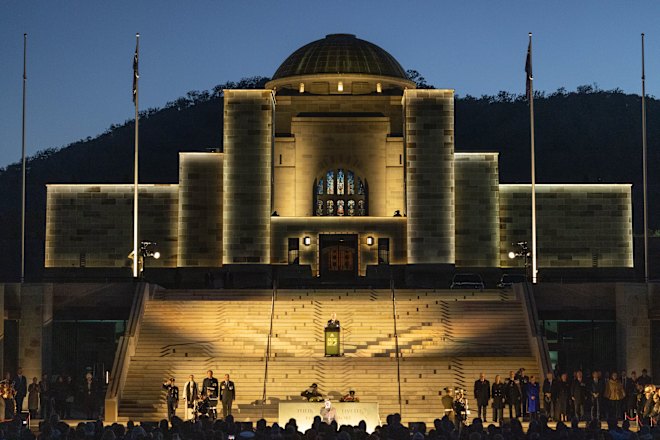
That tension – too much for some, not enough for others – runs through the new permanent exhibition inside the redeveloped museum, a major attempt to present Australia’s longest war without reducing it to a single, stable narrative.
For curators, the challenge has been less about what to include than how to hold it together at all.
Bliss Jensen, the memorial’s director of gallery development, says the project – part of a $550 million redevelopment of the building – was built around difficulty rather than certainty.
“We were very adamant from the beginning that we weren’t to shy away from telling difficult stories,” she says. “Our many audience surveys and advisory group feedback … all showed us there was a desire to see the difficult content, to be objective, to be balanced, but to go there.”
That impulse has produced a 900-square-metre gallery containing nearly 1400 objects, dozens of filmed testimonies and layered interpretations spanning Australia’s deployment from 2001 to 2021 – from the aftermath of September 11 to the evacuation of Kabul. Forty-one members of the Australian Defence Force died.
But even the ending resists finality.
“We started in 2019 and by 2021 we were all watching, quite horrified, from our lounge rooms in lockdown, the evacuation of Kabul,” Jensen says. “But the history of this conflict is still being written. We know that the story will evolve, and we’ve sort of planned some flexibility around the display.”
That uncertainty carries into the gallery’s most contested material.
The Inspector-General of the Australian Defence Force inquiry into war crime allegations committed by the ADF in Afghanistan between 2005 and 2016, known as the Brereton Report, is presented alongside operational artefacts, rules of engagement material and international humanitarian law.
A redacted page from the report is displayed openly, its blacked-out sections as visible as its text.
Nearby interpretation situates the findings within a broader account of service and its consequences.
“We are being open and honest about that, and we’re dealing with the facts,” Jensen says. “We’re also placing those allegations in the broader context.”
That “context” is doing heavy lifting in a gallery designed to avoid both sanitisation and reduction.
Alongside that is Reckoning, a series of photographic etchings by veteran, war widow, mother, advocate and artist Kat Rae responding to Brereton that layers redacted documents and figures in burqas, deliberately blurring and distorting imagery to reflect contested understandings of truth in war.
A large panel states from the report itself that “overwhelmingly, [those deployed] performed skilfully, effectively and courageously” and that there’s a long tail of consequential mental health issues, which continue to emerge.
Veteran testimony sits alongside Afghan accounts. Military operations are interwoven with civilian experience. Competing truths are held in the same space without reconciliation.
“There isn’t a homogenous voice for, you know, what Afghanistan service is,” Jensen says.
The memorial has deliberately resisted a single institutional framing. Instead, it leans into complexity, even when that produces discomfort.
Ben Roberts-Smith, the former SAS soldier who has been charged with five counts of war crime – murder over the alleged executions of Afghan detainees, is expected to be among the audience at the official opening next week. He denies the allegations.
Memorial officials understand the spotlight placed on the display.
“It’s going to be too much for some and absolutely not enough for others,” Jensen says.
That line has become, in effect, the gallery’s governing logic.
Expanded from a far smaller previous display, the new gallery assembles the nearly 1400 objects alongside 26 audiovisual touchpoints and more than 50 commissioned films, built to capture not just events but interpretation – how meaning shifts depending on who is telling the story.
Australian War Memorial director Matt Anderson, who served as Australia’s ambassador in Afghanistan, said the new gallery was a “first draft of history”.
“It tells our uniting story of service and sacrifice, through the experiences and the voices of the men and women who put themselves in harm’s way, in our uniform and in our name,” he says. “We must be terribly proud of them. I know I am.”
Jensen says it leaves the contradictions intact – a deliberate decision to reflect the reality that Australia’s longest war is still unsettled in memory, politics and public understanding.
Be the first to know when major news happens. Sign up for breaking news alerts on email or turn on notifications in the app.
 Rob Harris is the national correspondent for The Sydney Morning Herald and The Age based in Canberra. He is a former Europe correspondent.Connect via email.