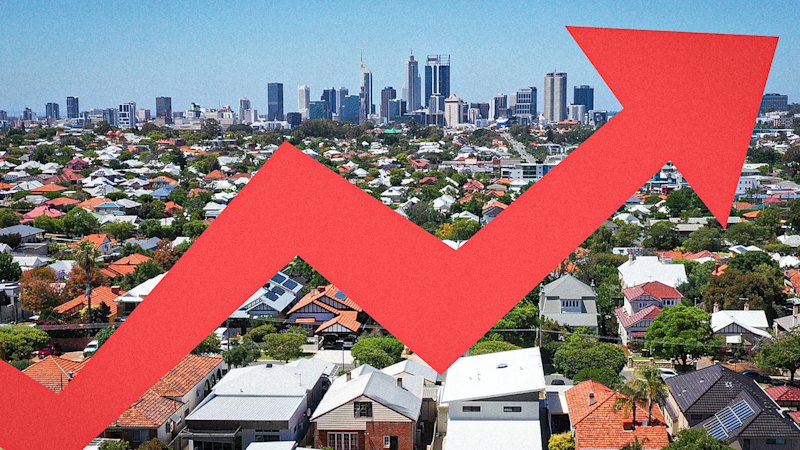
Perth tenants are now paying record prices for rentals this quarter with the median price for a house in Perth reaching $750 – $50 more than the same time last year, as the market cements itself as the third most expensive in the country.
WA residents are now paying $150 more per week than those seeking to rent a home in Melbourne, while units have also risen to a median price of $700 per week.
However, Domain’s latest Rent Report revealed on Thursday that despite the high prices across Western Australia, the market has risen significantly slower than other states.
Over the June quarter, Perth’s rents lifted by 0.4 per cent – the equivalent of $3 per week and the least amount of all Australian states. Sydney house rents led the pack, surging by 6.3 per cent ($50) to $850 per week, followed by Darwin which saw a rise of 5.6 per cent ($40) to $760 a week.
Melbourne is now the cheapest capital city to rent a typical house, with a median price of $600 a week having risen by 0.8 per cent over the same period.
The rises follow the federal budget’s negative gearing and capital gains tax concessions reforms, aimed at improving younger people’s chances of buying homes. Treasury modelling predicted an uptick in rents of $2 a week.
The budget failed to provide short-term relief for renters, with no new increase to Commonwealth Rent Assistance and support for 80,000 new rental homes over the next decade. Despite the budget grandfathering existing landlords’ negative gearing arrangements, investors are preparing to pay more tax on capital gains when they sell.
A spokesperson for federal housing minister Clare O’Neil said the government knows renters are doing it really tough at the moment in a very tight rental market.
“That’s why we’re making renting easier, fairer and more affordable with longer leases, stronger tenant protections and more help to pay the rent: increasing Commonwealth Rent Assistance by more than 50 per cent by delivering the first back-to-back increases in 30 years,” the spokesperson said.
“Our policies are increasing supply overall and will put downward pressure on rents over time but importantly, we want more renters to become home owners – and our tax changes will help 75,000 renters to do that.”
Domain chief residential economist Dr Nicola Powell attributed the slower rise in rent prices across Perth to tenants no longer being unable to absorb the high costs.
“Perth’s rental market is starting to show different rental conditions, and what’s very interesting is on the national basis we’ve seen a re-acceleration of rent growth, but that is not what we’re seeing in Perth,” Powell said.
“Perth is actually bucking that national trend, and we have still got rents rising, but over the most recent quarter they only nudged marginally higher.
“Rents are still at a record high, but the pace in which they are rising is now starting to slow down. And to contextualise that, for houses, it was the weakest June quarter that we’ve seen for six years.
“I think it’s demonstrating that probably tenants are reaching that affordability ceiling.”
Powell said while vacancy rates haven’t changed over the past year, it is still very much a “landlords’ market” across Perth.
House prices in Perth over the past five years have increased by 67 per cent, while units have seen a rise of 77 per cent.
Cotality Australia’s Head of Research Gerard Burg said data from the company’s Rental Review, also released on Thursday, shows the June quarter signalled a shift in property dynamics, with house rents outpacing unit growth.
Median house rents rose nationally by 1.7 per cent over the quarter, compared to a 1.2 per cent increase for units.
“This marks a significant slowdown for the unit sector, which had outpaced houses in the March quarter with a 2.5 per cent increase,” Burg said.
“Over the longer term, unit rents have grown faster than houses, rising 46.3 per cent over the past five years compared to 38.5 per cent for houses. This was largely driven by a post-pandemic recovery, particularly in Sydney and Melbourne.”
Of the suburbs in Perth that saw the highest house rental price growth over the past year, western and northern areas dominated the field.
Floreat house prices rose the most, increasing by 25 per cent over the past year to a median price of $1250, followed by Sorrento with a 22.2 per cent jump to median prices of $1100 and Doubleview which went up by 18.8 per cent to a median house price of $950.
Also in the top-10 suburbs that saw price growth over the last year was Iluka, 30km north-west of Perth.
House prices in the coastal suburb rose by 16.3 per cent to a median price of $1250 which local real estate agent Todd Utley said was a “long time coming”.
“The [prices have] probably just been sitting a little bit lower than what they should have been to start with,” he said.
“Quality single storeys are achieving $1500 per week for rent … and if you’ve got a classy double storey, you’re going to be accepting somewhere between $2000 and $2300 per week in rent.”
Utley added that homes were being snapped up mostly by immigrants new to WA.
“A lot of people who are migrating into Western Australia, looking to base in the area and buy in the area, rent in the area first,” he said.
“People coming from the UK and South Africa, they always have a strong family or friend network within the area, so they come and suss it out and rent there first, generally for 12 months before they buy.”
As for what attracts renters to the area, Utley said it’s the size of the properties and its location.
Suburbs that topped the list for the most expensive to rent a house include Swanbourne with a median price of $1650 per week, Dalkeith at $1600 and City Beach coming in at $1400.
The highest suburb to rent a house in all of WA was in the Pilbara. The median rental price for a house in Baynton – 5km west of Karratha – would cost tenants $1800.
Shelter WA CEO Kath Snell said rent rises over the past five years have crippled Western Australians.
“Losing their home is the last thing people will let happen, so it means many Western Australians are sacrificing other basic needs to pay the rent,” she said.
“They’re going hungry, cutting back on medication and living with fear and anxiety of how much the next rent hike will be.”
She said that while the prices may have only gone up by $3 this past quarter, people might not realise how much that equates to over five years.
“All rent rises add up. Western Australian renters are paying $20,000 more a year in rent compared to 2021,” she said.
“Before the pandemic, Perth was considered the country’s capital city safe haven with more affordable places to live – not any more. We are now one of the least affordable.
“Renters are living in appalling properties that are unsafe, uncomfortable and making them sick because finding somewhere else that’s affordable is near impossible.”