The world’s treasurers and central bankers are about to endure a bad case of deja vu.
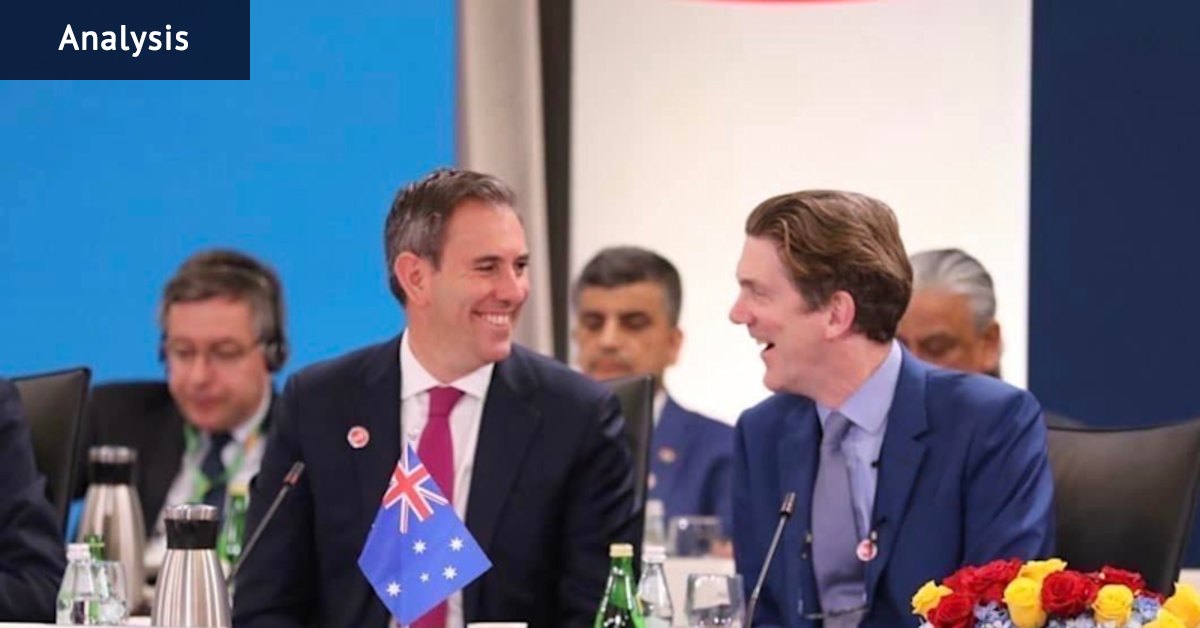
The annual spring meeting of the International Monetary Fund in Washington attracts financial leaders from around the world, including Jim Chalmers and Reserve Bank deputy governor Andrew Hauser, to take the pulse of the global economy.
The US-Israel war against Iran, and the turmoil it has sent through the economy from oil prices to helium used in semiconductor production, will be the discussion point of this week’s meetings.
It is eerily similar to what transpired in Washington in April 2008 when treasurers and central bankers gathered, just a few weeks after the collapse of American investment bank Bear Stearns. Its collapse was the harbinger of the global financial crisis, the impact of which reverberated through the world until the pandemic.
Then-treasurer Wayne Swan was preparing his first budget when he made the trip to the US in 2008. The budget was set to contain deep cuts and a winding back of John Howard’s middle-class welfare that had permeated the nation’s finances.
At the IMF, he found experts worried that Bear Stearns may not be a one-off. The fund’s economists had been forced to clip their global growth forecasts on concerns that the United States may slow because of the problems revealed by the investment bank’s demise.
At a meeting Swan attended in the Australian embassy with Wall Street investors, the issue of Bear Stearns came up. One of the investors, a former federal Treasury official, warned that the collapse of Bear Stearns was not even the beginning of the end of the disaster that would surely come.
“Somewhat shaken by his comment, I leaned over to [then-Treasury secretary] Ken Henry and whispered: I think we’re going to have to rethink our budget strategy,” Swan would later write.
When Swan and Henry returned home, they set to work on dulling some of the sharper edges of a budget that would ultimately contain $33 billion in savings (such as means testing Family Tax Benefit B and the baby bonus).
The warnings that Swan and Henry picked up on that trip transpired into the world’s largest economic crisis since the end of World War Two. The United States was already six months into a recession (although it wasn’t known at the time) that would run through to the middle of 2009.
Almost 20 years on, the IMF has downgraded its expectations for the global economy because of the war against Iran. It also fears that if the war is not resolved quickly, then high inflation and a deep global recession – a terrible combination – is a real prospect.
Chalmers has admitted that key decisions for this year’s budget, perhaps the government’s most important since taking office in 2022, will be made later than normal due to the uncertainty created by the war.
Before his trip, he conceded the budget would be different to what had originally been planned.
“This budget won’t be identical to the budget that we were planning in February for obvious reasons,” he said.
The treasurer confirmed the budget is still on track to contain a savings package, a tax package and a suite of reforms aimed at boosting productivity.
Chalmers revealed the savings may be more important than simply making space in the budget for the government’s spending priorities.
“It will be a responsible budget, there will be savings … to get the budget into better position, including to put it in a position to be able to respond if we see some of these more serious scenarios play out,” he said.
The government is already spending $2.6 billion over the next three months on lower fuel taxes. Come late June, and if oil prices are still around $US100 rather than the pre-war $US65, an extension of the excise would have to be on the government’s cards.
But more money may be needed to prop up the transport industry or the agricultural sector, which are already being squeezed to breaking point.
Credit data monitoring company CreditorWatch on Wednesday warned there were already signs of financial pressure from rising fuel bills, saying the chance of a lift in insolvencies was high.
This week, the IMF admitted it would have upgraded its economic outlook but for the war. It clipped its forecasts for global growth by about 0.2 percentage points.
That’s what happened in April 2008, with growth marked down only marginally. Within a year, however, the global economy was in freefall as the repercussions from America’s subprime mortgage disaster spread into every part of the world’s financial system.
Oil could similarly find its way into the same economy’s nooks and crannies.
Cut through the noise of federal politics with news, views and expert analysis. Subscribers can sign up to our weekly Inside Politics newsletter.
 Shane Wright is a senior economics correspondent for The Age and The Sydney Morning Herald.Connect via X or email.