
Updated ,first published
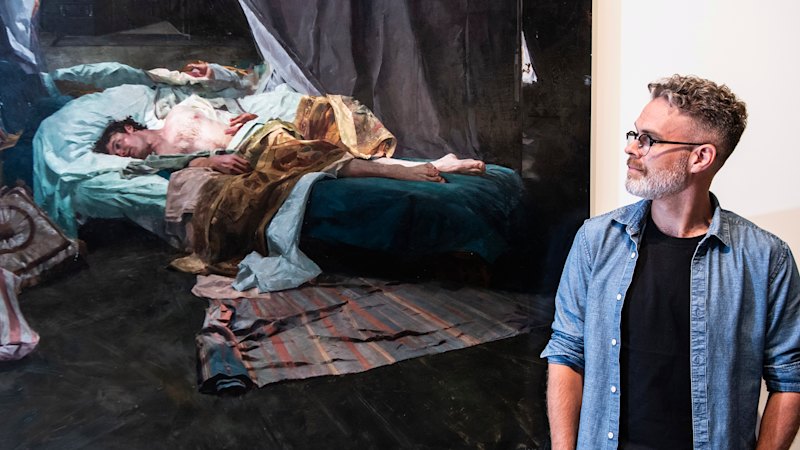
A series of pivotal moments paved the way for Melbourne artist Sean Layh’s Packing Room Prize win on Thursday with a brooding, epically staged portrait of British-Australian actor Jacob Collins performing Hamlet.
The self-taught artist was 18 years old when he first encountered Paul Newton’s portrait of comedians Roy and H.G. at the Art Gallery of NSW, where it was a finalist for the 2001 Archibald Prize.
“That really instructed me on what representational painting could be for an artist like myself who has a bit more of a traditional bent to his work,” he recounts. “It won the Packing Room Prize and the People’s Choice that year. So to stand here a quarter of a century later and actually take the same award is deeply satisfying.”
Then, six years ago – as the pandemic shuttered academia and spurred a mini art boom – Layh dropped out of a biological sciences degree at Monash University to pursue painting full-time. He soon drifted into theatre portraiture, merging his technical skill with a lifelong love of Shakespeare. “If it weren’t for COVID, I don’t think this prize would have happened. Suddenly, there was interest in my work,” he says.
In late 2024, Layh watched Collins in the titular role of Iain Sinclair’s production of Hamlet at Melbourne’s fortyfivedownstairs theatre. “It was a grungy, small, cut-down production – a Hamlet by candlelight, almost. An amazing ensemble, and Jacob carried it beautifully,” Layh remembers. “I left the theatre possessed with the idea of doing something with that.”
His striking composition, The tragicall historie of Hamlet, Prince of Denmarke – a title jointly agreed upon by artist and sitter – draws inspiration from French artist Albert Maignan’s The last moments of Chlodobert (1880). Layh secured the $3000 Packing Room Prize with his first-ever Archibald entry.
“Jacob came to the studio, and that’s my daughter’s bed he’s lying on,” he says. “We lugged it downstairs into the studio, set it all up, and took a whole day to play with different ideas from the play. Shakespeare, in particular, lends itself so beautifully to this type of painting because it’s filled with these dramatic moments where you can portray the characters visually. That’s just dynamite for a painter like me.”
Collins, the immortalised subject and an actor with extensive stage and film credits, is just glad the artist “came and saw the show on a good night”. He adds, “It was a pleasure to spend the sitting discussing the intricacies of what we both agreed is Shakespeare’s deepest incantation. Applause from here, Sean. The win is extremely well deserved.”
Layh’s entry was one of 2524 received for the Archibald, Wynne and Sulman prizes, the second highest recorded, eclipsed only by that pandemic-delayed year of 2020 when artists were housebound.
Of 1034 entries to the Archibald, 59 works have been selected by gallery trustees as finalists, with the winner to be announced on Friday, May 8. Entries must be painted in the past year and from life, with artists meeting their subjects face-to-face for at least one sitting.
Often regarded as a barometer of the nation’s mood, this year’s Archibald Prize finalists largely skirt party politics to plump for activists, fashion icons, artists, musicians and actors of stage and screen.
Apart from Caroline Zilinsky’s Zimmermann sisters, Técha Noble has brushed Anna Plunkett and Taryn Cameron-Smith captures Japanese designer Akira Isogawa.
Former Archibald Prize winners are back as painters and sitters: Morgan Stokes has painted on linen a chimeric Yvette Coppersmith, the 2018 Archibald Prize winner. Nine years after his win, Mitch Cairns is back with a distinctively abstracted portrait of novelist, essayist and poet, Gerald Murnane.
In 2020, Vincent Namatjira became the first Indigenous artist to win the Archibald Prize with a portrait of Adam Goodes. This year, he has painted himself playing bowls with Mother Earth in the middle of the Australian desert.
Guido Maestri, an Australian contemporary artist who won the 2009 Archibald Prize for a portrait of Australian singer and musician Geoffrey Gurrumul Yunupingu, is a finalist for a fractured rendering of himself with his “head in the clouds”.
Filipino-Australian artist Marikit Santiago won the Sulman Prize 2020 with a painting of her three children. She has painted Australia’s reinstated representative at the Venice Biennale, Khaled Sabsabi, with the title, Even doves have pride. Last year’s Archibald people’s choice winner Loribelle Spirovski is a finalist as both subject, for Tsering Hannaford, and artist, painting musician Daniel Johns.
Walpiri artist Adrian Jangal Robertson is the sole artist to achieve the trifecta and is a finalist in all three prizes.
The Archibald Prize is not blind to the cross currents of the Middle East, with Julia Dover’s pink rendering of Ahmed Al Ahmed, the intervening bystander shot while trying to wrest a gun off one of the Bondi gunmen.
Mohammed Mustafa, the Perth doctor who is on a mission to build a children’s hospital in Gaza, slouches in an undersized chair for Perth’s Desiree Crossing. Michael Zavros paints Alex Ryvchin, co chief executive officer of the Executive Council of Australian Jewry, paddling feet in shallow waters.
Finalists in the Archibald and the $50,000 Wynne Prize for best landscape painting and the $40,000 Sulman Prizes for best subject painting, genre painting or mural project will be exhibited at the Art Gallery of NSW from Saturday, May 9 to Sunday, August 16.
The Booklist is a weekly newsletter for book lovers from Jason Steger. Get it delivered every Friday.