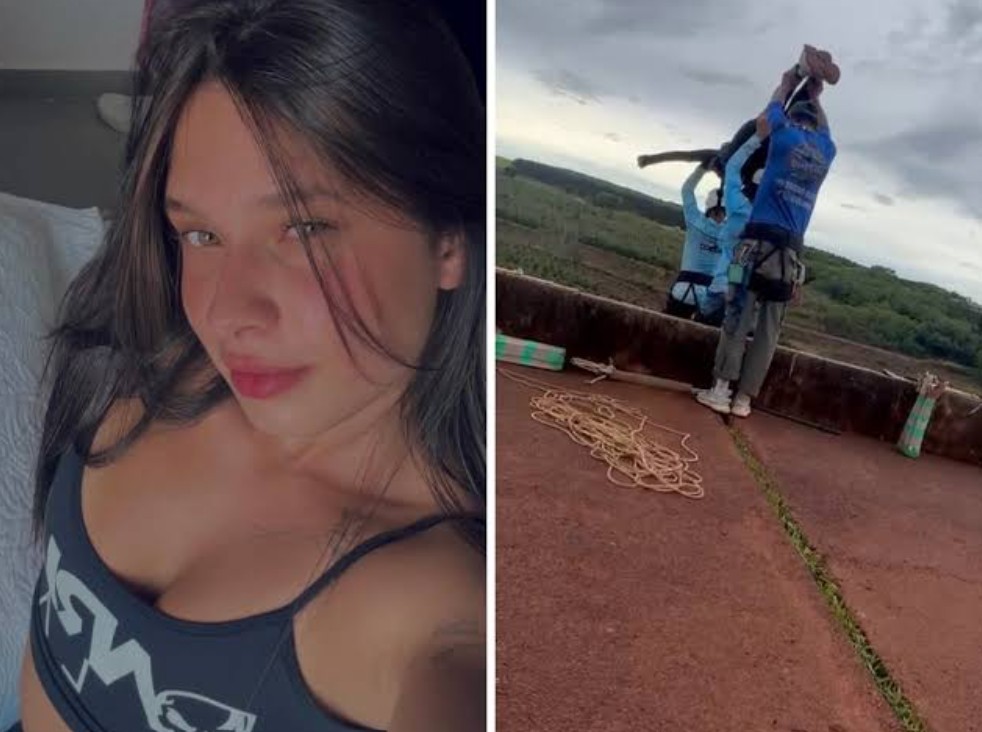

Extreme sports inherently carry an element of risk, a thrilling gamble against gravity that draws thousands of adrenaline seekers worldwide. However, there is a fundamental, unspoken contract between the participants and the commercial operators organizing these events: that the gear is sound, the anchors are secure, and the protocols are followed with mathematical precision. On a tragic Saturday in Limeira, a municipality in the interior of the state of São Paulo, Brazil, this contract was completely shattered. What was supposed to be a milestone of personal bravery turned into a horrific nightmare when 21-year-old Maria Eduarda Rodrigues de Freitas plunged to her death during a commercial “rope jump” excursion.
The incident occurred on the trail leading to the infamous Ponte do Esqueleto (Skeleton Bridge), a location renowned among local urban explorers and extreme sports enthusiasts. Initial reports published by Portal G1 shook the public, revealing an unbelievable and devastating error. According to eyewitness accounts provided to the Military Police, the operators in charge of the activity allegedly committed an act of catastrophic negligence: they completely forgot to secure the primary safety equipment to the young woman before permitting her to leap off the edge. This report explores the chronological sequence of the tragedy, the profile of the victim, the chaotic immediate aftermath, and the ongoing criminal investigation that has exposed the dark underbelly of unregulated commercial extreme sports operations in Brazil.
Chronology of the Accident and Full Video
The event took place in the early morning hours, a time when conditions are typically considered ideal for rope jumping due to lower wind speeds and clear visibility. Rope jumping, distinct from traditional bungee jumping, uses dynamic climbing ropes and a complex rigging system to create a massive pendulum swing rather than a vertical rebound. This setup requires rigorous double-checking of harnesses, carabiners, and anchor lines. Witnesses at the scene reported that the environment was bustling with participants and spectators, all waiting for their turn to experience the drop from the high bridge structure.
Uncensored video of Maria Eduarda Rodrigues de Freitas’s fatal high-altitude jump accident
When Maria Eduarda’s turn arrived, she was positioned at the jumping platform. Photographic and video evidence circulating in the aftermath captured the presence of several men managing the launch zone, distinctively wearing t-shirts emblazoned with the logos of two prominent local adventure groups: “Entre Cordas” (Between Ropes) and “Ih Voei” (Wow, I Flew). According to a primary witness testimony documented by the Military Police, the technical sequence of checks completely failed. The crew failed to attach the vital dynamic lines to her harness. Unaware of the fatal omission, Maria Eduarda stepped off the platform. Instead of a controlled, swinging trajectory, she experienced a free fall, impacting the terrain below.
The impact immediately triggered chaos at the site. Spectators screamed as the reality of the situation set in, and calls were urgently placed to emergency services. The response mobilized a massive contingent of local safety forces. The state Fire Department (Corpo de Bombeiros) and the Mobile Emergency Attendance Service (SAMU) rushed to the remote trail of the Skeleton Bridge. Emergency medics navigated the difficult terrain to reach the victim as quickly as possible. However, the forces of gravity and the sheer height of the fall left no room for survival. Medics confirmed that Maria Eduarda sustained catastrophic, fatal injuries upon impact and was pronounced dead at the scene, converting the rescue mission into a grim recovery operation and a secured crime scene.
The Flight, the Manhunt, and Subsequent Arrests
As the realization of the fatality spread through the crowd, the behavior of the organizers shifted from shock to self-preservation. Rather than remaining at the site to assist authorities, provide necessary technical documentation, or face the consequences of the failure, two primary operators immediately fled the area. They abandoned their equipment and plunged into the dense, surrounding forest canopy adjacent to the bridge, attempting to use the thick vegetation of the rural Limeira region to evade law enforcement.

The Military Police recognized the immediate risk of the suspects escaping justice and initiated a coordinated manhunt. Given the challenging topography of the valley and the thick brush, ground units requested airborne reinforcement. The State Police deployed the Águia (Eagle) helicopter, a specialized aerial unit equipped with thermal imaging and high-powered optics designed for search and tracking operations in wilderness areas.
From the air, the Águia crew successfully scanned the forest, identifying anomalies in the brush and tracking the movement of the fleeing individuals. Ground teams, guided by real-time coordinates from the helicopter pilots, pushed through the woods and intercepted the suspects deep within the brush. The scope of the police sweep expanded rapidly as officers rounded up everyone directly involved in managing, promoting, and executing the unauthorized event. By the conclusion of the immediate operation, a total of six individuals associated with the two companies had been arrested and escorted in custody to the local police precinct.
Profile of the Victim: Remembering Maria Eduarda Rodrigues de Freitas
The victim of this systemic failure was a young woman with a promising future ahead of her. Maria Eduarda Rodrigues de Freitas was only 21 years old and resided in Jandira, a municipality located within the metropolitan region of Greater São Paulo. Her digital footprint painted a vivid picture of an energetic, vibrant individual who possessed a deep love for the outdoors, physical fitness, and the natural beauty of Brazil. Her Instagram profile was filled with photos of hiking, exploring natural landscapes, and participating in various recreational sports.
Far from being an uneducated risk-taker, Maria Eduarda understood human movement and athletic endeavor. Her social media biography proudly highlighted her academic and professional pursuits, which included formal training and studies in Physical Education and Sports Management. This background suggested she likely appreciated the logistics and health benefits of physical activity, making her trust in the professional operators all the more natural and tragic. Additionally, she was a dedicated supporter of the Santos Futebol Clube, frequently sharing her passion for her favorite football team.
Perhaps the most heartbreaking aspect of the case is the digital archive she left behind just moments before her death. At 7:31 AM on the morning of the accident, Maria Eduarda uploaded a final story to her social media accounts. The image featured the scenic drop of the Skeleton Bridge, with a prominent promotional banner for the “Entre Cordas” company visible in the frame. Over the image, she typed a lighthearted, ironic caption that would later haunt her family, friends, and the public:
“Quem foi o doido que deixou eu vir pular de uma ponte???” > (Who was the crazy person who let me come jump off a bridge???)
The post, meant to express the standard pre-jump nervousness and excitement shared by thousands of extreme sports participants, became an accidental, tragic premonition. Within hours, the playful question was shared across news outlets nationwide, a stark symbol of a young life cut short by a completely preventable operational failure.
Commercial Exploitation and Unregulated Event Schedules
An investigation into the digital marketing and public outreach of the companies involved revealed a highly lucrative, fast-paced commercial operation. Far from being a small, private gathering of friends, “Entre Cordas” and “Ih Voei” were running an aggressive regional tour, capitalizing on the viral popularity of rope jumping to fill slots across multiple dates and locations in southeastern Brazil. The companies utilized social media platforms to display high-energy promotional videos, attract young clienteles, and process payments without providing verified safety certifications or proof of local government authorization.
The event at the Ponte do Esqueleto in Limeira was part of a packed itinerary. Slots (vagas) had been actively sold for the Friday and Saturday of that fatal weekend, and the company had already begun booking clients for a return date scheduled for July 11. The operational scope extended far beyond Limeira, detailing a structured circuit with significant financial revenue. The table below outlines the advertised itinerary and pricing structure utilized by the operators to attract clients across the states of São Paulo and Minas Gerais:
This aggressive booking schedule highlights the commercial pressures driving these organizations. When adventure groups operate on tight timelines across different cities, moving heavy gear and processing large groups of paying customers within hours, the risk of fatigue and compromised safety protocols increases exponentially. Following the tragedy, major journalistic outlets, including Portal G1, made repeated attempts to establish formal communication with the designated representatives or legal counsel of “Entre Cordas” and “Ih Voei.” However, all calls, messages, and digital inquiries went unanswered, as the companies completely deleted or locked down their public profiles in an attempt to shield themselves from public scrutiny.
Legal Proceedings and the Fight for Regulatory Accountability
The legal aftermath of Maria Eduarda’s death is currently centered at the 2nd Police District of Limeira, where civil and structural investigators have opened a comprehensive criminal inquiry. The primary objective of the precinct is to thoroughly map out the exact chain of custody regarding safety protocols and determine the individual criminal liabilities of the six detained suspects. Investigators are analyzing whether the action constitutes manslaughter (homicide culposo) or if the blatant omission of a primary safety line represents a conscious disregard for human life, which could elevate the charges to a more severe form of culpable homicide or third-degree murder under Brazilian law.
The forensic phase of the investigation involves reconstructing the pre-jump procedure. Experts are reviewing bystander mobile phone footage and any available internal cameras to determine who fitted the harness, who checked the anchor systems, and who gave the final verbal clearance for Maria Eduarda to jump. Furthermore, the police are looking into whether these companies possessed valid municipal permits, technical responsibility certificates (ART) issued by a certified engineer, or comprehensive liability insurance.
This case serves as a dark reminder of the urgent need for strict legislative oversight in the adventure tourism sector. Across Latin America, the rapid growth of extreme sports tourism has heavily outpaced local regulatory frameworks. Many operators function within a legal gray area, utilizing standard climbing gear bought at retail stores without undergoing independent safety audits, redundant backup system verifications, or formal staff training certifications. Until municipal authorities enforce mandatory, standardized double-check protocols where multiple independent instructors must physically sign off on a harness attachment before a participant steps onto a ledge preventable tragedies like the death of Maria Eduarda Rodrigues de Freitas will continue to threaten the public. The resolution of this case in the Limeira courts will likely set a crucial legal precedent for the future regulation and criminal prosecution of negligence in commercial extreme sports throughout Brazil.