
Cameron Woodhead and Tony Way
Updated ,first published
MUSICAL THEATRE
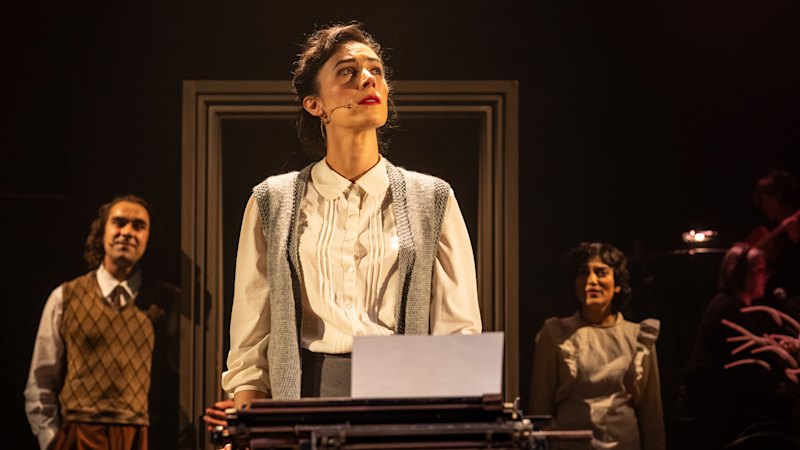
Stella: A New Australian Musical ★★★
Monash Performing Arts Centre, until June 20
Creating a musical from scratch is a difficult and laborious challenge. Stella refuses to set its sights low, and quite rightly. This musical odyssey is, after all, based on the life of that dauntless Australian literary pioneer, Stella Miles Franklin, and it reflects at least some of its subject’s boldness, determination, and passion for art.
Typically, biographical musicals focus on legends of popular music – the Tina Turners and Michael Jacksons of the world – though if you nudge the curtain of cultural amnesia that hangs over the Australian stage, you’ll find more adventurous indie nuggets.
All sorts of figures have been brought to all-singing, all-dancing life, from leaders in Australian politics (Keating! the Musical), to sport (Shane Warne the Musical), and even cookery (Margaret Fulton: Queen of the Dessert).
Literature? Well, the author of My Brilliant Career (a book which has itself been adapted into a brilliant musical in recent years) is in another league.
Franklin wrote her most famous novel as a teenager – it was published with a glowing, if sexist, foreword by Henry Lawson in 1901 – and she lived until 1954, with a long, self-imposed exile in the United States and Britain, and a subsequent return to Australia that revived her literary fortunes.
There’s a wealth of material, and the main criticism of Stella is that the storytelling doesn’t have a consistent and compelling dramatic shape. Franklin’s early life (and complex relationship with her family) sets an intimate frame, mirroring that of her irrepressible heroine, Sybylla Melvyn. From there, the drama frays into a scattershot approach to the five decades between My Brilliant Career and the inauguration of the Miles Franklin Award upon the author’s death.
There isn’t quite a song for every sentence on Franklin’s Wikipedia page, but the musical is over-realised. And the desire to leave no stone unturned tends to dissipate its central emotional conflict between the demands of art and those of life.
Monique diMattina compensates with music. Her songs are often charming, with clever lyrics and a melodic approach that finds inspiration in colonial balladry, as well as music hall, cabaret and other popular styles from the first half of the 20th century.
Having the live orchestra onstage works well, and Geraldine Hakewill gives a luminous performance as Stella, especially opposite other women in the cast.
Indeed, you could argue that female friendships and rivalries alone could sustain the show. Highlights include affectionate scenes with Stella’s younger sister, Linda (Shubshri Kandiah), and turbulent ones with her mother (Johanna Allen), whose limited opportunities concentrate her daughter’s fierce feminism. Just as interesting is Stella’s complicated disdain for fellow writer Dame Mary Gilmore (Allen). The male characters (Joe Kosky, Kaya Byrne) are less convincing, with a rather sanitised portrayal of an alcoholic father, among other things.
Theatrically, Stella’s a bit of a mess, but it’s musically talented – and a defiant and daring attempt to channel the spirit of one of the most important figures in Australian literature.
Reviewed by Cameron Woodhead
MUSIC
Isles of Light ★★★★
Australian Chamber Orchestra, Hamer Hall, June 14
English violist and violinist Lawrence Power was the perfect choice to lead the Australian Chamber Orchestra through this visionary celebration of British music.
Centred around Ralph Vaughan Williams’ groundbreaking Fantasia on a Theme of Thomas Tallis, Power’s thoughtfully devised program began with an “English Mixtape” featuring music by Purcell, Jonny Greenwood, Kate Bush, Ivor Gurney, the Tallis tune on which the Fantasia is based, and finishing with the eleventh of Elgar’s Enigma Variations.
The remainder of the concert explored the spatial possibilities opened up by the Fantasia, which masterfully uses three distinct bodies of sound to create a haunting interplay of light and shade.
Partly commissioned by the Australian Chamber Orchestra and dedicated to Power, Irish-born composer-violist Garth Knox’s The Ancient Mariner: Concerto for Viola and String Orchestra is an enterprising recounting of Samuel Coleridge’s classic tale of transgression and redemption.
Playing the main protagonist, Power recites some of the poem while the players adopt various positions, sometimes looking like rowers on an ancient ship. The dead albatross is represented by a detuned viola hung around the soloist’s neck. This is a story told through visual imagery as much as through the effective but often sparsely textured musical material.
Inspired by Vaughan Williams, Herbert Howells’ soulful Elegy for Viola, String Quartet and String Orchestra set the mood for an impassioned account of the Fantasia, in which Power (now taking up the violin) relished its chiaroscuro and revolutionary harmonies.
Vaughan Williams’ student Elizabeth Maconchy’s accomplished Symphony for Double String Orchestra was full of ear-catching detail, not least in Power’s cameos dispatched on his 1742 “ex Baillot” Francesco Stradivari violin.
Throughout the concert, Power demonstrated the extraordinary timbral capabilities available across the entire range of his 1580 Amati Brothers viola. His ardent expressivity and the eager collaboration of the Australian Chamber Orchestra made for a fascinating musical journey.
Reviewed by Tony Way
THEATRE
The Wolves ★★★
Theatre Works, until June 20
As the curtain rises on the FIFA World Cup this week, Theatre Works brings us a striking American play that highlights the beautiful game.
Sarah DeLappe’s The Wolves – shortlisted for the Pulitzer Prize for Drama in 2017 – follows the fortunes of a girls’ high school soccer team. It’s structured around weekly training sessions, where the girls assemble on a soccer field to practise and play and gossip among themselves.
Inventive staging transforms the space in this production. The audience flanks a rectangular expanse of astroturf in two banks at right angles, as if arranged for the best possible view of a corner kick, and the action is peppered with soccer drills and choreographed exercise routines that ground all the chat in physical presence and prowess.
The performers seem to relish letting their feet do the talking, though it’s the intricacy of the overlapping ensemble dialogue that’s the play’s defining feature.
The Wolves is structured largely as naturalistic adolescent gossip. While director Belle Hansen makes a fair fist of orchestrating the dialogue so that it feels overheard, the venue’s challenging acoustics don’t make her task easier: some of the hubbub is difficult to comprehend, and occasional nuances in exposition are lost.
Yet, the central dynamic is animated precisely, as the girls navigate shifting goalposts between individual and collective identity, between working out who they are and how they behave, unconsciously or otherwise, as social beings.
Topics of conversation rove widely and snake from the global to personal and back again. A discussion about the trial of an elderly genocidaire from Cambodia’s Khmer Rouge might yield to whispered speculation (behind other girls’ backs) about which team member had an abortion. Or why the new, homeschooled member of the team (Desiree Katakis) lives in a yurt. Or who can pull off a bicycle kick.
Each player carves out a distinctive niche, as friendships, rivalries and betrayals emerge.
A stalwart striker and her best friend (Bek Schilling and Shanu Sobti) fall out after a ski trip, the reliable team captain (Erin Perrey) tries to keep her motley bunch of likeable oddballs focused, and their goalie (Ellie Nunan) suffers serious anxiety disorder that will take the arrival of tragedy to cure.
One player won’t survive the season, and that revelation, when it comes, sees a piteous monologue from a grieving Soccer Mom (Emily Joy) reduce the group to stunned silence, and a recommitment from the team to honour their dead friend.
A final moving moment gets smudged a little, partly by design choices that don’t do enough to support the performances. It’s a valiant production, though, most involving when the cast relaxes into the absurdities and vulnerabilities of being a teenager, and its tragicomic view of adolescence should only grow and deepen through the season.
Reviewed by Cameron Woodhead
The Booklist is a weekly newsletter for book lovers from Jason Steger. Get it delivered every Friday.