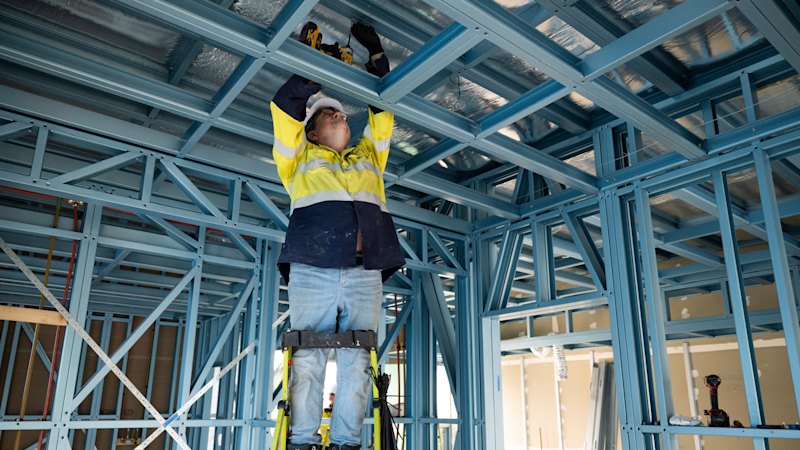

The decision by the Minns government to establish a partnership with a private manufacturer of prefabricated or modular housing to boost construction and establish NSW as a housing manufacturing hub is a welcome reform.
NSW is certainly in dire need of new housing. But for myriad reasons – some of them beyond the government’s control, including housing and construction costs and labour shortages – it lags a long way behind housing targets.
Premier Chris Minns deserves credit for the way he has identified and attempted to tackle the state’s housing supply crisis. Yet, NSW remains some 100,000 homes short of the 377,000 target set for 2029 under the National Housing Accord.
If they deliver as promised, the prefab reforms may fundamentally change how houses are built in NSW. They will go up more cheaply and more quickly, but they will also require the construction sector to keep up with demand. The changes, foreshadowed ahead of Tuesday’s state budget, are aimed at helping bridge the gap.
Minns said one of the government’s concerns was not having enough building trades workers in future, partly due to so many people retiring. “We’re genuinely concerned that the slow pace of building and construction in NSW could get even slower as these people exit the workforce, and we have to think creatively about where homes will be built in the future,” he said.
Although governments around Australia have taken a closer interest in expanding the use of prefab or modular housing, NSW is in a better position to utilise the technology. This is thanks in part to its decision last November to allow architect-designed Pattern Book homes to develop more sustainable and affordable low- and mid-rise homes.
A prefab manufacturing hub, the Modern Methods of Construction Innovation Facility, could also be used to provide a range of public infrastructure, including schools and hospitals.
From early colonial settlers to the post-war construction boom, prefabricated and modular housing has a long history in Australia. But it fell into disfavour when a brick veneer in the suburbs became the Australian dream and it continued to slide as the family home also evolved into an investment.
Modern prefab buildings can now offer higher quality than traditional homes, but they still comprise less than 5 per cent of new builds.
Apart from the housing crisis, climate change is putting an increasing number of people’s homes at risk. Advocates are pushing prefabricated or modular homes as possible solutions to both housing and climate crises, with the possibility of building climate-resilient, energy-efficient homes at scale, quickly and cheaply.
There is no dollar value attached to the government’s proposal. Planning Minister Paul Scully said it was looking for private sector assistance and the sweetener could be an equity position, land, training or something else.
The Minns government’s modest prefab modular housing decision joins a brace of sensible moves. But many more reforms are required to address the crisis that has put home ownership beyond the reach of so many.
Jordan Baker sends an exclusive newsletter to subscribers each week. Sign up to receive her Note from the Editor.
 The Herald’s View – Since the Herald was first published in 1831, the editorial team has believed it important to express a considered view on the issues of the day for readers, always putting the public interest first.