Stan Choe
Updated ,first published
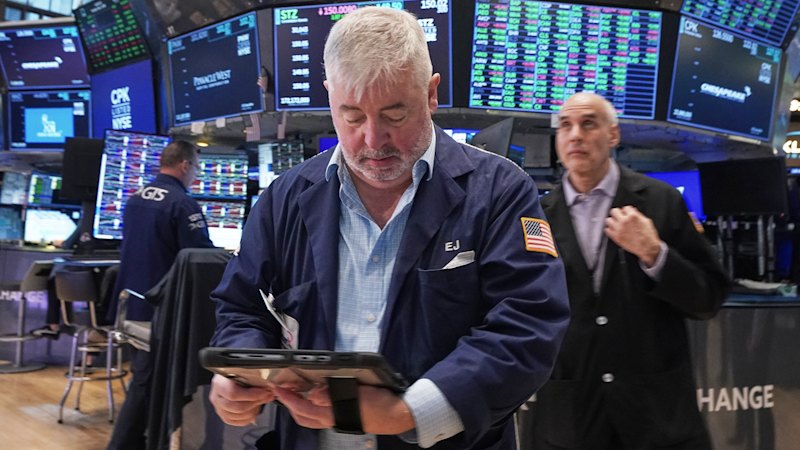
The US stock market rose to more records Thursday after Cisco Systems joined the parade of US companies reporting fatter profits for the start of 2026 than analysts expected.
The S&P 500 climbed 0.8 per cent to set an all-time high for a second straight day. The Dow Jones Industrial Average rose 370 points, or 0.7 per cent, and finished above the 50,000 level for the first time since the war with Iran began, while the Nasdaq composite added 0.9 per cent to its own record.
The Australian sharemarket is set to rise, with futures at 6.31am AEST pointing to a gain of 46 points, or 0.5 per cent, at the open. The ASX added 0.1 per cent on Thursday to break a four-session losing streak. The Australian dollar was weaker at US72.19¢.
Cisco helped lead the market after reporting better profit and revenue for the latest quarter than analysts expected. The tech giant’s stock leaped 13.4 per cent for its best day in nearly 15 years, and CEO Chuck Robbins said it saw “very strong, broad-based demand for our products.”
Big Tech behemoths in particular are pouring cash into artificial-intelligence technology, and Cisco gave a forecast for profit in the current quarter that easily topped analysts’ expectations.
Such voracious demand for AI, and the big profits it’s producing, have been major reasons the US stock market has set records throughout this year. Cerebras Systems, an AI processor company, raised $US5.55 billion after selling its stock in an initial public offering, and its shares surged 68.1 per cent in their debut on the Nasdaq Thursday.
Corporate earnings reported so far this season have “reinforced that this is still an AI-led market, but one where the impact is broadening quickly,” according to Gargi Pal Chaudhuri, chief investment and portfolio strategist at BlackRock.
“What started with a handful of companies is now driving earnings growth across semiconductors, infrastructure, and even parts of the industrial economy,” she said.
Outside of AI, other stocks rallying after delivering better-than-expected profit reports included StubHub Holdings, up 13.7 per cent, Viking Holdings, up 5.5 per cent and Yeti Holdings, up 6.2 per cent. All three companies sell products that aren’t day-to-day essentials, such as concert tickets, river cruises and insulated water bottles. Strong results from them could be an indicator that customers are still willing to spend even though US consumers have been telling surveys they’re feeling discouraged about the economy.
Meanwhile, China has agreed to buy 200 Boeing jets, US President Donald Trump told Fox News Channel, a number that was far fewer than analysts had expected, and the planemaker’s shares fell.
Details of the deal were not immediately available, including when and which type of jets would be delivered, but the amount was much smaller than the roughly 500-plane package that sources told Reuters was under discussion ahead of a meeting on Thursday between Trump and Chinese leader Xi Jinping.
“One thing he agreed to today, he’s going to order 200 jets … 200 big ones,” Trump said on Fox News’ Hannity, referring to Xi.
Whether US households will keep spending and support the economy is a big question because pressure has been bearing down on them due to high oil prices and inflation created by the Iran war. A report released Thursday said that shoppers overall spent less at US retailers last month than economists expected. But the deceleration after factoring out gasoline and automobile sales wasn’t quite as bad as economists thought it would be.
A separate report, meanwhile, said more US workers filed for unemployment benefits last week, which could be an indication of more layoffs. The number, though, remains relatively low compared with history.
Treasury yields flitted up and down in the bond market immediately after the reports, but they largely remained steady. The yield on the 10-year ticked up to 4.47 per cent from 4.46 per cent late Wednesday.
On Wall Street, the S&P 500 rose 56.99 points to 7,501.24. The Dow Jones Industrial Average added 370.26 to 50,063.46, and the Nasdaq composite climbed 232.88 to 26,635.22.
In stock markets abroad, indexes rose in Europe following a mixed finish in Asia. Japan’s Nikkei 225 fell 1 per cent, while South Korea’s Kospi jumped 1.8 per cent to another record thanks to gains for AI-related stocks.
Stocks were virtually flat in Hong Kong and down 1.5 per cent in Shanghai as Chinese leader Xi met with Trump in Beijing.
Some investors hope Trump could encourage Xi to use China’s close economic ties with Iran to get it to reopen the Strait of Hormuz. The strait’s closure because of the war has kept oil tankers pent up in the Persian Gulf instead of delivering crude to customers worldwide, which has driven up prices.
The price for a barrel of Brent crude oil, the international standard, rose 0.1 per cent to settle at $US105.72 Thursday, and it remains well above its price of roughly $US70 from before the war.
AP
The Market Recap newsletter is a wrap of the day’s trading. Get it each weekday afternoon.