Updated ,first published
Vienna: Seven decades after the creation of the Eurovision Song Contest, and a little more than five decades after her mentor Olivia Newton-John walked onto the same stage, the stars have aligned for Delta Goodrem to deliver a career-defining performance in Vienna, Austria, overnight.
This was a performance for the ages, and confirmation of Goodrem’s maturation as an artist. Already an accomplished singer-songwriter-instrumentalist, Eclipse is the apotheosis of her stagecraft: explosive, majestic and, to the 16,000-strong crowd in the arena, quite simply mesmerising.
The semi-final rounds of Eurovision are watched by about 35 to 40 million people. Like other global events such as the Oscars, the global TV audience figure is a somewhat nebulous calculation of uncertain mathematical provenance. Best estimates say upwards of 150 million people.
Whatever the final number, it is certainly the biggest audience of Goodrem’s professional career. What makes that calculus so extraordinary is that Goodrem did not just meet the moment, she exceeded it in every way. A hefty fusion of acoustic and visual artistry, Goodrem moved through it as though she were light as air.
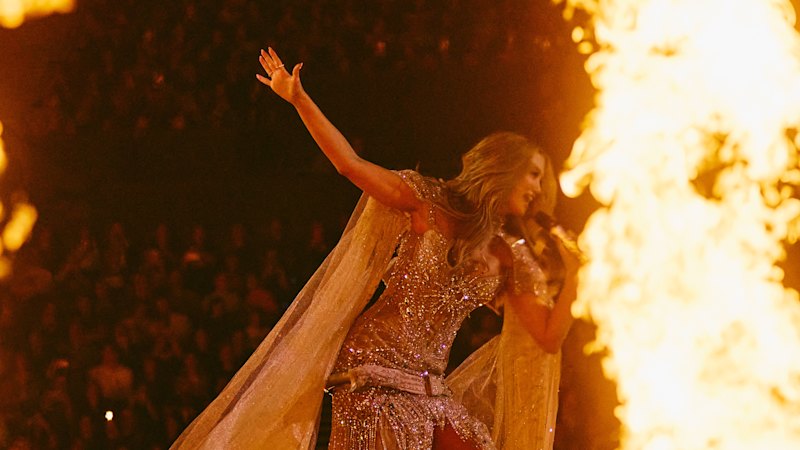
Behind the diaphanous folds of her hand-crafted gold gown – a dazzling assembly of 7000 Swarovski crystals, which took more than 500 hours to sew by hand – was a piece of innovative stage technology known as a Versa Ribbon Lift; the same technology was used by the queen of stagecraft, Beyoncé.
The performance itself took Goodrem through layers of moon shadow, to an intersection of moon and sun at the heart of the eclipse, and finally – after a piano intermezzo played in fortissimo with a cheeky smile – into an explosion of gold that turned the Wiener Stadthalle arena into a shimmering ocean of fire.
Designed by Dan Shipton and Ross Nicholson, the effect was extraordinary. Goodrem knew it, her confidence clearly on display. And the audience knew it, erupting into rapturous applause. Even in the media centre, backstage, a 1000-strong crowd of journalists from around the world applauded and cheered. Win or place, whatever happens now, this was truly a winning performance.
That reaction also underlined Goodrem’s months-long campaign for Eurovision love, that took her from Australia to the “pre-party” season in Europe in March and April, performing at concerts in Amsterdam and Oslo, and pressing the flesh with Eurovision fans.
Those moments were repaid tenfold in audience “tele-votes”, which account for half of a performer’s final Eurovision score. The other half comes from juries of music industry professionals in each competing country. The TV audience and juries awards points to any country, except their own.
Despite the colour and the camp, Eurovision is a brutal schedule for competitors. After a week of intense rehearsals, each of the two semi-finals and the grand final are run four times: two dress rehearsals, a jury show and a live show, which is telecast around the world.
By week’s end, a dozen or more delegations are eliminated in the semi-final rounds and sent home, there is a flag parade of nations which has become one of the most powerful, and contentious, expressions of soft diplomatic power in the world, and one winner is left on stage, clutching the most coveted statue in European music.
For Australia, the Eurovision journey is as existential as it is colourful. Our place in a European music competition is always up for debate, even as it seems like a natural expression of our European history and the plain ambition of the European Broadcasting Union (EBU) to turn Eurovision itself into a global brand.
Regardless of the outcome, Goodrem’s successful campaign this year will momentarily silence the critics who found voice recently, as a number of Australian entrants had their Eurovision campaigns cut short, cut down in the semi-finals.
This year’s first semi-final sent Greece, Finland, Belgium, Sweden, Moldova, Israel, Serbia, Croatia, Lithuania and Portugal to the final. The second sent through Bulgaria, Ukraine, Norway, Romania, Malta, Cyprus, Albania, Denmark, the Czech Republic and Australia.
In the grand final, those 20 countries were up against four of the so-called “Big Five” – the biggest members of the European Broadcasting Union, France, Germany, Italy and the UK – and the host country, Austria, all of whom book final slots automatically.
The fifth member of the Big Five, Spain, withdrew in protest over the inclusion of Israel, following the war in Gaza.
Four other countries joined the boycott: Iceland, Ireland, the Netherlands and Slovenia, reflecting a deeply felt schism that illuminated a growing problem for the EBU: how it handles the delicate relationship between soft diplomacy and the perception that Eurovision is being used as a political proxy.
The Eurovision grand final is, in the final count, a four-hour-long marathon of song, spectacle and abacus-style mathematics.
The contest’s antiquated scoring system, which involves crossing from the main stage in the host country to each of the participating countries for them to assign scores from two to eight, 10 and 12 points to the songs, is one of the most beloved aspects of the broadcast.
As an event, Eurovision is hard-selling European Idol, but in truth, it does give Brownlow Medal vibes.
Once the professional jury scores are on the leaderboard, the television audience “tele-voting” is applied in a series of blocks, each one effectively re-ordering the scores, resulting in a build-to-a-climax finish that is often peppered with shocks and twists.
The 2026 Eurovision competition featured artists and songs from 35 countries performing in 20 languages.
SBS will replay the Eurovision grand final tonight at 7.30pm AEST. Both semi-finals and the grand final are available via SBS on Demand.
Find out the next TV, streaming series and movies to add to your must-sees. Get The Watchlist delivered every Thursday.
 Michael Idato is the culture editor-at-large of The Sydney Morning Herald and The Age.Connect via X or email.