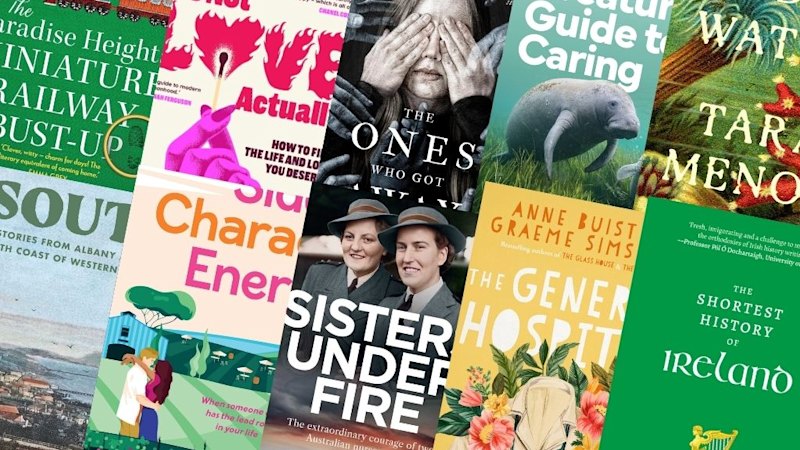
This week’s reviews range from romcom and medical drama, from navigating modern love to an entertaining history of Ireland.
FICTION PICK OF THE WEEK
The Ones Who Got Away
Stephen Graham Jones
Open Road, $39.99
This collection of 13 horror stories from a master of the genre ranges widely in tone and style but largely avoids jump-scares in favour of a creeping, more twisted sense of dread. The brilliant opener, Father, Son, Holy Rabbit, takes on survival horror. It’s viewed partly through the eyes of a child, with layers of fantasy peeling back like skin to reveal a bitter and bloody truth. Body image issues among the catty teenage girls in So Perfect lead to a revelation that makes your flesh crawl. Lonergan’s Luck cleverly mashes the classic Western into zombie fiction, with a fraudster selling a dreadful virus, while other tales have novel twists on common tropes – a shipwrecked werewolf, a detective with terminal cancer hunting a man-eating killer, and in the satisfying final story, a baby monitor with supernatural powers. Stephen Graham Jones works unexpected moments of humanity and genuine poignancy into these tales. That intensifies the horror, and allows some of his fiction to transcend genre, without compromising on thrills and chills.
Side Character Energy
Olivia Tolich
Text, $34.99

This is contemporary romcom with a difference, starting only when our narrator has become something of a third wheel. Bee and Gertie have been best friends forever. The two young women are flatmates and work colleagues (in hospo, with Bee’s job slightly better than Gertie’s). They’re also collaborators on social media, though again Bee hogs the spotlight, while Gertie works in the background. Obviously, Gertie’s always been a reliable shoulder to cry on every time Bee’s romances has gone up in flames. Still, it takes Bee meeting William for Gertie to feel like she’s not the main character in her own life any more, and that everything she does revolves around Bee. Turning to William’s best friend Arthur for life advice is a desperate move. Gertie doesn’t like him, but her identity crisis demands a reality check from someone – anyone – who isn’t Bee … Some plot points strain credibility, but it’s a charming read, animated as it is by a vulnerable yet slightly acerbic narrative voice, a gift for entertaining banter, and a likeable arc towards self-discovery.
Under Water
Tara Menon
Simon & Schuster, $34.99

A travel writer who doesn’t often travel, Marissa earns a crust writing tourist-bait – tantalising descriptions of pristine beaches composed from her desk in New York. She has memories from her youth on a Thai island to guide her. Moving there as a young girl after her mother’s death, Marissa befriended Arielle, with whom she used to go diving among the manta rays and vibrant coral ecosystems of the island. Eight years ago, that idyll was shattered by the 2004 Boxing Day tsunami, a tragedy (and it’s so heavily signposted this isn’t a spoiler) which only Marissa survived. Under Water blends an intimate account of girlhood friendship with the relentlessness of a grief, and a trauma, that exceeds personal loss. Ecological destruction and climate change are set to batter Marissa’s world again, as Hurricane Sandy bears down on New York, and the comforts the natural world can afford humanity continue to face human-induced destruction. The novel explores female friendship, tourism, ecocide, grief and trauma, yet isn’t entirely convincing fiction. Weirdly, natural disaster scenes feel more vivid than anything else and Menon might consider a genre switch to make better use of her strengths.
The Paradise Heights Miniature Railway Bust-Up
Kate Solly
Affirm, $34.99

Kate Solly’s Paradise Heights novels are set among a group of volunteers at the Many Hands craft store. Our cosy crime detective is Fleck Parker – a mother with undiagnosed ADHD who moonlights, whenever a mystery presents itself, as an amateur sleuth. This time, Fleck’s radar goes off when her husband informs her of a potential theft from the local Miniature Railway, and with three young kids, Fleck wastes no time. With her friend Trixie and a neighbour Ranveer to help her, Fleck follows a trail that leads her into unexpected peril. Meanwhile, a new member at the Many Hands craft store ruffles feathers and upsets long-established group dynamics. Fans should enjoy this instalment of a series inspired by Solly’s initial standalone mystery, Tuesday Evenings with the Copeton Craft Resistance. The puzzle-like plot is constructed along classic Agatha Christie lines: it’s cute, funny, and a bit frantic, yet raises more serious questions about motherhood, identity and mental health as the novel progresses.
The General Hospital
Anne Buist & Graeme Simsion
Hachette, $34.99

Another popular series continues with The General Hospital. This collab between an experienced psychiatrist (Buist) and the bestselling author of The Rosie Project (Simsion) follows Dr Hannah Wright, a young doctor training in psychiatry in the public health system. Previous books The Glass House and The Oasis were appealing for the behind-the-scenes realism of the pressures and dilemmas, the structural problems and the personal dramas confronting Hannah and her fellow young doctors, as well as the empathy and human complexity (and sometimes humour) with which mental health patients are portrayed. The latest novel cleaves to the authors’ winning formula. Hannah has returned to the hospital at which she interned, now treating minds rather than bodies. Her work across multiple sectors of the hospital shows that physical and mental health are, almost inevitably, interlinked. As Hannah’s clinical experience advances, romance and a long-held family secret await her on the personal front. It’s clever, well-plotted medical drama with melodramatic flourishes, and a more credible depiction of doctoring than most.
NON-FICTION PICK OF THE WEEK

It’s Not Love, Actually
Dee Salmin
Macmillan, $36.99
My initial reaction to this women’s guide about navigating the minefield of modern love was – God, I’m old! I even had to look up “hook up”. But, for all that, there is a certain thematic familiarity in the multiple feminist concerns she explores – notably, the way women are brought up to satisfy the expectations of a male-centred world, what they should settle for (partner, marriage. wife, mother), instead of what they want and deserve. In this sense, a key theme is authenticity, as apart from living the “they-self” (Heidegger’s term for the inauthentic life). Part confessional (among other things she talks of the “shitty” men she’s dated) and part political tract (but always snappy, clear and witty), Salmin covers such things as the male gaze and how women, consciously or unconsciously, are raised to pander to it, as well as the joys of simply being single. In fact, she celebrates going “boy sober” throughout Melbourne’s lockdown period. Although aimed at women, especially young women, in the hope that they will not repeat her mistakes, men would do well to read this too and know, perhaps for the first time, what it is to experience the cool, female gaze.
The Creatures’ Guide to Caring
Elizabeth Preston
Scribe, $36.99

Animal and insect life can, as biologist Elizabeth Preston demonstrates, not only teach people about parenting and caring, but also mirror the human impulse to create a community. Take the wasp, for example, one of her key case studies. When the female mates, it leaves the home of its bustling hive, builds a nest and hatches, the mother dedicating her life to caring for the daughters, sometimes dying in the process. But for the mothers who survive, the daughters, in turn, become carers and a community is born. Everything, says Preston, humming – like the “components of a machine … or, like members of a human society”. And it all begins with a parent and a child. Preston documents the parenting practices of a wide range of creatures, from a selfless octopus to co-parenting robins, chimps and spiders, highlighting the similarities and differences to the human experience. She also weaves in her own parenting tales about rearing a “screamer” child, in a relaxed, sometimes playful way that gets you in.
South
Malcolm Traill
UWAP, $34.99

On my one and only trip to Albany, WA, I was quickly informed that it was pronounced Albany – not Awl-bany. However, as local historian Malcolm Traill points out in this monograph on the life of the town, from its earliest inhabitants (the Menang people) to the arrival of Europeans, “the debate on our name and pronunciation goes on”. For a small town, it’s got a colourful history, and as these stories, first presented at the local library as “curatorials” demonstrate, a number of big names have passed through. Henry Lawson, for example, lived there in 1890, poignantly observing of the town, “It seems to exist only in a far-away-on-the-horizon sort of way. I like it all the better for that.” And some big beasts, like Jumbo the elephant who rampaged through the town in 1929 after escaping from Wirth’s Circus, prompting the local policeman to say, “… I can’t arrest an elephant.” From Charles Darwin’s dismissive comments to the tale of indigenous educator Bessie Flower, to whaling, oysters and massive tidal floods, this is a scholarly, highly entertaining portrait of a town.
The Shortest History of Ireland
James Hawes
Black Inc, $27.99

The history of Ireland, it seems, has often been shaped by what didn’t happen. The great non-event of its history, Hawes says, was that the Roman Empire did not occupy Ireland. The country didn’t suffer the fallout of Rome’s collapse and, for some time, went its own independent way. But, of course, it’s also a story of invasion, brutal occupation, rebellion and uprising, mostly by the British. And much of the book concentrates on this and the rise of the republican movement – the 1916 uprising, the insane decision of the British to execute the rebels, civil war, partition and the Troubles – among other things. Along the way he dismantles a few myths, such as no snakes (spoiler: it wasn’t St Patrick). It can be a grim tale, but Hawes, who sees Ireland’s cultural home as Europe, is highly optimistic, saying “Few countries have a brighter future”. A complex history, entertainingly distilled.
Sisters Under Fire
Colin Burgess
Simon & Schuster, $36.99

The scenes on the docks at Singapore in February 1942, just before it fell, were chaotic and sometimes surreal; some civilian evacuees actually brought their golf clubs. Among all this a group of Australian army nurses were being ferried out. Two of the nurses, the subjects of this recreation of events, were Victorians Margaret Anderson and Vera Torney, who trained together before being sent to Singapore. Within hours of shipping out on the converted cargo ship Empire Star, they copped a four-hour bombing raid by the Japanese. Anderson and Torey were on deck caring for the wounded the whole time, amid machine-gun fire, bombs and shrapnel. They survived, made it back to Australia and were duly decorated for bravery. Incorporated into the tale is the tragic fate of another ship, the Vyner Brooke, which was sunk, the surviving nurses infamously executed on Banka Island, Indonesia. Burgess, who vividly captures the mayhem of the fall, has drawn on first-hand accounts in documenting the wartime and post-war lives of the two heroes.
The Booklist is a weekly newsletter for book lovers from Jason Steger. Get it delivered every Friday.