

The music industry is often defined by its relentless pace, a “blink and you’ll miss it” cycle that rarely affords artists the luxury of stillness. For Isaiah Rashad, the Chattanooga-born wordsmith and TDE standout, the silence following his 2021 masterpiece The House is Burning was not a choice of leisure, but a forced retreat into the trenches of the soul. Over the last five years, Rashad has moved through a gauntlet of public shaming, private addiction, and a profound re-evaluation of his own identity. The culmination of this turbulent era is It’s Been Awful, his long-awaited project released on May 1st. More than just a collection of songs, this album serves as a sonic lighthouse, signaling a man who has survived the storm and emerged with a redefined sense of masculinity and spiritual purpose.
A Breach of the Soul and Video
To understand the gravity of Rashad’s journey, one must look at the moment the walls came crumbling down. In a digital age where privacy is increasingly commodified, Rashad suffered a catastrophic breach: a non-consensual leak of a private sex tape. For any public figure, such an event is a nightmare; for a Black man in the hyper-masculine world of Hip-Hop, it felt like an existential threat.
Isaiah Rashad Full Video
Rashad was forced to “wrestle with himself publicly” long before he was emotionally equipped to do so. The leak didn’t just expose his body; it exposed a part of his identity his bisexuality that he was still navigating in the quiet corners of his life. This was not a curated “coming out” moment; it was a violent theft of narrative. The resulting fallout forced a reckoning that would either break him or build him anew.
The Spiral: Substance Abuse and the Identity Manual
In the wake of the leak, the pressure of public scrutiny became an unbearable weight. Rashad has been startlingly candid about the months that followed, admitting to a “litany of drugs” and a continued struggle with alcohol. In his recent conversation with The Breakfast Club, he painted a picture of a man trying to numb the noise of a world that suddenly felt far too loud and far too judgmental.
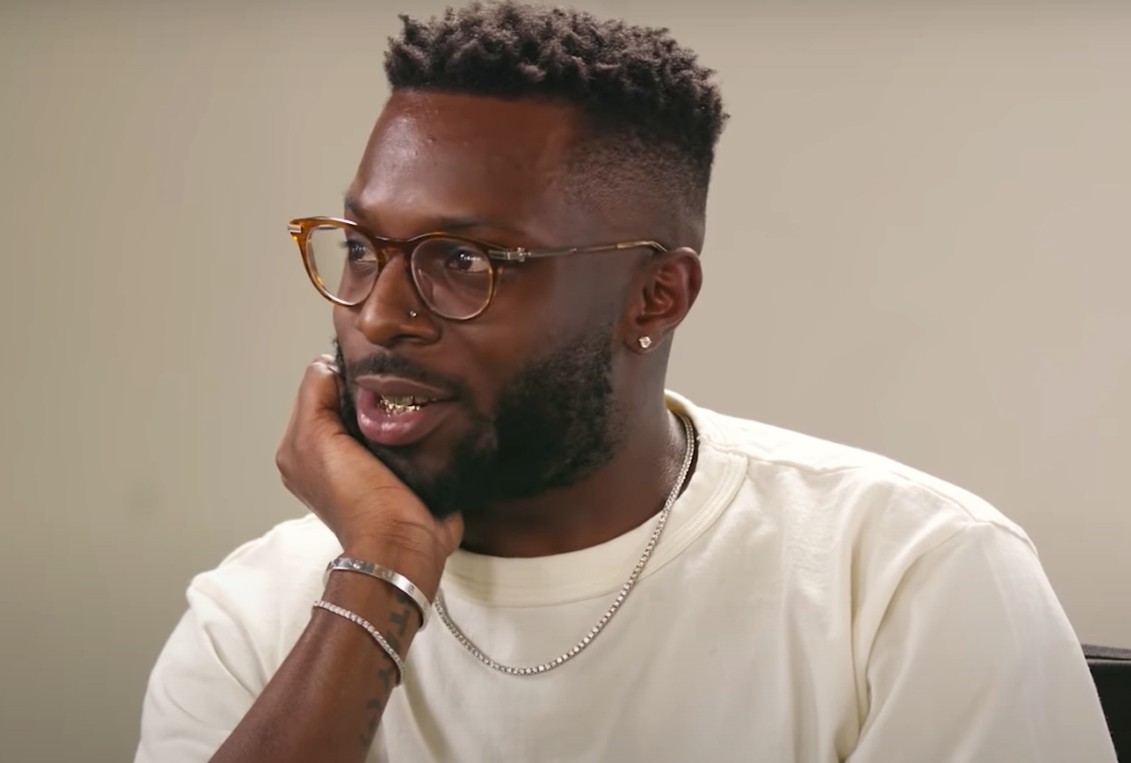
Central to this struggle was the lack of a roadmap. “At some point in time, I accepted that they don’t make a manual for being a bisexual Black dude,” Rashad remarked. This quote strikes at the heart of his isolation. In a society that often demands Black men adhere to rigid, heteronormative standards of “toughness,” Rashad found himself in a vacuum. Without a manual, he had to write his own rules, a process that involved falling down repeatedly before finding a stable footing. The drugs and alcohol were symptoms of a man searching for a version of himself that could exist comfortably in the light.
Finding “Divine Guidance” in the Dark
Despite the depths of his substance abuse, Rashad’s story is not one of nihilism, but of faith. Growing up in the church, he was rooted in a spiritual framework that he eventually outgrew in form, but never in essence. He speaks of a “divine guidance” that has remained a constant thread through his life, even when he was at his most lost.
For Rashad, his survival is evidence of a purposeful life. “I don’t feel like an artist just to make some money. I’m here to affect change in some way,” he asserted. This sense of mission transformed his trauma into a tool. He began to see the “ups and downs” not as random acts of cruelty, but as a spiritual refinement process. This perspective allowed him to view the current moment the release of It’s Been Awful as a predestined point of arrival. He wasn’t just making music; he was fulfilling a mandate to be honest.
The Paradox of Liberation: Broken and Free
One of the most poignant moments in Rashad’s recent discourse was his reaction to Charlamagne Tha God’s inquiry about whether the leak provided a strange form of liberation. Rashad’s response was a masterclass in nuance: he felt “broken and free alike.”
There is a terrifying freedom in having your “worst” secrets exposed. When the thing you fear most finally happens, the fear loses its power. Rashad realized he could no longer control how the world perceived him, and in letting go of that control, he found a radical honesty. This “brokenness” allowed him to dismantle the fragile ego he had built and look deeply at his own masculinity.
He admitted that much of his previous self-expression was a defensive crouch. “It made me confront a lot of stuff that I was saying about women. A lot of ways I was expressing myself was really coming just from a place of insecurity,” he confessed. By identifying these insecurities, he was able to move toward a state of genuine self-love a love that wasn’t dependent on a curated image, but on his messy, complicated reality.
The Power of the “Homeboys” and Accountability
While Rashad’s journey was deeply internal, it was supported by a framework of community. In a culture where “loyalty” is often confused with “enabling,” Rashad’s circle chose the path of difficult truth. He credits his “homeboys” for being the ones to look him in the eye and ask, “What the fk are you doing?” when his drinking and drug use spiraled.
This accountability was a lifeline. It allowed him to be honest with his inner circle in a way he hadn’t been before. He noted that while his friends knew everything about him from years on tour, the leak forced him to respect his own privacy more deeply. He realized that his previous “irresponsibility” with his life was a byproduct of not valuing himself enough to protect his own boundaries. His recovery was as much about setting boundaries as it was about breaking them down.
The Gospel of It’s Been Awful
The title of his new project, It’s Been Awful, is a blunt acknowledgment of the road traveled. It is a title devoid of pretension, reflecting the exhaustion and the grit required to make it to May 1st. However, the music within suggests that while it has indeed been awful, it has also been transformative.
Isaiah Rashad has emerged as a vital voice for a generation grappling with the intersections of mental health, sexual identity, and the pressures of digital life. He has proven that masculinity is not found in the absence of vulnerability, but in the courage to inhabit it fully.
As listeners spin the new tracks, they aren’t just hearing a rapper return to form; they are hearing a man who has reclaimed his narrative from the hands of those who tried to use it against him. Isaiah Rashad isn’t just an artist who survived a scandal; he is a man who used the fragments of his broken privacy to build a house of truth. Through divine guidance and radical honesty, he has finally learned to love himself and in doing so, he has given his audience the permission to do the same.
News –
