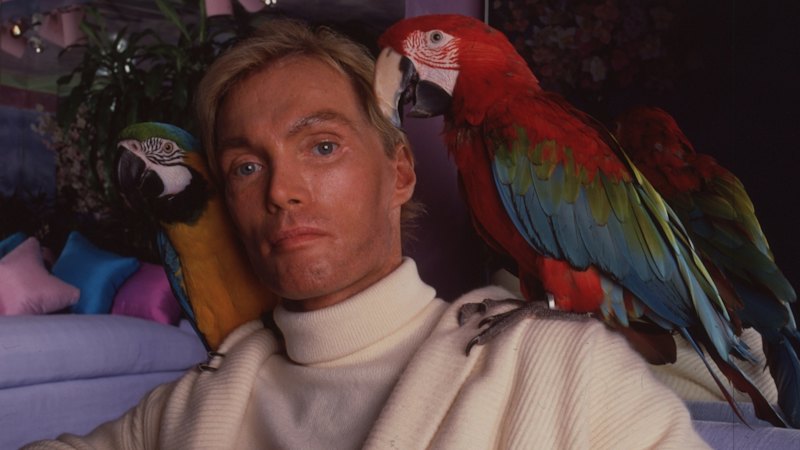
Once referred to as the world’s first male supermodel, New York-born model Hoyt Richards featured in hundreds of campaigns for brands including Versace, Valentino, Ralph Lauren and Cartier, and was photographed by everyone from Bruce Weber to Helmut Newton.
But at the peak of his career, he was drawn into a cult which exploited him financially and pressured him into disconnecting from his family. After more than two decades, he escaped in 1999.
Culture editor-at-large Michael Idato spoke to Richards, now 64, about his life-changing experiences and the gripping new three-part HBO documentary series, Bring Me the Beauties: A Model Cult, they inform.
Michael Idato: Let’s start in the here and now, Hoyt. If trust is the first thing you lose in a situation where there is coercive control, in the journey out of this, how quickly have you regained trust in yourself?
Hoyt Richards: It’s probably lifelong to some degree. But certainly, I would say initially very there was intense mistrust. My siblings and family would say it took four or five years until they felt like I was really back. I work now with a lot of cult survivors and try to assist them on their own personal journey because there’s no set way. Self-education is a huge piece of it.
You can get that information and intellectually go “oh, this is how it worked”. But to emotionally process that, that takes a long time. There’s such a compulsion initially to right the ship and put your life back on track. For me, coming to realise how I had hurt the people I loved the most, who were doing everything in their power to try to help me, was really hard.

All of this, somehow, felt like a parable for 2026 politics. People have been caught up in cults of personality. Some of them are finding their way out.
I think it’s more relevant today than when I went through it. Once you have the perspective that I have, I just see it everywhere.
For me, if I frame my experience in the most accurate terms, I would say I have a 20-year cultic relationship with this group. That word “cult” is so triggering, the way the media’s painted it. I’ve used that word plenty of times, but even in a social context where I’m just trying to be transparent, it’s a big hole to dig out of. That word immediately triggers ideas like, “what, were you sacrificing babies?” “Were you thinking about drinking Kool-Aid?”
Every relationship is somewhere on the cultic relationship spectrum. You’re usually unconsciously giving your power away to someone else. We’ve all found ourselves in those relationships. It can be a parent, it can be a sibling, it can be a boss, a lover, a coach, where they’ve swept us off our feet in some way or showered us with a lot of attention. We start liking that and wanting to seek it out, and then they start to pull back, and we start to pursue. Certain people will use that unhealthy power dynamic to control and potentially abuse you.
Most people find their way out of that relationship because that sucks, but they don’t recognise how traumatising it is. They just get out of it, and they start an unconscious pattern of pulling that type of relationship back into their life over and over again.
If we make it acceptable to talk about it, then people will recognise that they’ve had some form of that relationship … and start to heal. The more extreme cases like mine are valuable teaching tools.

How many people in your life knew the extent of your experience? Did you get a range of reactions from friends and family to the HBO documentary?
That’s been one of the most rewarding things: the outreach. People came out of the woodwork. They finally saw it all put together, and they’re like, “now I get it”. That’s been so incredible because all I wanted was for people to not only understand, but to take some ownership of the fact that it’s no one’s fault. It’s not unlike the conversations I’ve had with all my siblings and even my parents. We were out of our depth. We didn’t know, or really understand cults. We didn’t know.
My dad, he was so happy to have me back. But he did not want to talk about it at all.
Hoyt Richards
This has been a 25-year journey for me. It really hit me when I watched some of the earlier cuts, and I’m like, “oh, they’re going to start with the first time I go public”. That moment for me was a necessity because I had figured out, finally, in 2001 that it was a cult – and that’s almost two years after I’d escaped. It took me that long to come to grips with what it was. Google had just come out. And I knew I was never going to escape this. Anyone I meet and have any kind of connection with, they’re going to Google me and be like, “wait, this guy?”
Do you see the years in the cult as entirely lost? Was there any value in that time?
Huge value. I was still there in the midst of all the influence. There’s value in taking accountability and being transparent of the role I played participating as well. Yeah, I’m a victim, sure. But more importantly, I participated.
The other aspect of it was with my family and friends. I wanted them to know that there are things I can’t get back, the weddings I missed. But that this taught me valuable, valuable lessons, not only about myself, but the world we live in. I frame it like it’s a school of hard knocks: very expensive, hard lessons, but the life lessons were invaluable.
Everyone wants to blame themselves: “I should have seen it sooner”. “I should have come help you.” But it’s not constructive because it’s not accurate. No one knew what was really going on, so it’s no one’s fault.
And they were also traumatised watching someone they love go through this. It’s like an addict: they’re under an influence, but they’re still making decisions that are self-destructive and self-sabotaging. And you feel powerless to stop them. You suffer a very deep trauma.
What about your family?
My dad, he was so happy to have me back. But he did not want to talk about it at all. My mother and I had some good conversations. It was such a blessing and I love that time I was given because she was fighting cancer too. They gave her a year to live, and she fought it for seven. I’d still be in therapy, trying to figure everything out if I hadn’t had those years with her, being able to spend the time with her.
When I figured out it was a cult, I called my brother and said “you’re right, I’ve been in a cult”. And he was so gracious, there was no “I told you so”. He was like “listen, from everything I’ve read, it’s very rare that someone gets to the point where you’re talking about it, so what can I do to support you?” He was so wonderful.
To some extent now, this documentary becomes the definitive account of everything that transpired. Are you happy with that? And the choices that that director Chris Smith made? Because like it or not, that’s now how we all interpret the story.
Overall, I would say yes. Like I said, I want to have conversations based on people knowing this experience. I always felt like I would use up all my bandwidth going into the story.
Obviously, in three hours you can’t cover 25 years of my life, so I would say the story is also slightly bifurcated. I wanted to tell the survivor’s story. The cult story I saw as the backdrop. But the director was like, “I’ve got to sell this thing”, so he leaned more into the cult story than I would have. But again, I think it served its purpose. I will always look at it as an incredible asset where it starts the conversation.
That, to me, is a huge step forward.
This conversation has been edited for length and clarity.
Bring Me the Beauties: A Model Cult is streaming on HBO Max now.