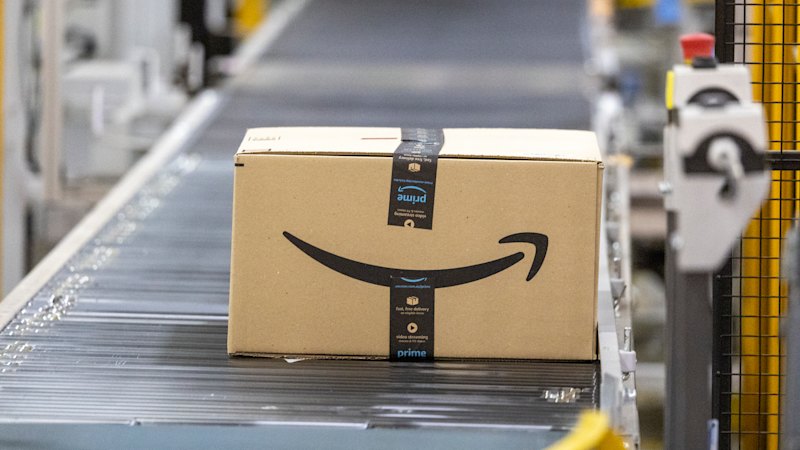

More Australians than ever before spent almost $5 billion with Amazon last year, as the American e-commerce behemoth starts pulling in more money from advertising, subscriptions and charging fees on merchants than actually selling goods.
The Seattle-based giant’s Australian business raked in revenue of $4.77 billion across 2025, a 25.1 per cent increase on the year before, according to a financial report lodged with the Australian Securities and Investments Commission.
Since establishing local operations in December 2017, Amazon has wrested sales away from local retailers and become the nation’s dominant online shopping marketplace, despite running losses for its first six years as it pursued aggressive expansion.
That market share has come from retailers, selling everything from books to electronics, and supermarkets; as shoppers split their grocery run and bulk-buy goods like toilet paper, nappies and cleaning supplies from Amazon.
Sales from amazon.com.au, the top online marketplace in Australia, grew 20 per cent from to $2.33 billion in 2025, but now represent less than half Amazon’s total Australian revenue, as growth in other parts of the business outpaces profits from selling products online.
Subscribers to Amazon’s streaming service and shopping membership program Prime paid $632.8 million, up 32 per cent, while fees from third-party merchants selling their wares on Amazon rose 36 per cent to $1.14 billion. But the platform’s fastest-growing segment was ads on its search and video results: advertising revenue climbed 62 per cent to $392.2 million in 2025.
And the company continues to expand: Amazon’s retail business received $520 million cash injection from the parent company as it invests in increasingly automated warehouses and paid $606.4 million in fees to other Amazon companies for “purchase of services”.
That left the company in Australia with a reported profit of $21.8 million, up from $3.6 million, representing a fivefold jump. It made a $31 million provision for income taxes.
But the figures do not necessarily present a comprehensive picture of Amazon’s performance in Australia because they are submitted to comply with Australian company and accounting laws rather than directly informing shareholders of the e-commerce giant’s US parent company.
A company spokesperson said that Amazon had invested $35 billion in Australia’s local operations, $8 billion alone of which came last year.
“These investments have strengthened our offering for Aussie customers, delivered faster than ever before and continued to support the more than 14,000 Australian businesses that sell on our stores,” said an Amazon spokesperson in a statement.
“We’d like to thank all our customers for continuing to place their trust in Amazon, and we look forward to continuing to grow and invest in our Australian business.”
The online juggernaut, which was founded in 1994 by billionaire Jeff Bezos as an online bookstore, is worth US$2.8 trillion ($3.9 trillion) on the NASDAQ stock exchange and has an estimated 8.8 million active local shoppers. It now reaches 60 per cent of Australians, beating eBay’s declining reach of 51 per cent, according to a 2026 report by ecommerce platform Pattern.
Both Coles and Woolworths chief executives called out Amazon, along with Costco and Chemist Warehouse, as retailers driving intensifying competition in the supermarket sector in a 2024 Senate inquiry. Woolworths reported $69 billion revenue last financial year, while Kmart reported $11 billion and Coles $44 billion.
Amazon recently made moves to extend its reach into grocery and retail even further by partnering with premium supermarket chain Harris Farms and launching its own answer to Temu, Amazon Haul.
Australians chose to shop at Amazon more frequently for its range, prices and service, but it was the company’s focus on the latter that turbocharged its success across the year, according to ecommerce software platform Shippit co-founder Rob Hango-Zada.
“If you would actually look at the data over 2025, eight times out of 10, they probably weren’t the cheapest retailer for that particular item … [but] Amazon was going to be faster,” said Hango-Zada.
Another Amazon company in Australia, the cloud hosting division Amazon Web Services (AWS), lifted revenue by 20 per cent from 2024 to 2025, taking the figure to $4.7 billion.
That brought the division back to profitability ($33.9 million in profits) from losses of $28.3 million from the year before, according to a separate financial report also filed with the corporate regulator. Taken together, Amazon’s Australian operations have hit nearly $9.5 billion.
AWS paid $3.4 billion in “cloud service fees” to overseas Amazon companies, up 24 per cent on the year before. AWS also paid a $410 million dividend.
The Business Briefing newsletter delivers major stories, exclusive coverage and expert opinion. Sign up to get it every weekday morning.
 Jessica Yun is a business reporter covering retail and food for The Sydney Morning Herald and The Age.Connect via X or email.