
Staff writers
Updated ,first published
The Australian sharemarket has declined at the open as escalating tensions in the Middle East cast doubt on when America and Iran can reach a deal to reopen the Strait of Hormuz, and as technology stocks came under more pressure on Wall Street.
The ASX/S&P 200 was down 80.1 points, or 0.9 per cent, to 8573.1 in early trade after the United States began a fresh round of strikes against multiple targets overnight in Iran. Seven of the local market’s 11 industry sectors were in negative territory. The Australian dollar was trading at US70.01¢.
The latest strikes highlight Trump’s growing impatience with stalled peace efforts after months of failed negotiations. They also suggest that the April ceasefire between the warring countries has effectively collapsed, despite the absence of a return to the large-scale bombing campaigns seen at the start of the conflict.
“We’re going to be attacking them, attacking them very hard,” Trump told reporters at the White House, before the latest strikes were announced. “We hit them hard yesterday, and we’re going to hit them hard again today.”
The escalation in the Persian Gulf sent oil prices higher, with Brent adding 2.3 per cent to $US95.22 and WTI up 2.8 per cent to $US92.55 in early trade in Asia, adding to overnight gains. Energy stocks in turn advanced in early trade on the ASX, with Yancoal rising 3.8 per cent, Woodside Energy up 2.2 per cent and Santos 2.4 per cent higher. Refiners Ampol and Viva Energy also climbed, adding 1.1 per cent and 0.2 per cent, respectively.
Technology stocks continued their rollercoaster ride with AI-related stocks again tumbling on Wall Street to continue a tumultuous month. Xero lost 1.4 per cent, WiseTech dropped 2.1 per cent, NextDC shed 2.3 per cent and Technology One dipped 0.1 per cent in early trade.
Mining stocks weakened, with BHP falling 1.5 per cent, Fortescue declining 2.5 per cent and Rio Tinto down 1.2 per cent. Gold miners fell sharply as bullion’s price extended losses to around $US4040 an ounce on concerns elevated oil prices will lead to higher interest rates – a key headwind for precious metals. Northern Star lost 4.5 per cent and Evolution Mining fell 4.2 per cent in early trade.
Financial stocks declined across the board, with Commonwealth Bank and National Australia Bank each down 1.7 per cent, while Westpac lost 1.6 per cent and ANZ Bank fell 1.4 per cent.
Shares of Southern Cross Media slumped 5.1 per cent after the business created from the merger of Kerry Stokes’ Seven West and radio group Southern Cross announced a profit downgrade and massive job cuts as market conditions continue to deteriorate. The cuts were foreshadowed by this masthead on Wednesday.
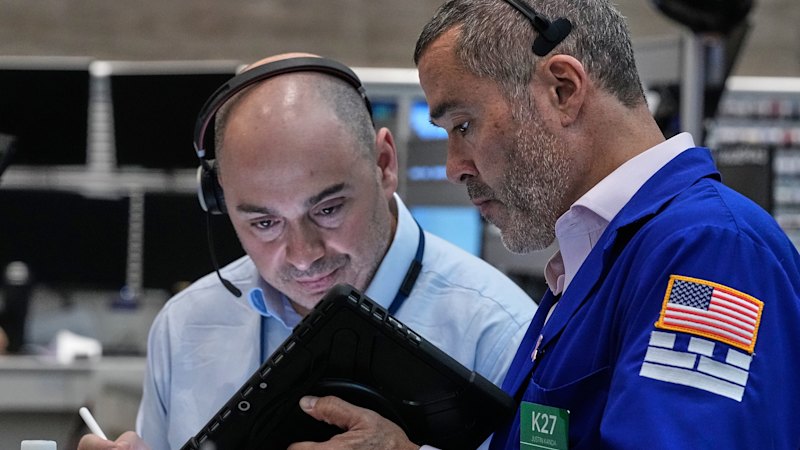
Overnight, the S&P 500 dropped 1.6 per cent for its first back-to-back drop in three weeks and is back to where it was in early May. The Dow Jones tumbled 953 points, or 1.9 per cent, and the Nasdaq composite led the market lower with a 2 per cent slide.
Softer-than-expected inflation data offered a brief reprieve, traders continued to price in higher US rates while a selloff in richly valued technology shares raised doubts about the durability of the record rally in equities.
Wall Street has been shaky since last week, when AI stocks went from roaring to records to suddenly turning lower. Among the worries is that their prices have simply shot too high, too fast because of AI mania. The question now is whether the break lower has cleared out excessive optimism that may have built into their stock prices, or if it’s the start of a longer downturn.
“Investors remain skittish despite being thrown a lifeline by the inflation figures,” said Chris Beauchamp, chief market analyst at IG. “It is now a case of ‘once bitten, twice shy’ – no one wants to go charging in to buy the dip yet, which suggests more of a drift lower for the time being, though leaving the overall trend intact.”
Super Micro Computer, which sells AI servers, tumbled 28 per cent after saying late on Tuesday that it plans to raise $US7 billion ($10 billion) in cash by selling shares of stock and convertible preferred stock. Such moves raise the most money for companies when their stock prices are high, and they can dilute the ownership stakes of existing shareholders.
Micron Technology swung from an early loss of nearly 4 per cent to a modest gain and back to a loss of 4.7 per cent. It’s coming off a wild stretch where it sank 7.7 per cent last Thursday, then plunged another 13.3 per cent Friday and rallied 9.9 per cent on Monday. Despite all the swings, the computer memory maker’s stock is still up 212.5 per cent for the year so far.
Nvidia, the chip company that’s grown into a nearly $US4.9 trillion ($7 trillion) behemoth because of the AI boom, was the heaviest weight on the S&P 500 after falling 3.7 per cent. The second-heaviest was another AI winner, Broadcom, which fell 5.1 per cent.
Some of the pressure on AI stocks could also be coming from investors pulling cash out to prepare for high-profile debuts on the US stock market for several AI giants like SpaceX’s initial public offering later this week.
Weakening stocks for companies with big fuel bills also pulled the market lower. United Airlines sank 6.2 per cent, and cruise-operator Carnival fell 6.3 per cent after oil prices rose due to the latest fighting in the war with Iran.
But Treasury yields nonetheless held relatively steady in the bond market because the figures were exactly what economists had forecast. The rise in an important underlying measure of inflation, meanwhile, was not as bad from April through May as economists expected.
The yield on the 10-year Treasury edged up to 4.54 per cent from 4.53 per cent late on Tuesday. The two-year Treasury yield, which more closely tracks expectations for what the Federal Reserve will do with its overnight interest rates, held at 4.13 per cent.
Traders have been building bets recently that the Fed will have to hike its main interest rate at least once this year, given how high inflation is and how strong the US job market remains. Wednesday’s inflation update didn’t sway them much, according to data from CME Group.
High yields can slow entire economies and undercut prices for all kinds of investments, including stocks and cryptocurrencies. They hit investments seen as the most expensive in particular, and some critics are calling AI a bubble where investment inflated too far.
In other international markets, indexes in Europe were mixed following sharper drops in Asia.
With AP, Bloomberg
The Market Recap newsletter is a wrap of the day’s trading. Get it each weekday afternoon.